In real projects, Nickel 201 vs Alloy 20 for heat exchanger tubing is not a theoretical debate. It is usually a shutdown-cost debate. Engineers may notice that Nickel 201 offers very high thermal conductivity and excellent resistance in caustic service, while Alloy 20 is built for sulfuric-acid-driven chemical environments and has better strength in typical tube product forms. The wrong instinct is to compare only nickel content or only heat transfer. The correct approach is to start with the exact chemistry of the fluid, the oxidizing potential, the chloride level, and the real upset conditions.
For most chemical-process exchangers, the selection boundary is surprisingly clear. Nickel 201 is a low-carbon handelsübliches Reinnickel, minimum 99.0% Ni, with carbon limited to 0.02% max so it resists intergranular embrittlement above 600°F / 315°C. Alloy 20, by contrast, is a Ni-Fe-Cr-Cu-Mo alloy around 32–38% Ni, 19–21% Cr, 3–4% Cu, and 2–3% Mo, developed specifically for aggressive aqueous corrosion service, especially sulfuric acid. That compositional difference is why these two materials behave so differently in heat exchanger tubing.
Nickel 201 vs Alloy 20 for Heat Exchanger Tubing: Start with the Process Fluid
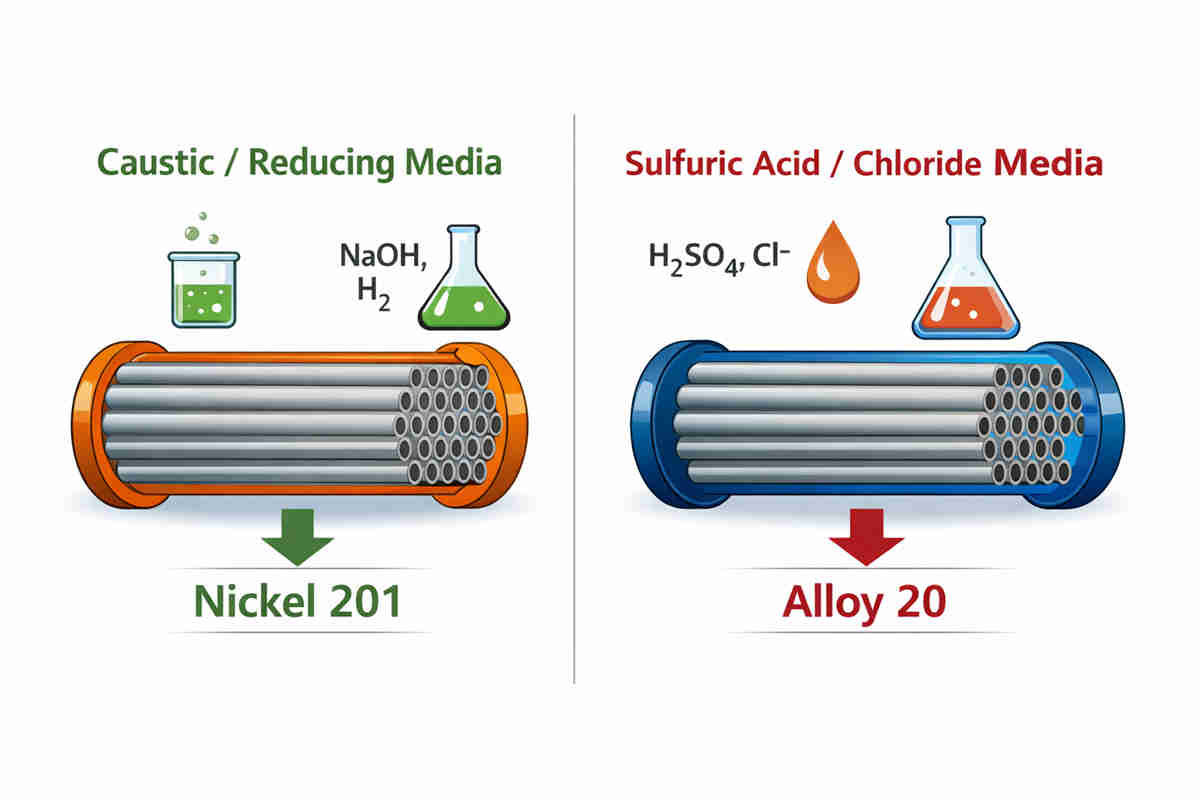
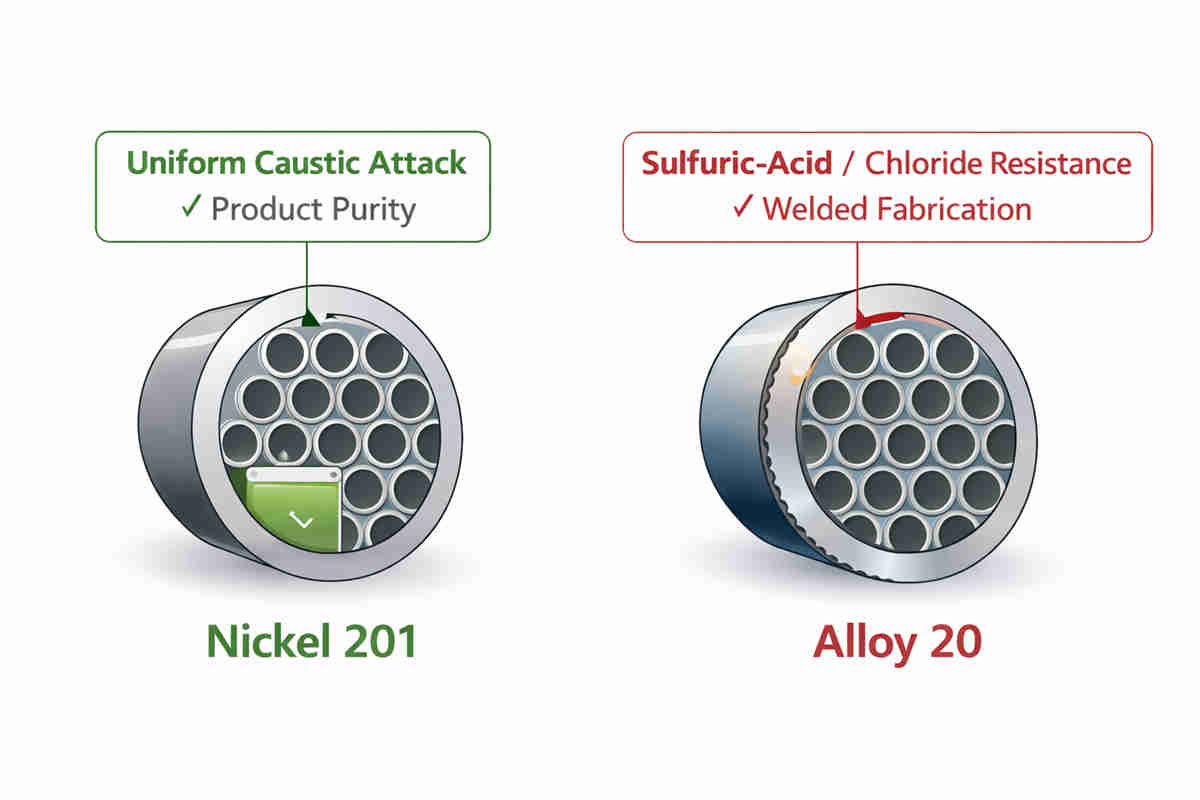
If the exchanger handles hot caustic soda, concentrated alkali, or a reducing medium where product purity matters, Nickel 201 deserves serious consideration. Special Metals states that commercially pure nickel is highly resistant to various reducing chemicals and is “unexcelled” in resistance to caustic alkalies. Nickel 201 also keeps the low-carbon advantage over Nickel 200 when service temperature exceeds 315°C, which matters in heaters, evaporators, and tube-side circuits that cycle above that range.
But that does nicht mean Nickel 201 is a universal acid-service tube alloy. In mineral acids, its behavior depends strongly on concentration, temperature, and especially aeration; Sandmeyer also notes that Nickel 200/201 performs better in non-aerated acid solutions and can suffer strong corrosion in oxidizing salt solutions. That is the point many buyers miss when comparing Nickel 201 vs Alloy 20 for heat exchanger tubing using only a generic “acid resistance” label.
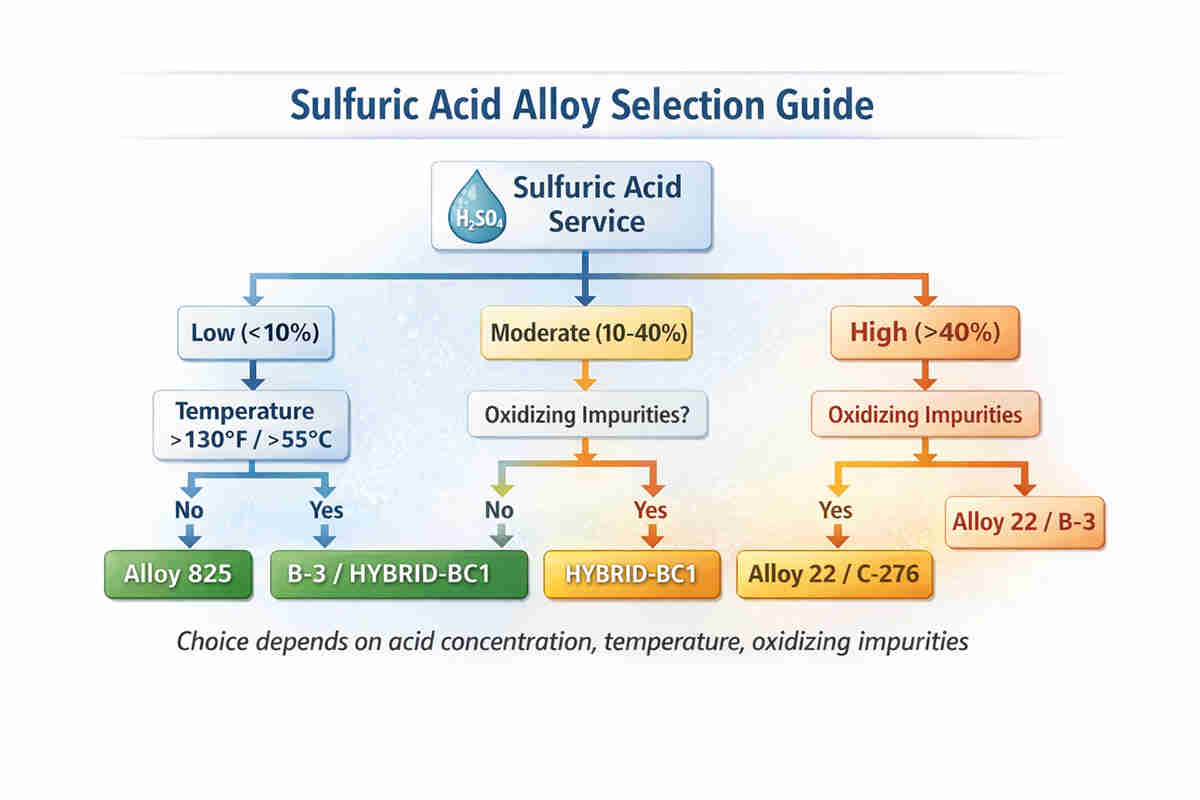
Alloy 20 is much more purpose-built for the exchanger services seen in sulfuric-acid process trains, mixed-acid chemical units, and many chloride-contaminated aqueous systems. Special Metals describes INCOLOY alloy 020 as having excellent corrosion resistance in sulfuric acid environments and useful resistance in chlorides, nitric acid, and phosphoric acid; Carpenter further notes superior resistance to stress-corrosion cracking in boiling 20–40% sulfuric acid, plus stabilization against intergranular attack in the sensitized condition. For exchangers in fertilizer, pickling, specialty chemical, or pharmaceutical plants, that is often the more relevant corrosion package.
Why Thermal Conductivity Does Not Decide the Selection
Yes, Nickel 201 has a much higher thermal conductivity than Alloy 20—about 79.3 W/m·K at 20°C for Nickel 201 versus 12.3 W/m·K for Alloy 20 in the cited supplier data. On paper, that looks decisive. In practice, it rarely is. In many shell-and-tube exchangers, the dominant resistances come from process-side film coefficients, fouling layers, and the corrosion allowance needed to survive the real plant environment. So the higher conductivity of Nickel 201 is valuable, but it does not compensate for choosing a material with the wrong corrosion mechanism for the fluid. That is the engineering core of Nickel 201 vs Alloy 20 for heat exchanger tubing.
Typical Engineering Comparison for Nickel 201 vs Alloy 20 for Heat Exchanger Tubing
| Eigenschaft / Auswahlfaktor | Nickel 201 | Alloy 20 |
|---|---|---|
| UNS designation | N02201 | N08020 |
| Basic alloy family | Handelsübliches Reinnickel | Ni-Fe-Cr-Cu-Mo corrosion-resistant alloy |
| Nickel content | 99.0% min | 32.0–38.0% |
| Carbon limit | 0.02% max | 0.07% max |
| Typical thermal conductivity | 79.3 W/m·K at 20°C | 12.3 W/m·K |
| Coefficient of expansion | 13.2 µm/m·°C at 100°C | 14.7 µm/m·°C at 25–100°C |
| Typical room-temp tensile strength | 50–70 ksi for seamless tube/pipe, cold-drawn annealed | 90 ksi annealed |
| Typical room-temp yield strength | 10–28 ksi for seamless tube/pipe, cold-drawn annealed | 45 ksi annealed |
| Best-known corrosion strength | Caustic alkalies, many reducing chemicals, selected high-purity duties | Sulfuric acid, mixed chemical environments, useful chloride/nitric/phosphoric resistance |
| Main caution | Oxidizing salts and aerated acid service can be problematic | Not the first choice for very aggressive hot caustic duty where pure nickel is preferred |
Typical values summarized from supplier technical data for Nickel 201 vs Alloy 20 for heat exchanger tubing. Always verify product form, size, heat treatment, and code requirements with the mill or tube supplier before final specification.
When Nickel 201 Is the Better Tube Choice
Nickel 201 usually wins when the exchanger sees hot caustic service, strong alkali, or a reducing environment where contamination control is important and oxidizing contaminants are tightly limited. It also brings a genuine high-temperature advantage over Nickel 200 because the lower carbon content reduces embrittlement risk above 315°C. In a plant that understands its chemistry well, Nickel 201 can be the more durable and cleaner solution.
There is also a narrower but real niche where Nickel 201 remains attractive in halogen-related service. Special Metals reports successful use in dry chlorine and hydrogen chloride at elevated temperatures, and notes that Nickel 201 can be effective in hydrofluoric acid provided flowing conditions do not strip the protective fluoride film. That is not mainstream exchanger duty, but for the right dry or carefully controlled service, it matters.
When Alloy 20 Is the Safer Heat Exchanger Tubing Material
If the plant fluid contains sulfuric acid, mixed acids, or chlorides in an aqueous process environment, Alloy 20 is more often the conservative engineering choice. It was developed precisely for sulfuric-acid-related processing, and suppliers explicitly list heat exchangers among its normal applications. For many buyers, this is where Nickel 201 vs Alloy 20 for heat exchanger tubing stops being a close contest.
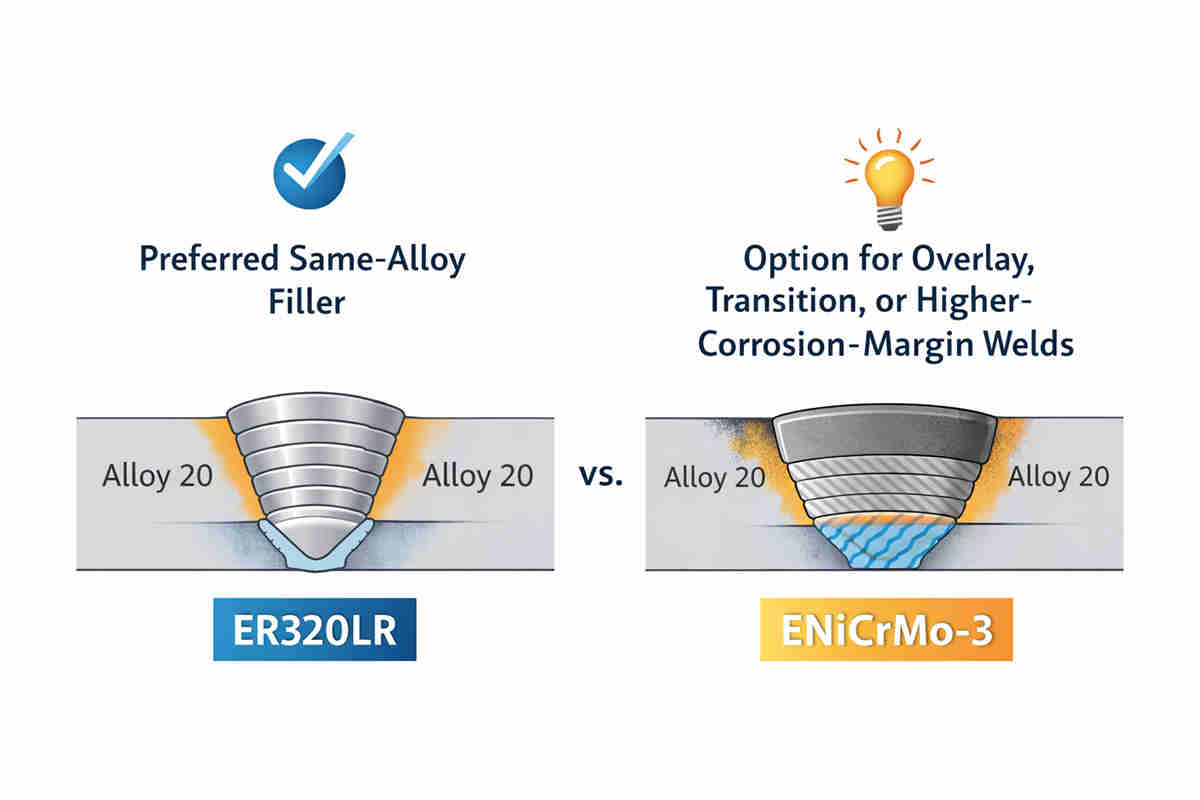
Alloy 20 also offers a stronger mechanical profile in standard annealed condition than Nickel 201 tube products, and Carpenter notes that the alloy is weldable, machinable, cold formable, and commonly placed into service in the as-welded condition because the niobium stabilization helps control carbide precipitation during welding. In practical fabrication terms, that is a meaningful advantage for exchangers with welded heads, tube-sheet transitions, or field repair expectations.
Conclusion: Which Alloy Should You Specify?
My engineering answer is simple: do nicht choose between these alloys by nickel percentage, and do not choose by thermal conductivity alone. Choose by corrosion mechanism. For hot caustic, reducing, and purity-sensitive service, Nickel 201 is often the better tube alloy. For sulfuric acid, mixed-acid process streams, and many chloride-bearing aqueous duties, Alloy 20 is usually the safer and more forgiving specification.
For procurement teams, the practical data package should include full chemistry, temperature window, flow velocity, oxygen or oxidizer content, chloride level, startup/shutdown excursions, cleaning chemicals, and welding route. That is the level of detail that actually closes the Nickel 201 vs Alloy 20 for heat exchanger tubing question. At 28Nickel, that is also the point where a serious technical inquiry becomes much faster to answer—and much less expensive than a premature tube failure.
Verwandte Fragen und Antworten
1) Is Nickel 201 better than Alloy 20 because it has higher nickel content?
No. Higher nickel content does not automatically mean better exchanger performance. Nickel 201 is stronger in caustic and many reducing environments, while Alloy 20 was engineered for sulfuric-acid-related and mixed chemical service. The fluid chemistry decides the winner.
2) Does Nickel 201’s thermal conductivity make it the better heat exchanger tube?
Not by itself. Nickel 201 conducts heat far better than Alloy 20, but exchanger life is often controlled by corrosion mode, fouling, wall loss, and upset chemistry rather than tube-metal conductivity alone.
3) In sulfuric acid service, should I default to Alloy 20?
In many cases, yes. Alloy 20 is a standard engineering answer for sulfuric-acid-containing aqueous systems and is widely used in heat exchangers, but final selection still depends on acid concentration, temperature, chlorides, velocity, and whether the system sees oxidizing upsets.