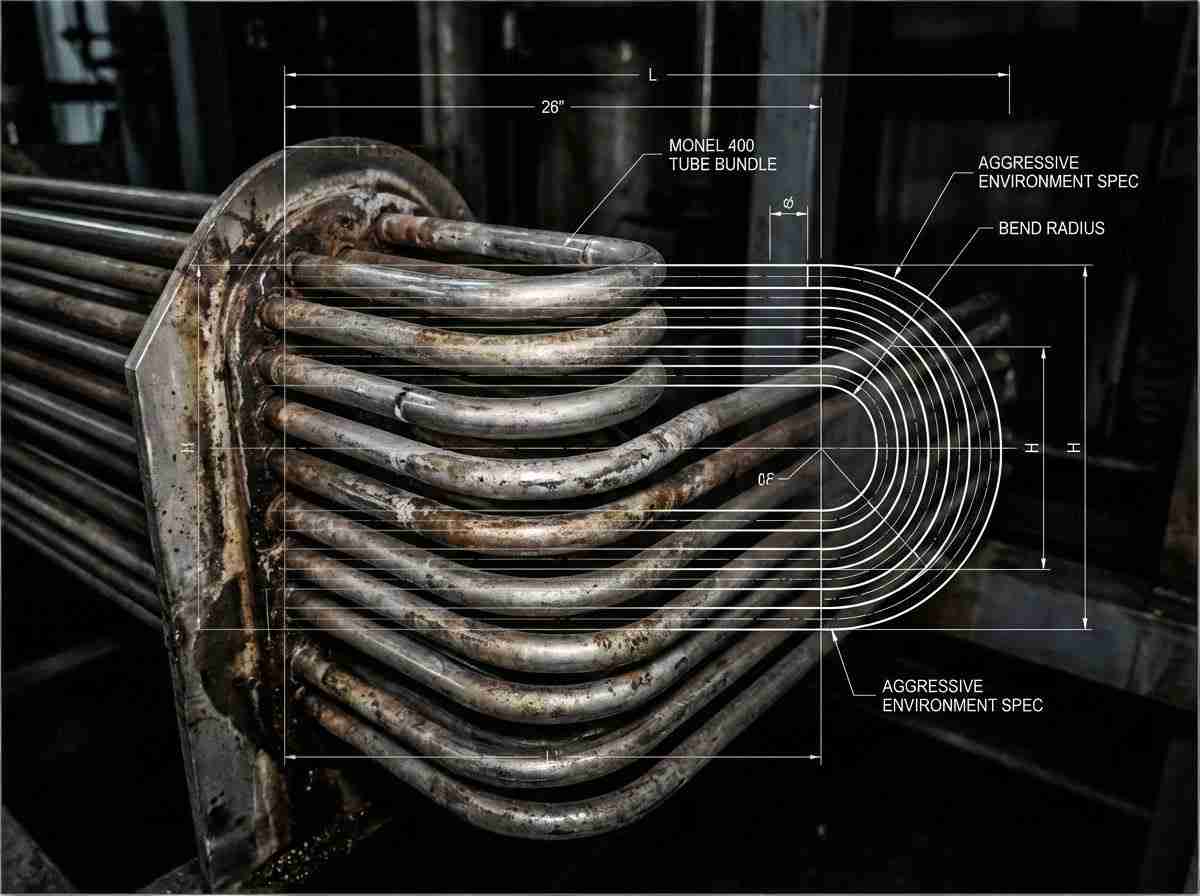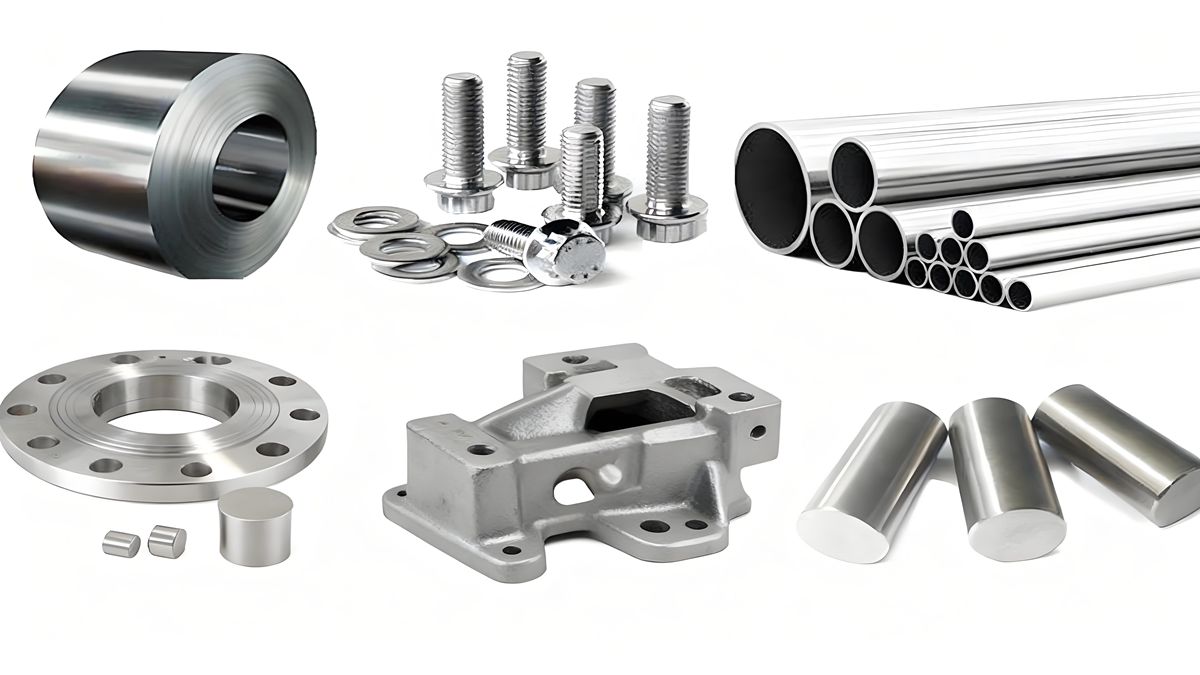
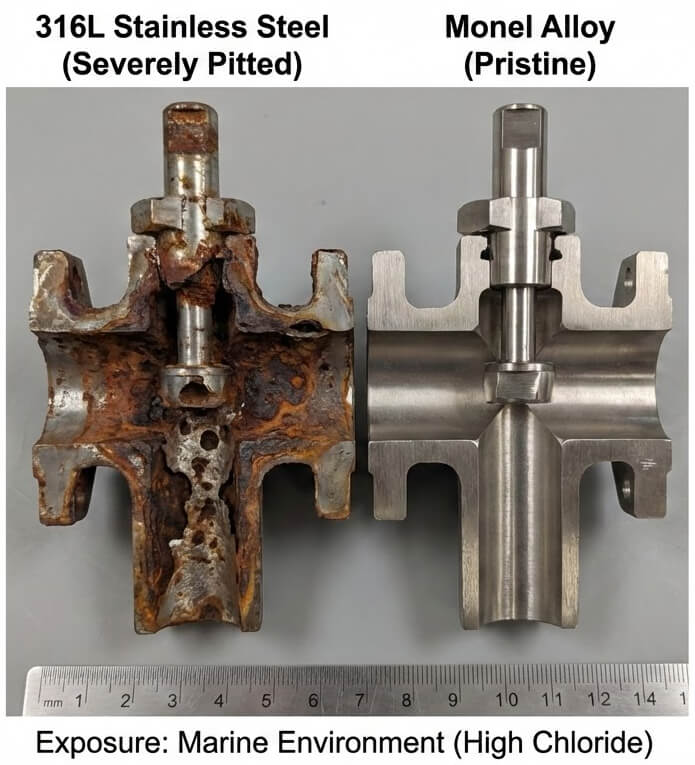
Managing hydrofluoric (HF) acid or high-velocity seawater presents a severe metallurgical challenge for piping systems. Standard austenitic stainless steels degrade rapidly through chloride stress corrosion cracking, localized pitting, or uniform metal loss. When environmental conditions threaten mechanical integrity, specifying the right nickel copper alloy monel becomes critical. Unlike purely nickel-based superalloys, this binary material system leverages the unique thermodynamic stability of both elements to endure severe reducing environments.
The Metallurgy Behind Monel Nickel-Copper Alloys
Solid solution strengthening is the primary mechanism dictating the mechanical properties here. A standard nickel copper alloy monel typically consists of roughly 63% nickel and 28-34% copper. This matrix exhibits a single-phase face-centered cubic (FCC) structure throughout its entire composition range.
Copper addition lowers the overall weight and cost compared to handelsübliches Reinnickel, while fundamentally enhancing resistance to reducing environments. Conversely, the high nickel mass fraction protects the matrix from oxidizing conditions far better than pure copper. This synergistic effect makes this nickel copper alloy monel highly ductile, readily cold-worked, and structurally stable across extreme temperature gradients.
| Element / Eigenschaft | Typical Value / Composition |
| Nickel (Ni) | 63.0% Min |
| Kupfer (Cu) | 28.0 – 34.0% |
| Eisen (Fe) | 2.5% Max |
| Streckgrenze (0,2% Offset) | 170 – 345 MPa (Annealed) |
| Zugfestigkeit | 480 – 585 MPa (Annealed) |
| Dichte | 8.80 g/cm³ |
Velocity and Aeration: Performance Thresholds
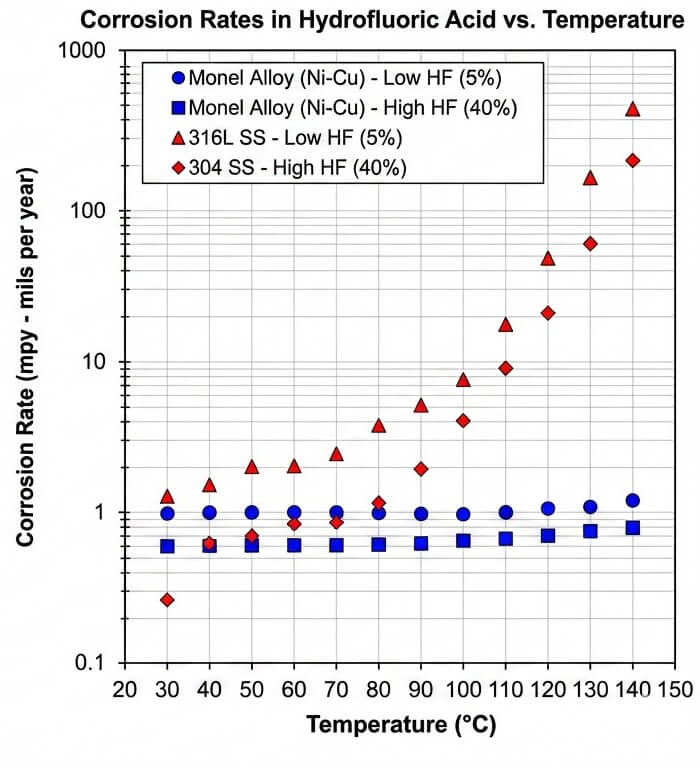
While mechanically robust, metallurgists must evaluate dynamic environmental variables. In un-aerated HF acid at room temperature, corrosion rates for nickel copper alloy monel remain exceptionally low, forming a highly adherent fluoride protective film. However, introduce dissolved oxygen or aeration into the process stream, and the passive cuprous oxide film destabilizes rapidly.
Fast-flowing seawater creates a different but related dynamic. Stagnant marine environments allow biofouling to accumulate on the metal surface, which can initiate under-deposit pitting. Yet, under high-velocity conditions (up to 4 m/s), the continuous sheer sweeps away localized deposits, allowing the material to thrive where other alloys fail.
Engineering Your Specific Fluid Application
Material selection is never a universal science. The exact temperature profiles, fluid velocity, and parts-per-million dissolved oxygen levels dictate whether a nickel copper alloy monel will perform reliably for decades or fail prematurely due to localized attack. Analyzing your specific process stream parameters is non-negotiable for system longevity.
If you are experiencing unexpected degradation in your current reactor vessels or designing a critical heat exchanger, reach out to the engineering team at 28Nickel. We can evaluate your metallurgical requirements and provide precise, data-backed technical support for your next project.
Verwandte Fragen und Antworten
Q1: Why is nickel copper alloy monel preferred over Alloy 20 in alkylation units? A1: Alloy 20 relies primarily on chromium for passivation, which aggressive hydrofluoric acid can strip away. The binary nickel-copper matrix does not rely on passive oxide layers in these conditions; instead, it relies on thermodynamic immunity in reducing environments, forming a stable, adherent fluoride film.
Q2: Can this alloy suffer from galvanic corrosion in piping networks? A2: Yes. In the galvanic series for marine environments, it is highly noble. If coupled directly with carbon steel or zinc in an electrolyte like seawater, the less noble metal acts as an anode and will corrode rapidly to protect the Monel component.
Q3: Does cold working negatively affect its corrosion resistance? A3: Generally, no. Cold working significantly increases the yield strength of the material without compromising the uniform corrosion resistance of the solid solution matrix. It remains highly resistant to chloride-ion stress corrosion cracking even in a cold-worked state.