










Cuando los ingenieros preguntan por Resistencia a la corrosión de la aleación 20 en ácido sulfúrico, Por lo general, no buscan un perfil de aleación genérico. Quieren saber si el material sobrevivirá a las condiciones reales del proceso: concentración mixta de ácidos, ciclos de temperatura, trazas de cloruros, zonas estancadas, soldaduras y excursiones de arranque o parada. Ahí es exactamente donde la selección de la aleación deja de ser un ejercicio de catálogo y se convierte en un problema de ingeniería de la corrosión.
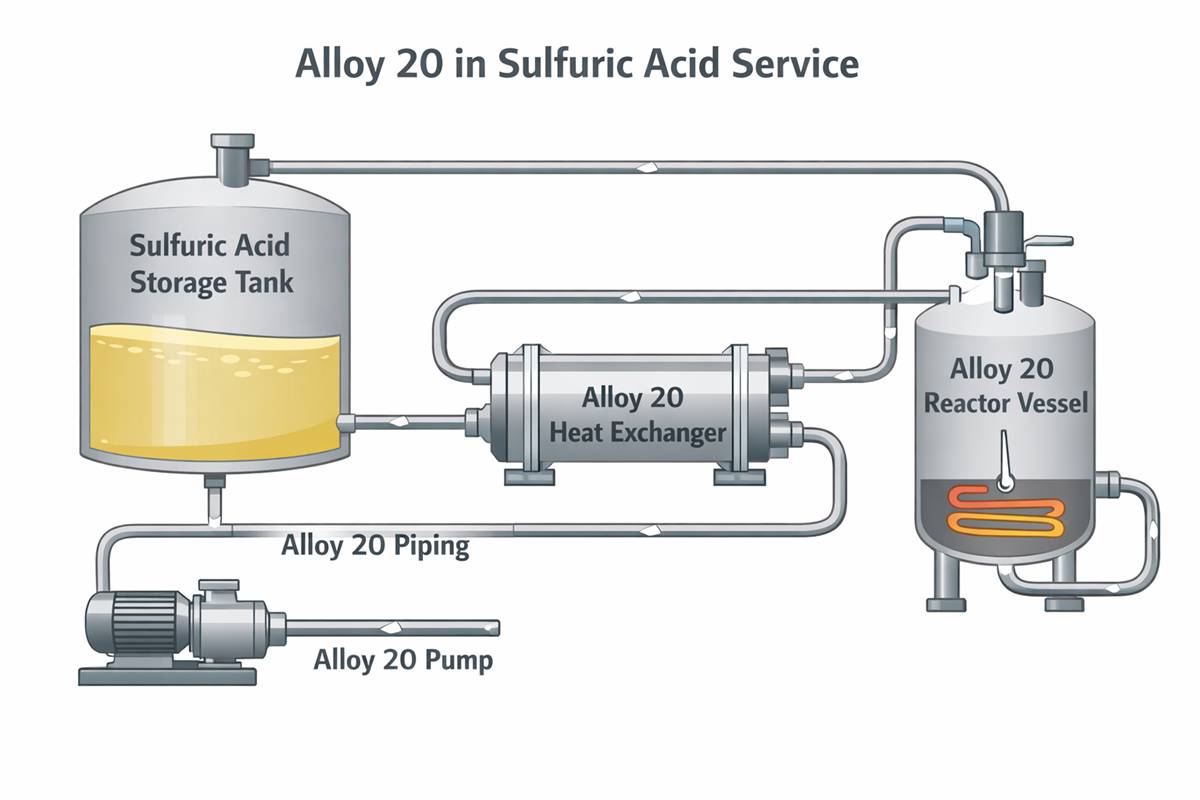
La aleación 20 se desarrolló para el servicio con ácido sulfúrico, y esa herencia sigue siendo importante. Su química equilibrada Ni-Cr-Mo-Cu le confiere un nicho diferenciado entre los aceros inoxidables que se atacan con demasiada facilidad y las aleaciones con mayor contenido en níquel que pueden ser técnicamente excelentes pero comercialmente excesivas para un servicio moderado. En la práctica, Resistencia a la corrosión de la aleación 20 en ácido sulfúrico se entiende mejor no como una única clasificación de “bueno” o “malo”, sino como una ventana de utilidad determinada por la resistencia a los ácidos, el potencial oxidante, la temperatura, la contaminación, el régimen de flujo y la calidad de fabricación.
Por qué la aleación 20 funciona bien con ácido sulfúrico
La razón por la que la aleación 20 suele considerarse para el ácido sulfúrico es metalúrgica, no de marketing. Nominalmente, la aleación combina un alto contenido en níquel con cromo, molibdeno y cobre, además de la estabilización con niobio. Cada elemento contribuye de forma diferente.
El níquel mejora la resistencia en medios reductores y ayuda a la aleación a evitar parte de la rápida corrosión general que puede limitar a los aceros inoxidables austeníticos convencionales. El cromo favorece la formación de una película pasiva cuando las condiciones son suficientemente oxidantes. El molibdeno añade valor en entornos corrosivos complejos, especialmente cuando el ataque localizado se convierte en un problema. El cobre es especialmente relevante aquí: en servicio con ácido sulfúrico, el cobre puede mejorar materialmente el rendimiento en determinados rangos de concentración en los que los grados inoxidables como el 316L pierden terreno rápidamente.
Por ello Resistencia a la corrosión de la aleación 20 en ácido sulfúrico suele ser más resistente de lo que los ingenieros esperan a primera vista cuando la comparan sólo por el nivel de cromo o níquel. La aleación se diseñó para un problema de corrosión específico, y su composición refleja ese propósito.
Aun así, no existe una inmunidad universal. El ácido sulfúrico es un medio engañosamente variable. Una línea que transporta nominalmente la misma concentración de ácido puede comportarse de forma muy diferente si contiene iones férricos, cloruros, sólidos arrastrados, oxígeno disuelto o contaminantes reductores. Un tanque de almacenamiento en servicio ambiental constante es un problema. Una línea de alimentación de un reactor calentado con flujo intermitente y drenaje deficiente es otro totalmente distinto.
¿Qué controla la resistencia a la corrosión de la aleación 20 en ácido sulfúrico?
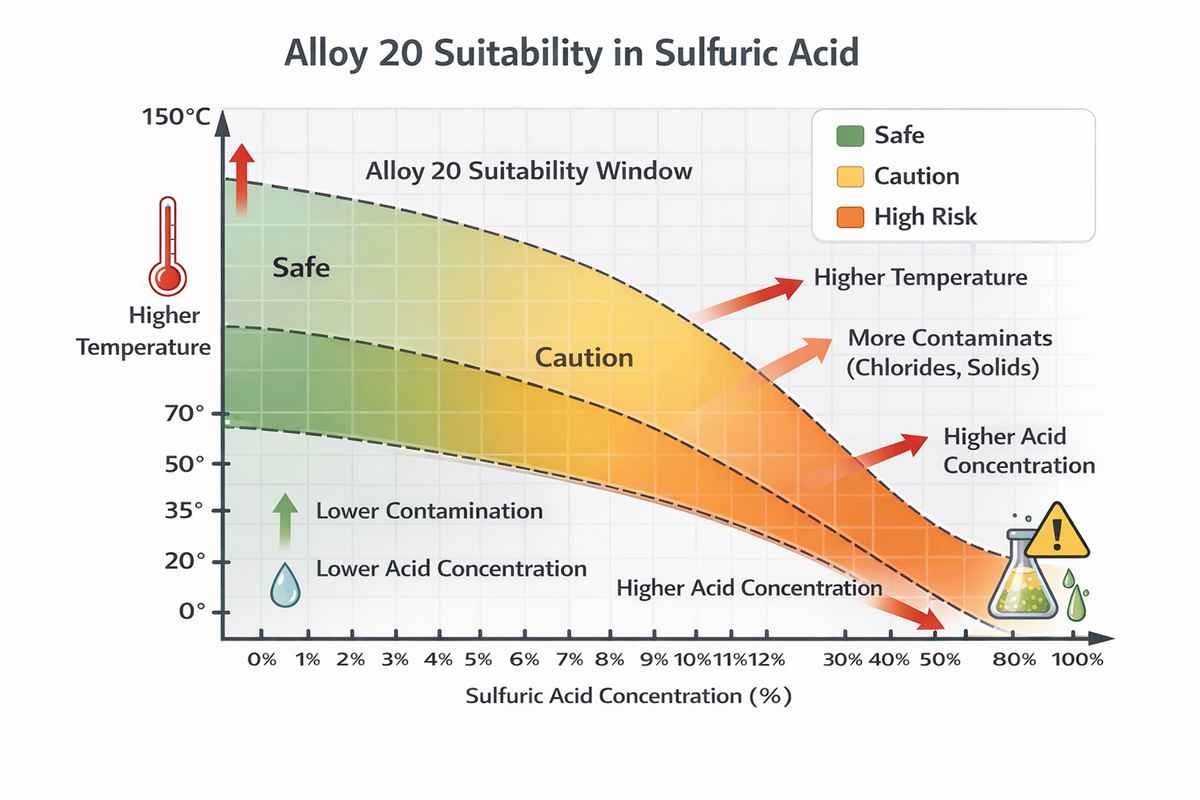
Desde el punto de vista de la ingeniería, la primera variable es la concentración. La corrosividad del ácido sulfúrico no es lineal. Algunas aleaciones se comportan aceptablemente en ácido diluido y fallan en ácido más concentrado; otras muestran la tendencia opuesta en bandas de temperatura limitadas. Por consiguiente, Resistencia a la corrosión de la aleación 20 en ácido sulfúrico nunca debe evaluarse sin indicar conjuntamente la concentración y la temperatura.
La segunda variable es la temperatura, y a menudo es la que decide el proyecto. Muchas aleaciones que parecen aceptables sobre el papel en condiciones ambientales pierden margen rápidamente al aumentar la temperatura. Los índices de corrosión pueden acelerarse bruscamente, y los fenómenos localizados se vuelven más difíciles de predecir. Si en su proceso hay ácido caliente, recalentamiento o trazado de vapor cerca de los puntos muertos, el margen de corrosión disponible puede desaparecer mucho antes de lo esperado.
La tercera variable es la contaminación. Los cloruros son especialmente importantes porque pueden hacer que el problema pase de la pérdida general de metal a las picaduras, el ataque de grietas o el ataque en detalles de soldadura mal drenados. Las especies oxidantes pueden mejorar o empeorar el rendimiento en función del equilibrio químico. Las sales de hierro, las sales de cobre, los productos orgánicos del proceso y los sólidos abrasivos modifican el entorno efectivo. En otras palabras, el ácido vegetal rara vez es “ácido puro”.”
Por eso los ingenieros experimentados no discuten Resistencia a la corrosión de la aleación 20 en ácido sulfúrico de forma aislada. Hacen preguntas más agudas: ¿Está aireado el ácido? ¿Hay arrastre de cloruros? ¿Hay sólidos? ¿Se humedece continuamente el sistema? ¿Cuál es el estado de la parada? ¿Se decapa y pasiva la soldadura o se deja tal cual? Estos detalles no son secundarios. Son el entorno de servicio.
Factores prácticos de diseño para la aleación 20 en sistemas de ácido sulfúrico
| Factor de diseño | Por qué es importante | Orientaciones prácticas de ingeniería |
|---|---|---|
| Concentración de ácido | El comportamiento de la corrosión cambia significativamente en los distintos rangos de concentración | Defina siempre el intervalo exacto de concentración, no sólo “servicio de ácido sulfúrico”.” |
| Temperatura | El aumento de la temperatura puede incrementar bruscamente la velocidad de corrosión | Revise por separado las temperaturas normales, de alteración y de limpieza |
| Condición oxidante frente a condición reductora | La pasividad y el comportamiento de disolución del metal pueden cambiar | Confirmar el oxígeno disuelto, los iones férricos y el estado redox. |
| Contaminación por cloruro | Puede favorecer la corrosión por picaduras y grietas | Compruebe la contaminación aguas arriba y las grietas estancadas |
| Régimen de flujo | Erosión: la corrosión y las turbulencias pueden eliminar las películas protectoras. | Evaluar bombas, codos, reductores y zonas de ventilación |
| Estado de la soldadura | El óxido de soldadura y un mal acabado pueden reducir el margen de corrosión | Especificar relleno cualificado, entrada de calor controlada y limpieza posterior a la fabricación. |
| Depósitos y sólidos | Un ataque por falta de depósito puede hacer fracasar una “buena aleación” a nivel local | Diseño para drenaje, acceso e inspección periódica |
| Exposición al arranque/parada | La condensación y los cambios de concentración pueden ser más graves que en funcionamiento continuo | Evaluar la exposición transitoria, no sólo las condiciones normales de funcionamiento |
Dónde funciona bien la aleación 20 y dónde no
En muchas plantas de ácido sulfúrico, unidades de procesos químicos, sistemas de decapado y servicios relacionados con los fertilizantes, Resistencia a la corrosión de la aleación 20 en ácido sulfúrico hace que sea una elección racional cuando 304L o 316L serían demasiado arriesgados, pero una aleación mucho más alta sería difícil de justificar económicamente. Ese es el práctico término medio en el que la aleación 20 se gana su reputación.
Sin embargo, los ingenieros deben tener cuidado de no simplificar en exceso esa reputación. La aleación 20 no es la solución por defecto para todas las corrientes de ácido sulfúrico caliente, todos los sistemas de mezcla de ácidos o todas las unidades con cloruros. Cuando la temperatura aumenta, las grietas son inevitables o la contaminación es grave, la aleación puede salirse de su cómoda ventana de funcionamiento. En esas condiciones, los materiales de níquel de mayor aleación pueden ofrecer el margen de fiabilidad necesario para una larga vida útil de la campaña.
Otro error frecuente es considerar que los datos publicados sobre corrosión son directamente transferibles a los equipos fabricados. No es así. Los datos de laboratorio son útiles para la selección, pero la geometría de la boquilla, el perfil de soldadura, la drenabilidad, los detalles de aislamiento y las prácticas de mantenimiento a menudo deciden el rendimiento sobre el terreno. Un buen material puede ser derrotado por un mal diseño. A la inversa, un paquete de diseño y fabricación disciplinado puede hacer que Resistencia a la corrosión de la aleación 20 en ácido sulfúrico proporcionan una excelente vida útil en aplicaciones en las que aleaciones inferiores muestran un ataque prematuro.
Para los equipos de compras, esto significa que la pregunta correcta no es simplemente: “¿Es la aleación 20 resistente al ácido sulfúrico?”. La mejor pregunta es: “Con nuestra química y temperatura exactas, ¿qué mecanismo de corrosión es más probable y qué controles de fabricación son necesarios?”. Ahí es donde la selección del material resulta fiable.
Ingeniería Conclusión
El valor real de la aleación 20 es que se diseñó pensando en el ácido sulfúrico, y esa intención de diseño todavía se muestra en servicio. Pero Resistencia a la corrosión de la aleación 20 en ácido sulfúrico no es una garantía general. Se trata de un sobre de rendimiento. Dentro de los límites adecuados de concentración, temperatura y contaminación, la aleación puede ser muy eficaz y rentable. Fuera de esos límites, los fallos pueden ser silenciosos, localizados y costosos.
Para los proyectos serios, el enfoque más defendible es combinar los datos de corrosión publicados, la revisión química de la planta, los requisitos de fabricación y, cuando la tarea es crítica, los ensayos de corrosión específicos de la aplicación. Este es el nivel de rigor técnico que hace que un material pase de ser una elección de folleto a un activo fiable.
Preguntas y respuestas relacionadas
1. ¿Es la aleación 20 mejor que la 316L en ácido sulfúrico?
En muchas aplicaciones de ácido sulfúrico, sí. La aleación 20 se desarrolló específicamente para este servicio y, en general, ofrece una ventana de utilización mucho más amplia que el 316L. Sin embargo, la comparación real debe incluir la concentración de ácido, la temperatura y la contaminación.
2. ¿Resiste la aleación 20 el ácido sulfúrico a alta temperatura?
Puede, pero sólo dentro de un margen de funcionamiento limitado. A medida que aumenta la temperatura, los índices de corrosión pueden aumentar rápidamente, y la presencia de cloruros, depósitos o grietas puede estrechar aún más el margen de seguridad. El funcionamiento a altas temperaturas debe comprobarse caso por caso.
3. ¿Cuál es el mayor error al seleccionar la aleación 20 para el servicio con ácido sulfúrico?
Tratar el ácido sulfúrico como un único entorno. La concentración, el estado redox, los cloruros, los sólidos, el estado de la soldadura y la exposición al apagado afectan al rendimiento. La mayoría de los fallos de campo se deben a la subestimación de estas variables combinadas.