










Cependant, contrairement aux métaux plus simples, la “ proportion ” exacte de nickel dans l’alliage 625 varie en fonction de la présence d’autres éléments durcisseurs, tels que le molybdène et le niobium. Ce guide détaille les normes de composition exactes, explique pourquoi ce pourcentage spécifique est important et montre comment la teneur en nickel détermine les performances du matériau.
La composition chimique exacte : ce que prévoient les normes
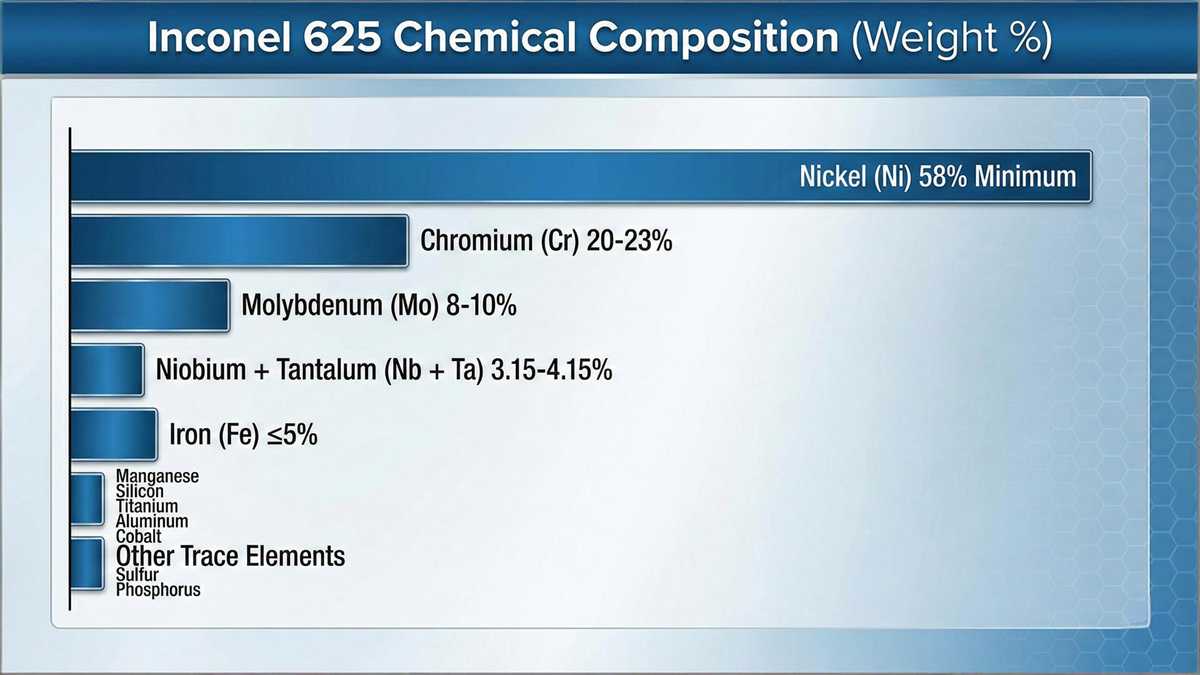
Pour connaître avec précision la teneur en nickel de l'Inconel 625, il faut se référer aux normes industrielles applicables, notamment ASTM B443 et AMS 5599. Ces spécifications définissent les limites de la composition chimique afin de garantir que le matériau présente un comportement prévisible lorsqu'il est soumis à des contraintes élevées.
Bien que le nickel soit l'élément principal, il sert de base à une matrice complexe. Voici la composition chimique limite standard (en poids %) :
| Élément | Symbole | Pourcentage (%) |
| Nickel | Ni | 58.0 min (équilibre) |
| Chrome | Cr | 20.0 - 23.0 |
| Molybdène | Mo | 8.0 - 10.0 |
| Niobium + tantale | Nb + Ta | 3.15 - 4.15 |
| Fer | Fe | 5.0 max |
| Manganèse | Mn | 0,50 max |
| Silicium | Si | 0,50 max |
Remarque : dans de nombreuses certifications de matériaux (MTR), la teneur en nickel est indiquée sous la mention “ Balance ”. Cela signifie qu’une fois tous les autres éléments spécifiques (Cr, Mo, Nb, Fe) pris en compte, le nickel constitue le reste. En pratique, cela se traduit généralement par une teneur en nickel comprise entre 60% et 62%.
Pourquoi le seuil “ 58% minimum ” est-il important ?
La question de Quelle est la teneur en nickel de l'Inconel 625 ? Il ne s'agit pas seulement d'une classification, mais d'une question de survie dans des environnements hostiles. Le seuil spécifique de 58% est crucial pour trois raisons principales :
1. Résistance à la fissuration par corrosion sous contrainte induite par les ions chlorure
Le principal avantage de l'acier au nickel 58% réside dans son immunité quasi totale à la fissuration par corrosion sous contrainte (SCC) induite par les ions chlorure. Les aciers inoxydables à plus faible teneur en nickel (comme le 316SS) présentent souvent des défaillances dans les environnements salins ou de traitement chimique, car ils se fissurent sous l'effet d'une contrainte de traction. La forte teneur en nickel de l'Inconel 625 agit comme un stabilisateur, empêchant ce mode de défaillance spécifique.
2. Stabilité à haute température
Le nickel est un stabilisateur austénitique. Grâce à sa forte teneur en nickel, l'Inconel 625 conserve sa structure cristalline cubique à faces centrées (FCC) depuis les températures cryogéniques jusqu'à 1 800 °F (982 °C). Cela garantit que le matériau ne devient pas cassant à des températures glaciales et ne perd pas son intégrité structurelle dans les systèmes d'échappement des moteurs à réaction.
3. Solubilité des éléments d'alliage
Le nickel possède la capacité unique de retenir de grandes quantités d’autres éléments en solution solide. La matrice formée par la teneur en nickel (~60%) permet l’ajout de molybdène (8-10%) et de niobium (3-4%). C'est l'interaction entre la base de nickel et ces éléments de renforcement qui confère à l'alliage 625 son incroyable limite d'élasticité sans nécessiter de traitements thermiques de durcissement par précipitation.
Inconel 625 vs. autres alliages : la différence apportée par le nickel
Pour apprécier pleinement cette composition, il est utile de comparer Quelle est la teneur en nickel de l'Inconel 625 ? par rapport à d'autres superalliages courants.
-
Inconel 625 (58%, teneur minimale en Ni) : Conçu pour offrir une résistance maximale à la corrosion et un renforcement par solution solide.
-
Inconel 718 (~50-55% Ni) : Il contient moins de nickel et plus de fer (environ 17-20%). Alors que le 718 est plus résistant grâce à son durcissement par vieillissement, le 625 offre une meilleure résistance à la corrosion en raison de sa teneur plus élevée en nickel et en molybdène.
-
Hastelloy C-276 (~57% Ni) : Sa teneur en nickel est très similaire à celle du 625, mais il présente une teneur en molybdène plus élevée et une teneur en chrome plus faible.
Lors du choix des matériaux destinés à des applications en milieu marin, dans le secteur aérospatial ou dans l'industrie chimique, il convient de vérifier Quelle est la teneur en nickel de l'Inconel 625 ? C'est la première étape pour garantir la qualité. Avec une teneur minimale de 58,01 TP3T de nickel, associée à des teneurs élevées en chrome et en molybdène, ce superalliage offre un équilibre rare entre facilité d'usinage et résistance extrême aux agressions environnementales.
Foire aux questions (FAQ)
Q1 : La teneur en nickel de l'Inconel 625 le rend-elle magnétique ?Non. En raison de sa forte teneur en nickel (minimum 58%) et de sa structure cristalline austénitique, l'Inconel 625 est non magnétique. Il conserve ses propriétés non magnétiques même après une exposition prolongée à des températures très basses ou très élevées, ce qui le rend particulièrement adapté aux applications électroniques sensibles ou sous-marines.
Q2 : Quelle est la différence entre la teneur en nickel de l'Inconel 625 et celle de l'Inconel 718 ?L'Inconel 625 présente généralement une teneur en nickel plus élevée (58% au minimum) que l'Inconel 718, qui contient généralement entre 50% et 55% de nickel. L'Inconel 718 compense cela par une teneur en fer plus élevée. La teneur en nickel plus élevée de l'Inconel 625 contribue à sa résistance supérieure à l'oxydation et à la corrosion par rapport à l'Inconel 718.
Q3 : La forte teneur en nickel est-elle la seule raison pour laquelle l'Inconel 625 résiste à la corrosion ?Si la forte teneur en nickel confère une immunité à la fissuration par corrosion sous contrainte, ce n'est toutefois pas le seul facteur. La résistance à la corrosion de l'Inconel 625 résulte de la synergie entre le nickel, le chrome (résistance à l'oxydation) et le molybdène (résistance à la corrosion par piqûres). La matrice de nickel lie essentiellement ces éléments entre eux pour offrir une protection complète.