





Lors de la sélection de matériaux de haute performance pour des environnements industriels extrêmes, la compréhension de la composition chimique de l'alliage inconel est la première étape fondamentale pour les ingénieurs et les spécialistes de l'approvisionnement. L'inconel, une famille de superalliages austénitiques à base de nickel et de chrome, est réputé pour sa capacité à maintenir l'intégrité structurelle à des températures élevées et à résister à une oxydation ou une corrosion sévère. Chez 28Nickel, nous savons que l'équilibre spécifique des éléments dans ces alliages détermine leur aptitude à être utilisés dans tous les domaines, des moteurs à réaction aux équipements de forage en haute mer.
Les fondements de la composition chimique de l'alliage d'Inconel
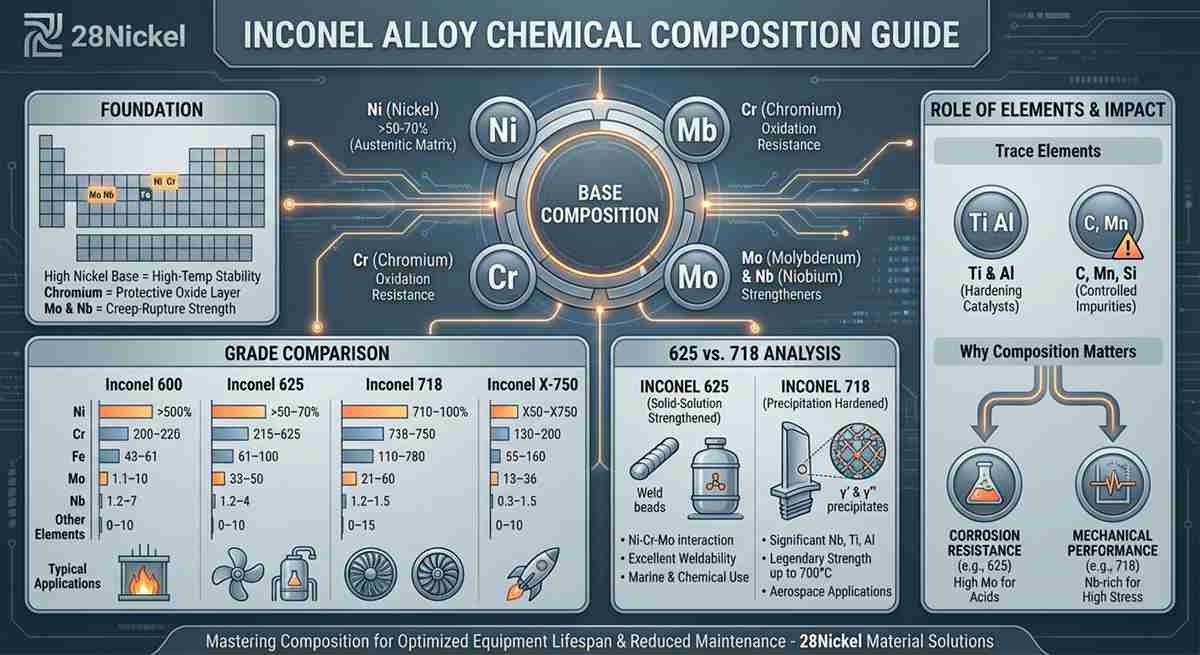
L'architecture principale de toute nuance d'Inconel tourne autour d'une teneur élevée en nickel, allant généralement de 50% à plus de 70%. Cette teneur élevée en nickel constitue la matrice “austénitique” qui permet au métal de rester stable à des températures où l'acier inoxydable perdrait sa résistance. Cependant, la véritable “magie” de la composition chimique de l'alliage inconel réside dans l'ajout stratégique de chrome, de molybdène, de niobium et de fer.
Le chrome est essentiel pour assurer la résistance à l'oxydation. Lorsqu'il est exposé à la chaleur, il forme une couche d'oxyde protectrice qui protège le métal sous-jacent. Le molybdène et le niobium agissent comme renforçateurs en solution solide ou participent au durcissement par précipitation, ce qui améliore considérablement la résistance à la rupture par fluage de l'alliage.
Comparaison des nuances d'Inconel les plus courantes
Des applications différentes nécessitent des profils chimiques différents. Vous trouverez ci-dessous une ventilation détaillée de la composition chimique des alliages d'inconel pour les qualités les plus fréquemment utilisées sur le marché mondial.
| Grade de l'alliage | Nickel (Ni) | Chrome (Cr) | Fer (Fe) | Molybdène (Mo) | Niobium (Nb) | Autres éléments |
| Inconel 600 | 72.0 min | 14.0 - 17.0 | 6.0 - 10.0 | – | – | Cu, Mn, Si |
| Inconel 625 | 58.0 min | 20.0 - 23.0 | 5.0 max | 8.0 - 10.0 | 3.15 - 4.15 | Ti, Al, Co |
| Inconel 718 | 50.0 - 55.0 | 17.0 - 21.0 | Équilibre | 2.8 - 3.3 | 4.75 - 5.5 | Ti, Al, B |
| Inconel X-750 | 70.0 min | 14.0 - 17.0 | 5.0 - 9.0 | – | 0.7 - 1.2 | Ti (2.25-2.75) |
Analyse des compositions de l'Inconel 625 par rapport à l'Inconel 718
La distinction entre l'Inconel 625 et l'Inconel 718 est peut-être le sujet le plus discuté concernant la composition chimique des alliages d'inconel.
L'Inconel 625 repose fortement sur l'interaction entre le nickel, le chrome et le molybdène, complétée par le niobium. Cette combinaison permet d'obtenir une excellente résistance à la fatigue et à la fissuration par corrosion sous contrainte due aux ions chlorure. Comme il ne dépend pas du durcissement par vieillissement, il est hautement soudable et largement utilisé dans la marine et le traitement chimique.
En revanche, la composition chimique de l'alliage d'inconel de qualité 718 comprend des quantités importantes de niobium, de titane et d'aluminium pour faciliter le “durcissement par précipitation”. Ce processus métallurgique crée un gamma prime () et gamma double-prime (). Ces structures microscopiques bloquent les dislocations dans le réseau cristallin du métal, ce qui confère à l'Inconel 718 sa résistance légendaire à des températures allant jusqu'à 700°C (1300°F). Pour l'industrie aérospatiale, c'est cette chimie spécifique qui permet aux disques de turbine de résister à d'immenses forces centrifuges.
Le rôle des oligo-éléments
Si les principaux composants dominent la discussion, les éléments mineurs de la composition chimique des alliages d'inconel sont tout aussi importants. Par exemple, de faibles ajouts de titane (Ti) et d'aluminium (Al) ne sont pas simplement des charges ; ils sont les catalyseurs des phases de durcissement dans les alliages 718 et X-750.
À l'inverse, les éléments tels que le carbone (C), le manganèse (Mn) et le silicium (Si) doivent être strictement contrôlés. Un excès de carbone peut entraîner la formation de carbures aux joints de grains, ce qui peut réduire la ductilité et la résistance à la corrosion. Chez 28Nickel, nous veillons à ce que nos partenaires d'approvisionnement respectent les tolérances les plus strictes pour ces éléments traces, garantissant ainsi que la composition chimique de l'alliage d'inconel des matériaux que nous fournissons est conforme aux normes internationales telles que l'ASTM, l'ASME et l'AMS.
Pourquoi la composition est-elle importante pour votre projet ?
Le choix d'une mauvaise composition chimique peut entraîner une défaillance catastrophique. Si un projet implique de l'acide sulfurique ou phosphorique, une teneur plus élevée en molybdène, que l'on trouve dans la composition chimique de l'alliage d'inconel 625, est préférable. Si l'exigence est une performance mécanique sous forte contrainte dans un four, le 718, riche en niobium, est la norme.
La compréhension de ces nuances est ce qui différencie un simple négociant d'un partenaire spécialisé comme 28Nickel. Nous ne nous contentons pas de vendre du métal, nous fournissons des solutions matérielles basées sur des connaissances métallurgiques approfondies. En maîtrisant la composition chimique des alliages d'inconel, nous aidons nos clients à optimiser la durée de vie de leurs équipements et à réduire les coûts de maintenance à long terme.
Questions et réponses connexes
Q1 : Comment la composition chimique de l'alliage d'inconel affecte-t-elle la soudabilité ?
R1 : En général, les alliages comme l'Inconel 600 et 625 ont une excellente soudabilité parce qu'ils sont renforcés par une solution solide. En revanche, les alliages tels que le 718 nécessitent des paramètres de soudage plus contrôlés pour éviter les fissures dues à l'usure, en raison de leurs éléments durcissant avec l'âge, tels que le niobium et l'aluminium.
Q2 : Pourquoi le fer est-il inclus dans la composition chimique de l'alliage inconel si le nickel est meilleur ?
R2 : Le fer est souvent inclus pour gérer les coûts et améliorer la maniabilité de l'alliage. Cependant, il est soigneusement limité (en particulier dans les nuances 600 et 625) car une trop grande quantité de fer peut réduire la résistance à l'oxydation du matériau à des températures extrêmement élevées.
Q3 : La composition chimique de l'alliage d'inconel peut-elle varier d'un fabricant à l'autre ?
A3 : Alors que les fourchettes générales sont fixées par des normes internationales (par exemple, ASTM B443 pour 625), “28Nickel” veille à ce que ses produits se situent au point optimal de ces fourchettes afin de maximiser les performances et la cohérence pour ses clients du monde entier.