











Le contrôle par ultrasons des pièces forgées en alliage de nickel est souvent requis lorsque le matériau est trop précieux, trop épais ou trop critique pour se fier uniquement à l’aspect de surface. Les pièces forgées de grande taille destinées aux vannes, corps de pompes, buses, arbres, brides et composants internes sous pression peuvent présenter des discontinuités internes invisibles jusqu’à ce que l’usinage ou une défaillance en service les révèle. À ce stade, le coût ne se limite plus à celui de l’inspection. Il inclut les pertes liées à l’usinage, les retards de production, les délais de remplacement et, parfois, un litige épineux visant à déterminer si le défaut était présent avant la fabrication. C’est pourquoi le contrôle par ultrasons des pièces forgées en alliage de nickel reste l’un des outils non destructifs les plus pratiques de la chaîne d’approvisionnement pour les composants à haut risque.
Les pièces forgées en alliage de nickel méritent une attention particulière, car elles sont couramment utilisées dans des applications où l'épaisseur, la pression, la température ou un environnement corrosif accentuent les conséquences des défauts cachés. En fonction de leur géométrie et de la famille d’alliages à laquelle ils appartiennent, les pièces forgées peuvent présenter des indications liées au retrait, des inclusions, des zones de défaut de solidité ou d’autres discontinuités qui doivent être évaluées au regard d’une norme d’acceptation convenue. Un programme rigoureux de contrôle par ultrasons des pièces forgées en alliage de nickel permet à l’acheteur d’examiner la qualité sous-jacente avant que l’usinage coûteux n’épuise le stock et avant que la traçabilité ne devienne plus difficile à garantir.
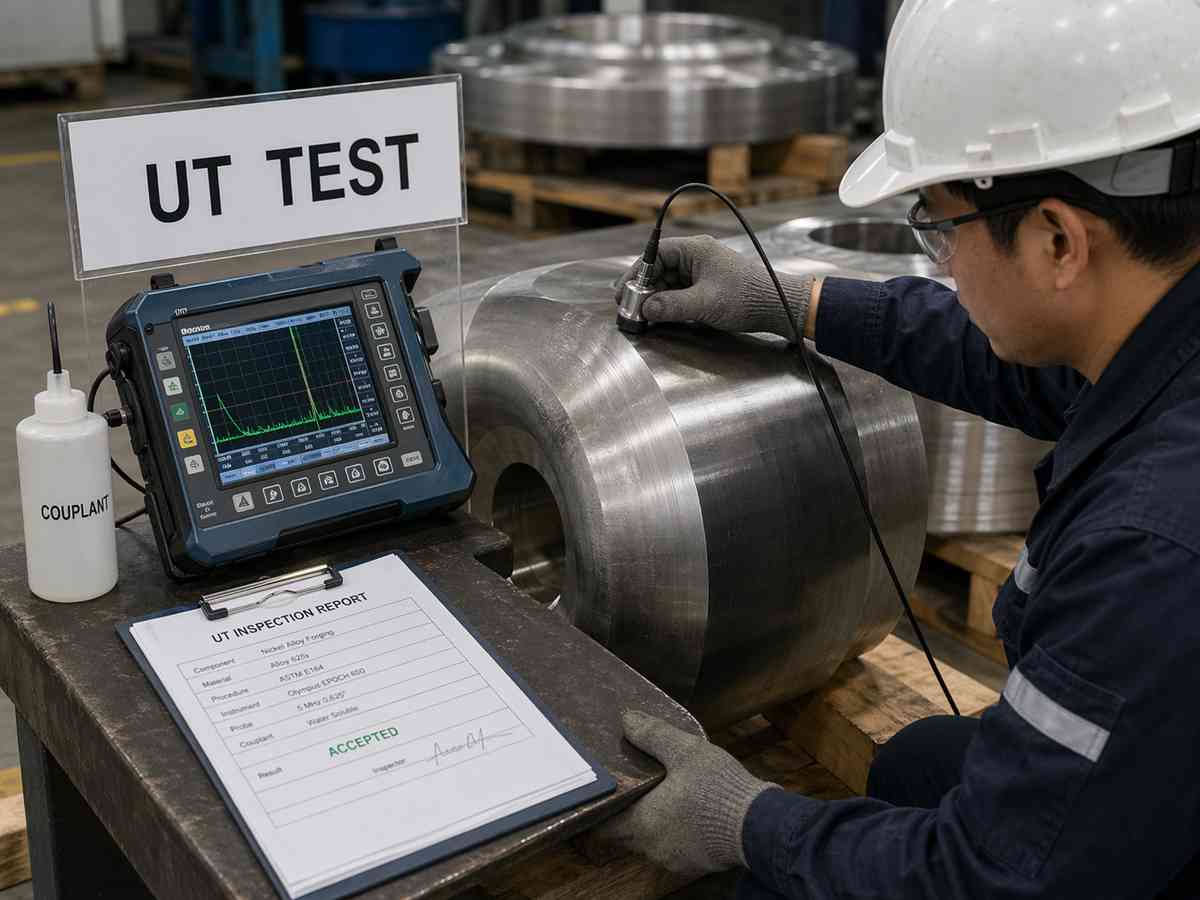
Comment fonctionne, dans la pratique, le contrôle par ultrasons des pièces forgées en alliage de nickel ?
Concrètement, le contrôle par ultrasons des pièces forgées en alliage de nickel est précieux car il permet d’évaluer l’intégrité interne sans avoir à découper la pièce. Une surface correctement préparée, un couplant adapté, un opérateur qualifié et un plan de balayage convenu sont essentiels. L’acheteur ne doit pas considérer qu’une simple déclaration de conformité suffit. La pertinence du résultat dépend de la norme applicable, de la géométrie de la pièce forgée, de la couverture du balayage, de la méthode d’étalonnage et de la manière dont les indications sont évaluées. Les sections épaisses, les changements de sens du grain et les géométries complexes peuvent tous influencer la réponse du signal ; c’est pourquoi il est important de clarifier les aspects techniques avant le début du contrôle.
Le rapport doit également être lié à l’identité réelle de la pièce forgée. Un rapport de contrôle par ultrasons pertinent pour les pièces forgées en alliage de nickel mentionne généralement le numéro de la pièce ou de la coulée, la méthode de balayage, les blocs de référence ou la base d’étalonnage, la couverture, les critères d’acceptation et tout constat pertinent. C’est ce niveau de détail qui permet au résultat de résister à un examen ultérieur par le propriétaire ou à des vérifications du dossier de fabrication. Sans cela, le contrôle par ultrasons peut facilement se réduire à une simple formalité administrative plutôt qu’à une véritable mesure de contrôle. Pour les pièces forgées critiques, la rigueur dans l’établissement des rapports est presque aussi importante que le contrôle lui-même.
| Élément de commande UT | Pourquoi c'est important | Attentes des acheteurs |
| Préparation de la surface | Un mauvais contact peut fausser les résultats | Nettoyez les surfaces de test accessibles avant la numérisation |
| Base d'étalonnage | L'interprétation du signal en dépend | Étalon de référence défini ou bloc d'étalonnage |
| Plan de couverture | Chaque géométrie nécessite des trajectoires de balayage différentes | Présentation claire des zones numérisées et de leurs limites |
| Critère d'acceptation | Les indications brutes doivent faire l'objet d'une évaluation technique | Limites de rejet spécifiées par la norme ou définies par le maître d'ouvrage |
Quand le contrôle par ultrasons des pièces forgées en alliage de nickel revêt une importance capitale
Le retour sur investissement des contrôles par ultrasons pour les pièces forgées en alliage de nickel est maximal lorsque la pièce est de grande taille, coûteuse à usiner, difficile à remplacer ou destinée à une application sous pression ou approuvée par le client. On peut citer comme exemples les brides lourdes, les pièces forgées en forme de bloc pour les équipements sous-marins, les buses forgées, les pièces forgées annulaires et les composants internes résistants à la corrosion qui doivent faire l’objet d’un examen rigoureux de la documentation. Dans ces cas-là, détecter un défaut sous-jacent avant l’usinage revient bien moins cher que de le découvrir après avoir déjà consacré des heures au tournage, à l’alésage, au dressage ou à la préparation de la soudure.
Les acheteurs doivent également envisager le contrôle par ultrasons (UT) en termes de calendrier. Le moment idéal se situe généralement avant que l’usinage majeur n’enlève de la matière et avant que la pièce forgée ne soit irréversiblement orientée vers un parcours de fabrication spécifique. Chez 28Nickel, nous recommandons souvent d’intégrer le contrôle par ultrasons des pièces forgées en alliage de nickel à l’étape clé de l’achat, plutôt que de le laisser pour la fin, juste avant l’expédition. Lorsque cette exigence est clairement stipulée dans la commande, le fournisseur peut planifier le contrôle, le rapport et toute décision de retouche tant que la pièce forgée est encore maniable. C’est généralement là que le contrôle par ultrasons apporte sa véritable valeur commerciale.
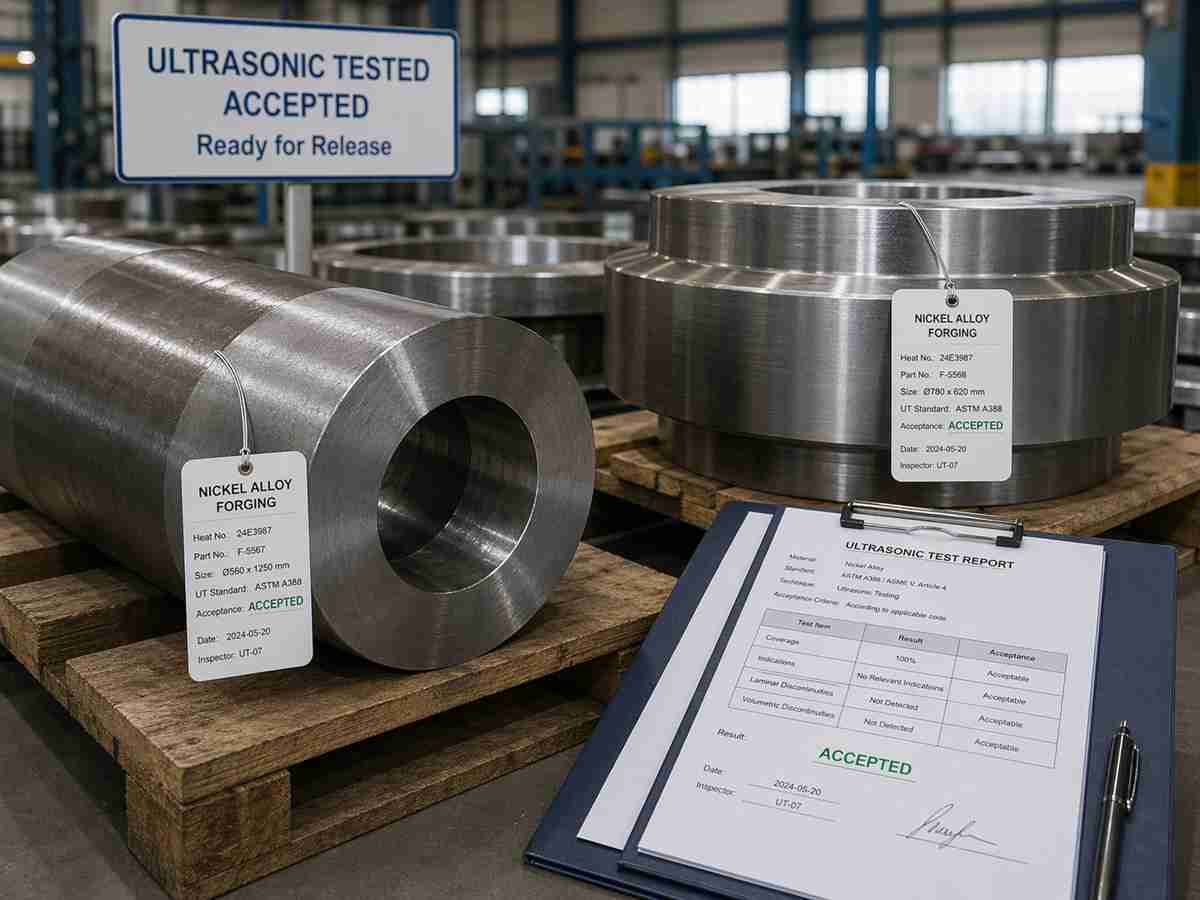
Conclusion
Il est plus économique de corriger les défauts internes avant de procéder à l'enlèvement de matière. Pour les pièces forgées critiques, le contrôle par ultrasons (UT) n'est pas un luxe facultatif. Il s'agit d'une étape de contrôle indispensable qui permet de préserver le budget d'usinage, de respecter les délais de livraison et de garantir la fiabilité des composants. Si vous avez besoin d’aide pour définir le périmètre du contrôle par ultrasons ou les critères d’acceptation pour une commande de pièces forgées en alliage de nickel, 28Nickel peut vous aider à adapter le plan d’inspection à la géométrie de la pièce forgée et aux risques liés à son utilisation.
Questions et réponses connexes
Q : L'UT permet-elle de détecter tous les défauts internes d'une pièce forgée ?
Aucune méthode de contrôle non destructif n'est parfaite en soi, mais le contrôle par ultrasons des pièces forgées en alliage de nickel s'avère très efficace pour détecter de nombreuses discontinuités sous-superficielles lorsque la géométrie, l'état de la surface et la procédure sont adaptés.
Q : Le contrôle par ultrasons doit-il être effectué avant ou après l'usinage ?
Souvent avant les opérations d'usinage importantes, car c'est à ce moment-là qu'il est le plus économique de corriger les défauts. Certains projets peuvent également nécessiter un contrôle supplémentaire après l'usinage, en fonction de la géométrie et des exigences du client.