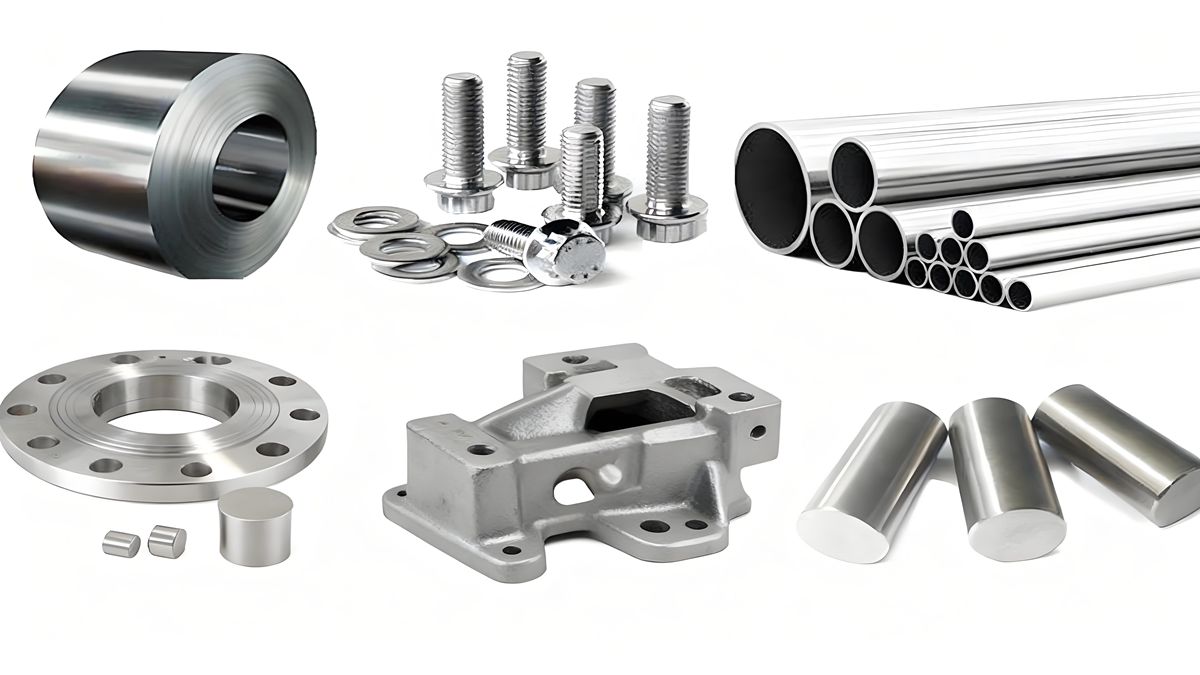
In real projects, engineers do not compare materials in isolation; they compare failure modes. That is exactly why Hastelloy X vs Nickel 200 pour les tubes d'échangeurs de chaleur is not a simple “high alloy vs pure nickel” decision. On paper, both are nickel-based materials. In service, they behave very differently. Hastelloy X is a high-temperature Ni-Cr-Fe-Mo alloy developed to survive oxidation, thermal cycling, and strength loss in hot gas environments. Nickel 200, by contrast, is commercially pure wrought nickel valued for its resistance to caustic media, its excellent thermal conductivity, and its clean metallurgy in reducing environments.
This distinction matters because many exchanger failures are misdiagnosed at the quotation stage. A tube bundle may see hot gas on one side, wet chemistry on the other, intermittent shutdowns, aggressive cleaning, or local crevice attack at the tubesheet. In those cases, selecting the “more expensive alloy” does not automatically buy reliability. It only buys the wrong failure mechanism more slowly.
Hastelloy X vs Nickel 200 for heat exchanger tubing: start with the real failure mechanism
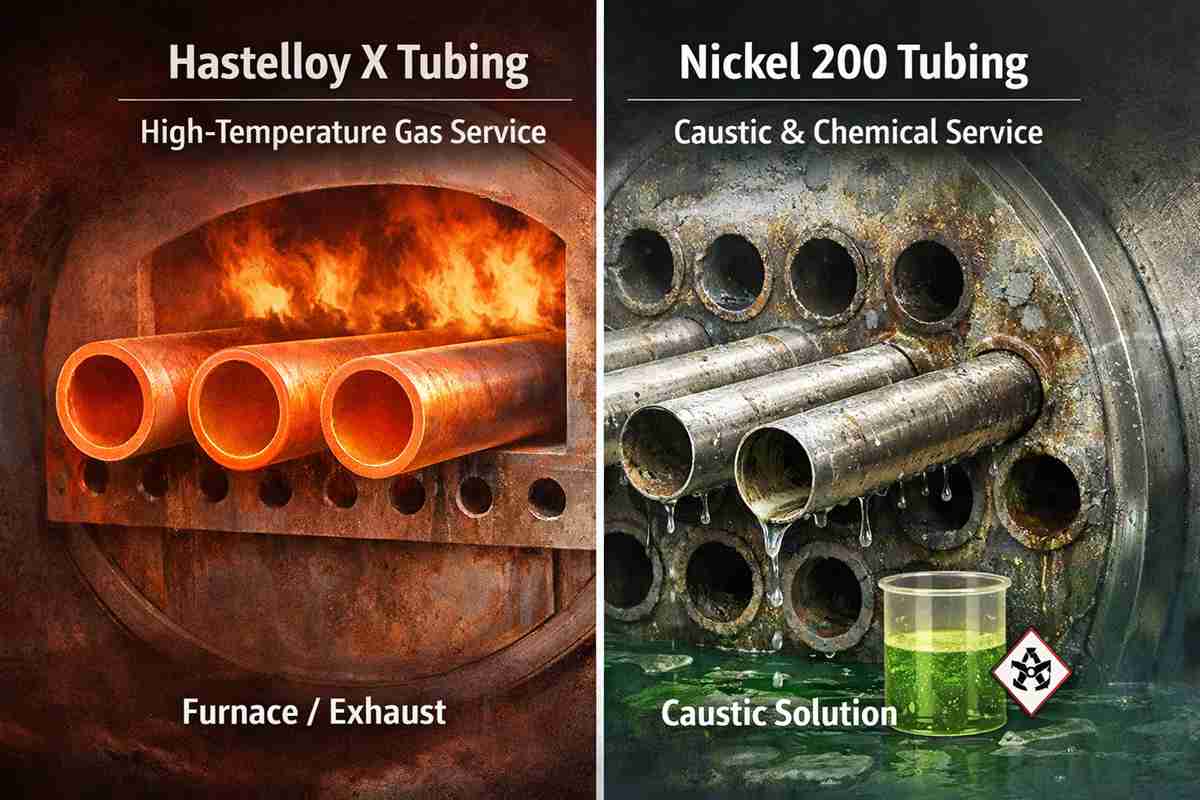
The first question is not composition. It is: what is trying to kill the tube? If the dominant risk is oxidation, carburization, thermal fatigue, or loss of hot strength, Hastelloy X immediately becomes relevant. If the dominant risk is attack by hot caustic alkali or a reducing chemical stream at moderate temperature, Nickel 200 deserves serious attention.
Hastelloy X, typically identified as UNS N06002, gains its usefulness from chromium and molybdenum additions plus a matrix that retains strength far better than pure nickel at elevated metal temperatures. It is well known in combustor hardware, furnace internals, and hot ducting for a reason. In exchanger duty, that advantage appears when tubing is exposed to high-temperature gaseous service, especially where scaling resistance and thermal-cycle stability matter more than maximum heat-transfer efficiency.
Nickel 200, UNS N02200, solves a different problem. Its high nickel content gives excellent resistance in many caustic alkalis and certain reducing conditions, while its thermal conductivity is dramatically higher than that of most heavily alloyed nickel materials. That can be a major design advantage in heat exchanger tubing. The limitation is equally important: at elevated temperatures, especially above roughly 315°C / 600°F, Nickel 200 is generally not the preferred grade because carbon-related embrittlement or graphitization concerns begin to matter; engineers often move to Nickel 201 for hotter service.
| Property / Selection Point | Hastelloy X | Nickel 200 | What it means for heat exchanger tubing |
|---|---|---|---|
| Type d'alliage | Ni-Cr-Fe-Mo high-temperature alloy | Commercially pure wrought nickel | They are built for different service regimes, not the same job at different price levels |
| Typical strength retention at elevated temperature | Haut | Low to moderate | Hastelloy X is favored where tube wall temperature is high |
| Oxidation resistance in hot gas | Excellent | Limited to fair | Hot gas, furnace, and exhaust-side duty often favors Hastelloy X |
| Resistance in caustic alkalis | Not its main advantage | Excellent | Caustic evaporators and alkaline service often favor Nickel 200 |
| Thermal conductivity | Relatively low | Haut | Nickel 200 can improve heat-transfer efficiency where corrosion allows it |
| Aqueous chloride service | Not a first-choice alloy | Not a first-choice alloy | Wet chlorides may require another alloy altogether |
| Temperature limitation | Suitable for very high-temperature service | Commonly kept below about 315°C / 600°F for Nickel 200 | Temperature alone can eliminate Nickel 200 from consideration |
| Raw material and fabrication economics | Higher alloy cost, good fabrication | Lower alloying cost, easy forming, lower strength | Lifecycle cost depends on both corrosion life and required wall thickness |
Where Hastelloy X wins, and where Nickel 200 wins
When clients ask about Hastelloy X vs Nickel 200 for heat exchanger tubing, I usually separate the answer into gas-side service and chemistry-side service.
For high-temperature gas-side duty, Hastelloy X is usually the more technically defensible choice. Think recuperators, waste-heat equipment, exhaust-gas coolers, furnace-related exchangers, or any tubing arrangement exposed to repeated heating and cooling. In these applications, oxidation resistance and creep-related strength matter more than raw thermal conductivity. Pure nickel simply does not hold its mechanical margin the same way. A tube that transfers heat efficiently but distorts, scales, or loses strength is not an economical tube.
Nickel 200 wins in a narrower but very important envelope. In hot caustic alkalis, certain reducing salt environments, and chemically clean services where purity and corrosion behavior dominate, it can outperform more complex alloys on both corrosion resistance and heat transfer. Procurement teams sometimes overlook that last point. A lower-alloy material with much better thermal conductivity can support very attractive exchanger efficiency, provided the pressure, tube-wall stress, and temperature remain inside a safe range. That said, Hastelloy X vs Nickel 200 for heat exchanger tubing should never be framed as a universal upgrade path. Nickel 200 is not a cheaper Hastelloy. Hastelloy X is not a superior Nickel 200. They are answers to different process questions.
There is also a trap that experienced engineers watch closely: wet chloride service. Buyers occasionally assume any nickel alloy will be comfortable there. That is a costly shortcut. Hastelloy X was not primarily designed as a best-in-class aqueous corrosion alloy, and Nickel 200 is not the default answer for chloride-bearing exchanger streams either. If the process side contains serious chlorides, low-pH condensate, or mixed oxidizing-reducing contamination, the correct comparison may not be Hastelloy X vs Nickel 200 for heat exchanger tubing at all. The real short list may shift toward a different nickel alloy family.
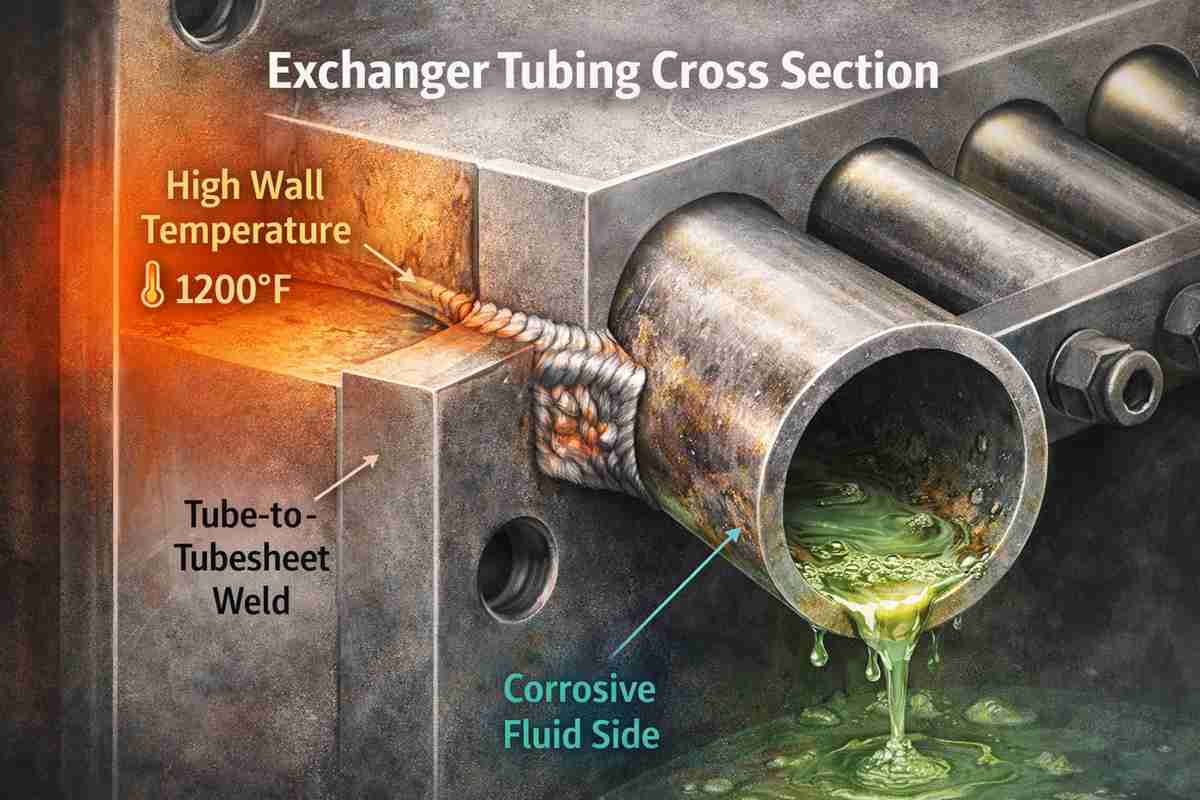
Fabrication matters too. Hastelloy X offers solid weldability and good fabrication for a high-temperature alloy, but it is still a stronger, lower-conductivity material that may change the thermal design. Nickel 200 is easier to form and attractive for clean fabrication, yet its lower strength can require thicker walls or tighter design limits. Tube-to-tubesheet joints, shutdown chemistry, pickling practice, and mechanical cleaning method all influence which alloy survives longest. In other words, material selection should not stop at the mill certificate.
Conclusion
The most useful way to read the Hastelloy X vs Nickel 200 for heat exchanger tubing question is this: are you buying high-temperature structural stability, or are you buying corrosion resistance plus heat-transfer efficiency in a moderate-temperature chemical environment? If the exchanger sees hot oxidizing gas, thermal cycling, and elevated metal temperature, Hastelloy X is usually the stronger engineering answer. If the service is caustic, reducing, and thermally moderate, Nickel 200 can be the smarter and more economical tubing material.
The best quotations come from complete process data, not alloy myths. If you are sizing a tube bundle and want a sharper material recommendation, send the fluid chemistry, chloride level, operating and upset temperatures, pressure, cleaning method, and expected shutdown frequency to 28Nickel. That is where material selection becomes engineering rather than guesswork.
Questions et réponses connexes
1. Is Hastelloy X better than Nickel 200 for chloride-containing heat exchanger service?
Not by default. Neither alloy is automatically the best answer for wet, aggressive chloride duty. If chlorides are the main risk, the material review often needs to move beyond this comparison.
2. Can Nickel 200 be used for high-temperature heat exchanger tubing?
Only with caution. For sustained service above about 315°C / 600°F, engineers usually review Nickel 201 or another alloy because Nickel 200 may face embrittlement-related limitations.
3. Does Nickel 200 always give better heat exchanger performance because it has higher thermal conductivity?
No. Higher thermal conductivity helps, but only when corrosion resistance, allowable stress, wall thickness, and operating temperature are all still acceptable for the service.