When engineering projects demand materials that can survive the most “hellish” environments—where extreme heat meets aggressive corrosion—Inconel superalloys are the gold standard. As a premier provider, 28Nickel understands that selecting the right grade is critical for mission-success. In this guide, we dive deep into the most significant inconel alloy applications across global industries, exploring why these nickel-chromium-based materials remain irreplaceable in modern metallurgy.
The Science Behind Inconel Performance
Before exploring specific inconel alloy applications, it is vital to understand the “why” behind the metal. Inconel alloys are oxidation- and corrosion-resistant materials well-suited for service in extreme environments subjected to pressure and heat. When heated, Inconel forms a thick, stable, passivating oxide layer protecting the surface from further attack. Unlike stainless steel, which might succumb to creep or oxidation at high temperatures, Inconel retains its structural integrity.
Aerospace: The Frontier of Inconel Alloy Applications
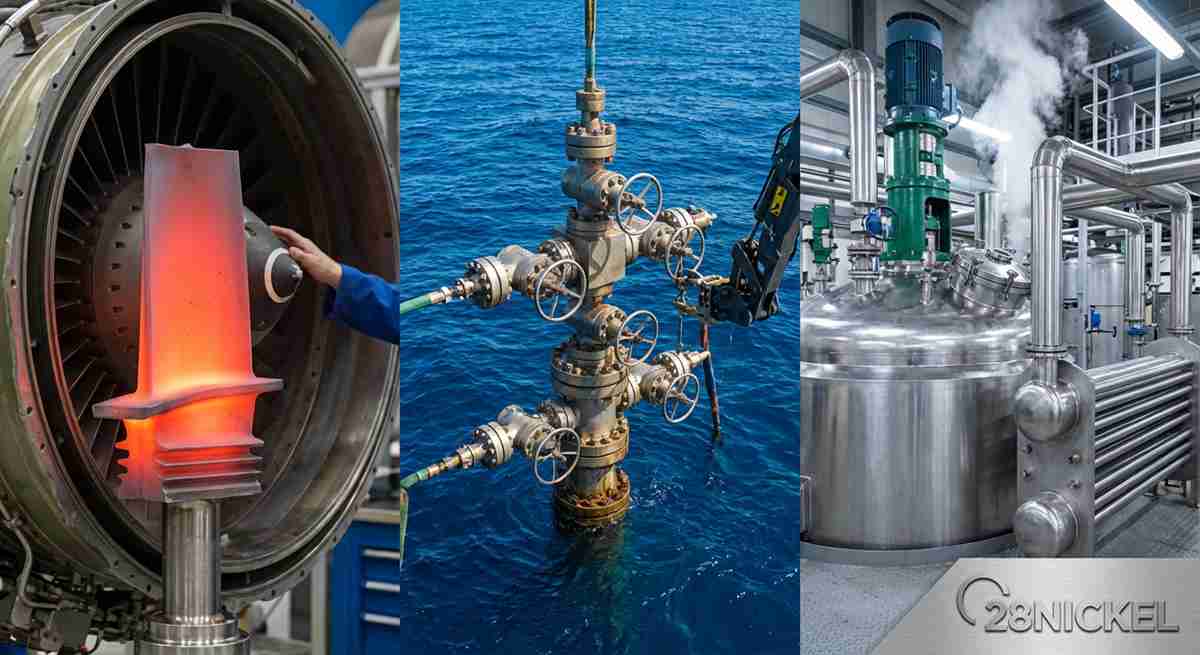
The aerospace sector is arguably the largest consumer of superalloys. Because jet engines operate at temperatures that would melt lesser metals, inconel alloy applications are found in almost every stage of propulsion.
-
Turbine Blades: Inconel 718 is frequently used for turbine blades and discs due to its precipitation-hardening properties and excellent weldability.
-
Exhaust Systems: The high-temperature oxidation resistance makes these alloys ideal for exhaust ducting and tailpipes.
-
Engine Enclosures: Protecting the airframe from engine heat requires materials that don’t lose strength under thermal cycling.
Oil and Gas: Tackling “Sour” Environments
In the upstream oil and gas industry, equipment is often exposed to “sour gas” (high levels of et ). Standard steels would suffer from sulfide stress cracking almost immediately. Here, inconel alloy applications focus on durability and safety. Inconel 625 is the workhorse here, often used for cladding subsea wellheads, valves, and hangers. By using a specialized “overlay” technique, companies can enjoy the corrosion resistance of Inconel with the cost-effectiveness of a steel base.
Chemical and Nuclear Processing
Chemical reactors often handle highly acidic or alkaline solutions at elevated temperatures. Inconel alloy applications in this field include heat exchanger tubing, vessels, and mixing blades. In the nuclear sector, Inconel 600 is preferred for nuclear reactor core and control rod components. Its resistance to high-purity water corrosion and chloride-ion stress-corrosion cracking is essential for maintaining the long-term safety of power plants.
Comparative Overview of Common Inconel Grades
To help you choose the right material for your project, 28Nickel has compiled this reference table for various inconel alloy applications:
| Grade | Éléments d'alliage primaire | Caractéristiques principales | Applications typiques |
| Inconel 600 | Ni, Cr, Fe | Haute résistance à l'oxydation | Nuclear engineering, furnace components |
| Inconel 625 | Ni, Cr, Mo, Nb | High strength, sea-water resistance | Marine piping, chemical processing, O&G |
| Inconel 718 | Ni, Cr, Fe, Mo, Nb | Excellente résistance au fluage et à la rupture | Jet engines, high-speed airframe parts |
| Inconel X-750 | Ni, Cr, Fe, Ti, Al | Corrosion/Oxidation resistant to 700°C | Gas turbine rotors, springs, bolts |
Marine and Automotive Excellence
While aerospace gets the spotlight, marine engineering relies heavily on Inconel for propeller blades, motor shafts, and subsea cables. The alloy’s immunity to local attack (pitting and crevice corrosion) makes it superior for long-term saltwater immersion. In the automotive world, high-performance exhaust systems and turbocharger components utilize Inconel to handle the intense heat generated by modern, high-compression engines.
Why Choose 28Nickel?
Understanding the nuances of inconel alloy applications is only half the battle. You also need a supplier that ensures material traceability and quality standards. At 28Nickel, we bridge the gap between high-performance metallurgy and your project’s specific needs, ensuring your components are built to last.
Questions et réponses connexes
Q1: Why is Inconel used instead of stainless steel in high-heat environments?
A1: While stainless steel is excellent for general corrosion, it loses significant strength at temperatures above 500°C. Inconel forms a protective oxide layer and maintains its mechanical properties at temperatures exceeding 700°C, making inconel alloy applications essential for furnaces and engines.
Q2: Which Inconel grade is best for saltwater resistance?
A2: Inconel 625 is widely considered the best choice for marine environments. Its addition of Molybdenum and Niobium provides exceptional resistance to pitting and crevice corrosion in seawater.
Q3: Is Inconel difficult to machine?
A3: Yes, due to its rapid work-hardening and high strength. However, with the right tooling and cooling techniques, it can be precision-machined. This is why many inconel alloy applications rely on experienced fabricators and high-quality raw materials from suppliers like 28Nickel.