Choosing an inconel alloy supplier China is rarely about price alone. Inconel‑type nickel‑chromium superalloys sit at the intersection of corrosion science, high‑temperature metallurgy, and tight manufacturing tolerances. A small mistake—wrong heat treatment, mixed heats, incomplete traceability—can turn a “meets spec” shipment into a costly shutdown. This guide breaks down what to specify, what to verify, and how to compare offers so you can buy from China with fewer surprises and faster approvals.
What buyers really mean by “Inconel”
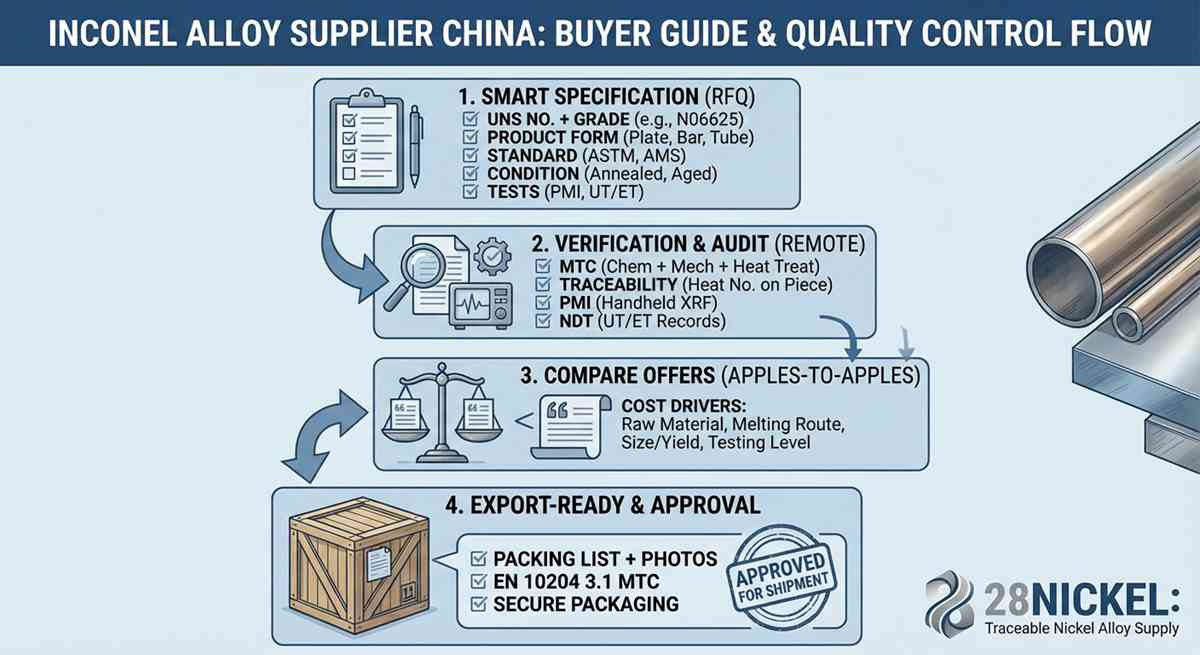
“Inconel” is a trademark name that buyers often use as a shortcut for several nickel‑based alloys (commonly UNS N06600, N06601, N06625, N07718, and others). For purchasing, the shortcut is risky. A strong RFQ should name:
-
UNS number + common grade (e.g., UNS N06625 / Alloy 625)
-
Product form (plate, sheet, strip, bar, wire, pipe, tube, forging)
-
Standard (ASTM/ASME, AMS, EN, or a project specification)
-
Condition and heat treatment (solution annealed, aged, stress relieved, cold worked)
-
Inspection and documentation (EN 10204 3.1, PMI, UT/ET scope, etc.)
When a quote arrives from an inconel alloy supplier China, ask whether pricing is tied to an exact UNS grade and standard—or to a generic “Inconel” description. The difference usually shows up later in service performance, not only on the chemistry line of a certificate.
Who you are buying from in China
China’s nickel‑alloy supply chain can look similar on paper but behave very differently in practice. Most export orders come through one of three models:
-
Mill-direct: best when you need large tonnage, tight project schedules, or full process control.
-
Stockist/service center: best for short lead times, mixed sizes, and cut-to-length processing.
-
Trading + integrated QC: best when you want one point of contact that can combine multiple mills, arrange third‑party inspection, and consolidate shipments.
A capable inconel alloy supplier China will tell you which model they are using for your order and what that means for lead time, testing scope, and traceability.
Spec sheet first: what an inconel alloy supplier China needs
To reduce back‑and‑forth and prevent “assumption gaps,” send a one‑page “must match” spec sheet. A reliable inconel alloy supplier China will confirm each item in writing before production or cutting starts.
Include:
-
Dimensions and tolerances (OD/ID, wall, thickness, straightness, length)
-
Surface and end finish (pickled, bright annealed, ground, beveled, capped)
-
Mechanical requirements (yield/tensile, elongation, hardness, grain size if critical)
-
Testing: tensile, hardness, flattening/flaring (tubing), eddy current (tubes), ultrasonic (plates/forgings)
-
Service environment: chloride level, sulfur, seawater, reducing acids, max temperature, cycling vs steady
One practical tip: if your end user runs a strict incoming inspection, tell the supplier upfront how you will receive‑inspect (PMI coverage, sampling plan, retest rules). It helps your inconel alloy supplier China package and mark material in a way that passes receiving faster.
A compact RFQ template you can copy
Use this as a starting point when contacting an inconel alloy supplier China:
-
Material: Alloy 625 / UNS N06625
-
Form: Seamless tube, OD ___ mm, WT ___ mm, Length ___ m
-
Standard: ASTM B444 + project supplementary requirements
-
Condition: Solution annealed + pickled
-
Tests: MTC, tensile, hardness, flattening, ET 100% (if required), PMI on finished goods (sample plan ___)
-
Docs: EN 10204 3.1, packing list with heat numbers, photos before shipment
How to audit an inconel alloy supplier China without visiting
You can do a meaningful “paper audit” remotely. A serious inconel alloy supplier China should be comfortable sharing evidence, not only sales claims.
Ask for:
-
Heat/lot traceability: heat numbers tied to each piece, with marking method explained
-
Mill Test Certificate (MTC): chemistry + mechanicals + stated heat treatment details
-
EN 10204 3.1 (typical) and 3.2 if your project requires third‑party witnessing
-
PMI process: whether they use handheld XRF/OES and where it is applied (incoming, finished, both)
-
Calibration records: tensile machines, hardness testers, UT/ET equipment
-
NDT procedures: acceptance criteria and operator qualification
If the supplier hesitates to share traceability examples (redacted customer info is fine), treat it as a risk signal.
Disputes that happen in the real world (and how to prevent them)
Most disputes are preventable. These are three common ones we see when buyers change suppliers:
-
Wrong condition: Alloy 718 is shipped solution treated but not aged, so chemistry “passes” while strength fails. Prevent it by writing the exact heat treatment/condition in the PO and requiring it on the MTC.
-
Mixed heats: bundles combined during cutting or packing. Prevent it with piece-level or bundle-level marking rules, photos, and receiving PMI.
-
Substitution by “equivalent” grade: a well‑intentioned swap (e.g., a different nickel alloy family) that is not truly equivalent in corrosion mode. Prevent it by locking the UNS number and disallowing substitutions without written approval.
A good inconel alloy supplier China will warn you when a request looks inconsistent (for example, asking for tight hardness plus heavy cold work plus high elongation) and propose an achievable path.
Key grades and what to ask for
Use this table to keep conversations anchored in UNS grades and standards rather than brand names. It also helps different teams (engineering, QA, purchasing) align on what they are actually buying from an inconel alloy supplier China.
| Common name | UNS | Strength & corrosion “why” | Typical delivery condition | Common specs (examples) | Typical supply forms |
|---|---|---|---|---|---|
| Alloy 600 | N06600 | Good general corrosion + oxidation; stable at temperature | Solution annealed | ASTM B168 (sheet/plate), ASTM B166 (bar/wire) | plate, sheet, bar, wire |
| Alloy 601 | N06601 | Strong oxidation resistance for furnace/heat‑treat parts | Solution annealed | ASTM B168, ASTM B166 | plate, sheet, bar |
| Alliage 625 | N06625 | Excellent pitting/crevice resistance; seawater & chlorides | Solution annealed | ASTM B443 (plate), ASTM B444 (seamless pipe/tube) | plate, tube, pipe, bar |
| Alliage 718 | N07718 | Very high strength after aging; fatigue/creep capable | Solution + age | AMS 5662/5663 (bar), AMS 5596 (sheet) | bar, forging, sheet |
| Alloy X‑750 | N07750 | Spring strength + oxidation resistance; age‑hardenable | Solution + age | AMS 5698/5699 | wire, spring, bar |
Note: “Common specs” vary by project. Always lock the exact revision, acceptance criteria, and any supplementary tests in the PO.
Lead time, yield, and cost drivers that change the quote
If two quotes look far apart, it is often because the assumptions differ. A transparent inconel alloy supplier China will explain the drivers instead of hiding them in a lump sum.
Main cost factors:
-
Raw material index (nickel and alloying elements) and surcharge method
-
Melting route (vacuum melting/remelting for high‑integrity aerospace items)
-
Size and yield loss (thick‑wall pipe and heavy plate can have higher yield loss)
-
Heat treatment and straightening (long tubes with tight straightness)
-
Testing level (extra UT/ET, witnessed tests, additional samples)
-
Cutting and finishing (waterjet, plasma, saw cut, machining allowance, beveling)
When evaluating an inconel alloy supplier China, compare offers on an “apples to apples” basis: same standard, same condition, same test scope, same documentation.
Export-ready documentation checklist
For international buyers, paperwork is part of quality. Ask your inconel alloy supplier China to provide a document set that matches customs and end‑user needs:
-
Packing list with heat numbers and piece count
-
Commercial invoice with clear product description and standards
-
MTC / EN 10204 3.1 (and 3.2 if required)
-
Country of origin statement (when requested)
-
Compliance statements (RoHS/REACH if your industry asks for them)
-
Photos of packing and marking before dispatch
Good export packaging matters for alliages de nickel: protect from seawater exposure, avoid carbon‑steel contamination, and use labels that stay readable after transit.
Where 28Nickel fits in your sourcing strategy
If your projects require repeatability, treat your inconel alloy supplier China as a technical partner, not a one‑time vendor. At 28Nickel, we focus on traceable nickel alloy supply—linking each shipment to heat numbers, verified test reports, and a clear standard/condition statement—so your engineering team can approve materials quickly and your purchasing team can reduce risk.
The goal is simple: the material you receive should match the material your design assumed, without surprises.
Questions et réponses connexes
Q1: What is the minimum documentation I should demand from an inconel alloy supplier China?
A: At minimum, request an MTC with chemistry, mechanical properties, and stated heat treatment, plus heat-number traceability to each item. For critical projects, add EN 10204 3.1 and PMI records.
Q2: Is “Inconel 625” enough to specify in an RFQ?
A: Not by itself. Add UNS N06625, the product form, the governing standard (e.g., ASTM B443/B444 or your project spec), the delivery condition, and the required tests.
Q3: How do I reduce the risk of mixed heats in bulk shipments?
A: Require bundle-level heat tags, permanent piece marking where feasible, photos before packing, and a receiving PMI plan that verifies a statistically meaningful sample.