Designing vessels, heavy-wall piping, and valve bodies for extreme environments requires an uncompromising approach to metallurgy. When system internal pressures exceed 10,000 psi—especially combined with corrosive fluid media or elevated thermal parameters—standard austenitic stainless steels simply lack the mechanical integrity required. This is exactly where the specification of a precise nickel alloy for high pressure applications becomes non-negotiable for engineers. We are not just looking at baseline tensile strength; we must rigorously evaluate creep resistance, phase stability over extended time domains, and susceptibility to stress corrosion cracking (SCC) under severe multi-axial mechanical loads. Material failure in these envelopes leads to instantaneous, catastrophic blowouts. By analyzing the microstructural hardening mechanisms of specific high-performance grades, we can engineer containment systems that maintain strict dimensional stability and absolute pressure containment over a decades-long operational lifecycle.
Evaluating Mechanical Integrity Under Load
When evaluating a nickel alloy for high pressure applications, understanding the fundamental distinction between solid-solution strengthening and precipitation hardening is paramount. For environments requiring immense, uncompromising yield strength, Alloy 718 (UNS N07718) frequently serves as the engineering baseline. The precise addition of niobium (Nb) and molybdenum (Mo) to the nickel-chromium matrix allows for the precipitation of the gamma double-prime () phase () during the controlled thermal aging process. This microstructural phenomenon creates localized strain fields that severely impede dislocation movement, granting the material a minimum yield strength often exceeding 1,034 MPa (150 ksi) in the fully age-hardened condition.
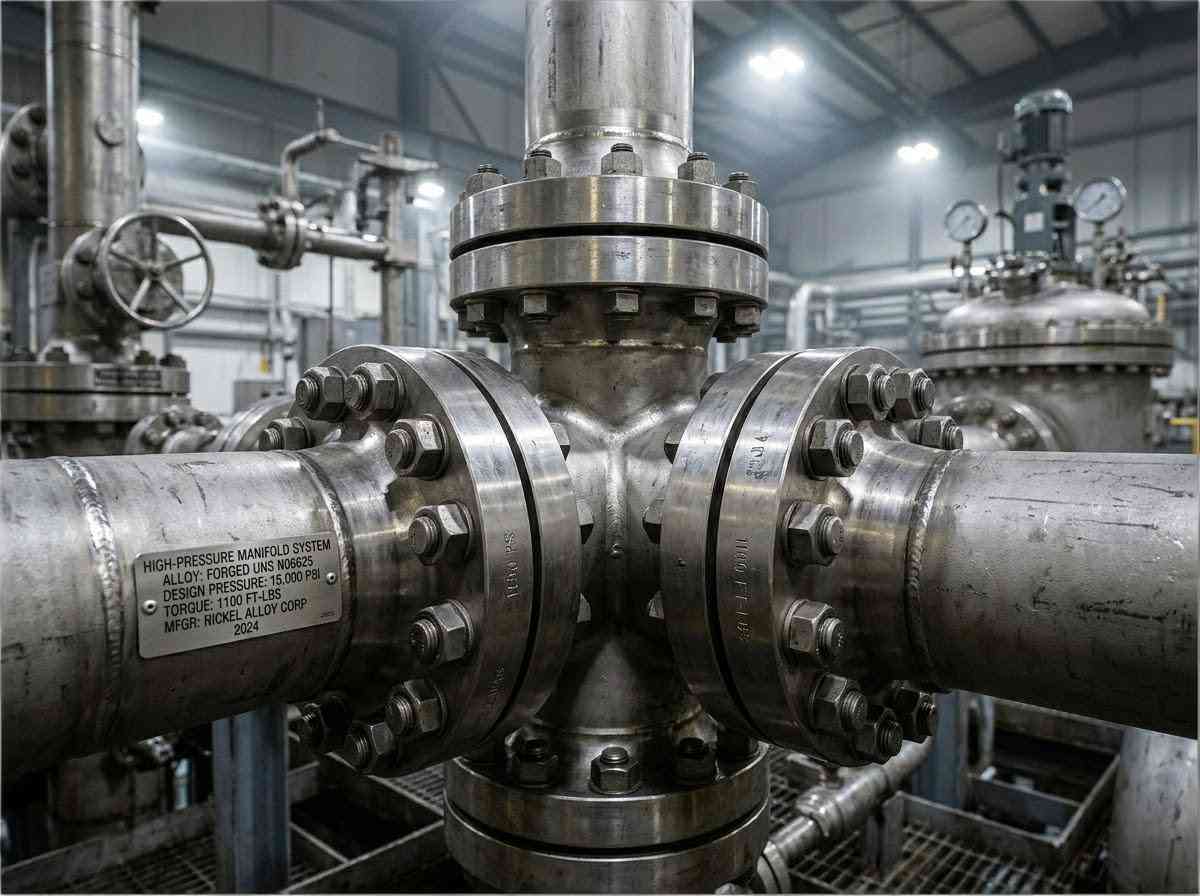
Beyond pure tensile strength, structural engineers must evaluate the stress intensity factor () to understand fracture toughness. A microstructurally optimized nickel alloy for high pressure applications ensures that preexisting microscopic flaws do not propagate into catastrophic macroscopic cracks under cyclic pressurization. Conversely, if the design prioritizes extreme corrosion resistance alongside high mechanical loads—such as in sour gas () reinjection wells—Alloy 625 (UNS N06625) provides a solid-solution strengthened alternative. While its baseline yield strength is lower than age-hardened 718, heavily cold-worked variations of 625 can achieve the mechanical thresholds required for specific tubular components. Selecting the exact nickel alloy for high pressure applications requires aligning the alloy’s strain-hardening profile with the dynamic pressure cycling and fatigue limits of the specific system.
| Grade de l'alliage | Ni (%) | Cr (%) | Mo (%) | Nb (%) | Min. Yield Strength @ 20°C (MPa) | Min. Yield Strength @ 600°C (MPa) |
| Alliage 718 (Age Hardened) | 50.0 – 55.0 | 17.0 – 21.0 | 2.8 – 3.3 | 4.75 - 5.50 | 1034 | 862 |
| Alliage 625 (Annealed) | 58.0 min | 20.0 - 23.0 | 8.0 - 10.0 | 3.15 - 4.15 | 414 | 331 |
| Alloy 925 (Age Hardened) | 42.0 – 46.0 | 19.5 – 22.5 | 2.5 - 3.5 | $\le$ 0.50 | 758 | 655 |
Microstructural Stability in Corrosive Environments
A high-stress structural environment rarely exists in a vacuum. The practical utility of a nickel alloy for high pressure applications is most severely tested when aggressive chlorination or sour service conditions overlap with extreme mechanical stress. In these demanding scenarios, NACE MR0175 / ISO 15156 compliance dictates rigid material limits to prevent sulfide stress cracking (SSC). For instance, Alloy 925 (UNS N09925) is engineered specifically for these overlapping extremes. By combining the high yield strength of a precipitation-hardenable alloy with the broad-spectrum corrosion resistance akin to Alloy 825, it resists insidious hydrogen embrittlement while holding back massive internal burst pressures.
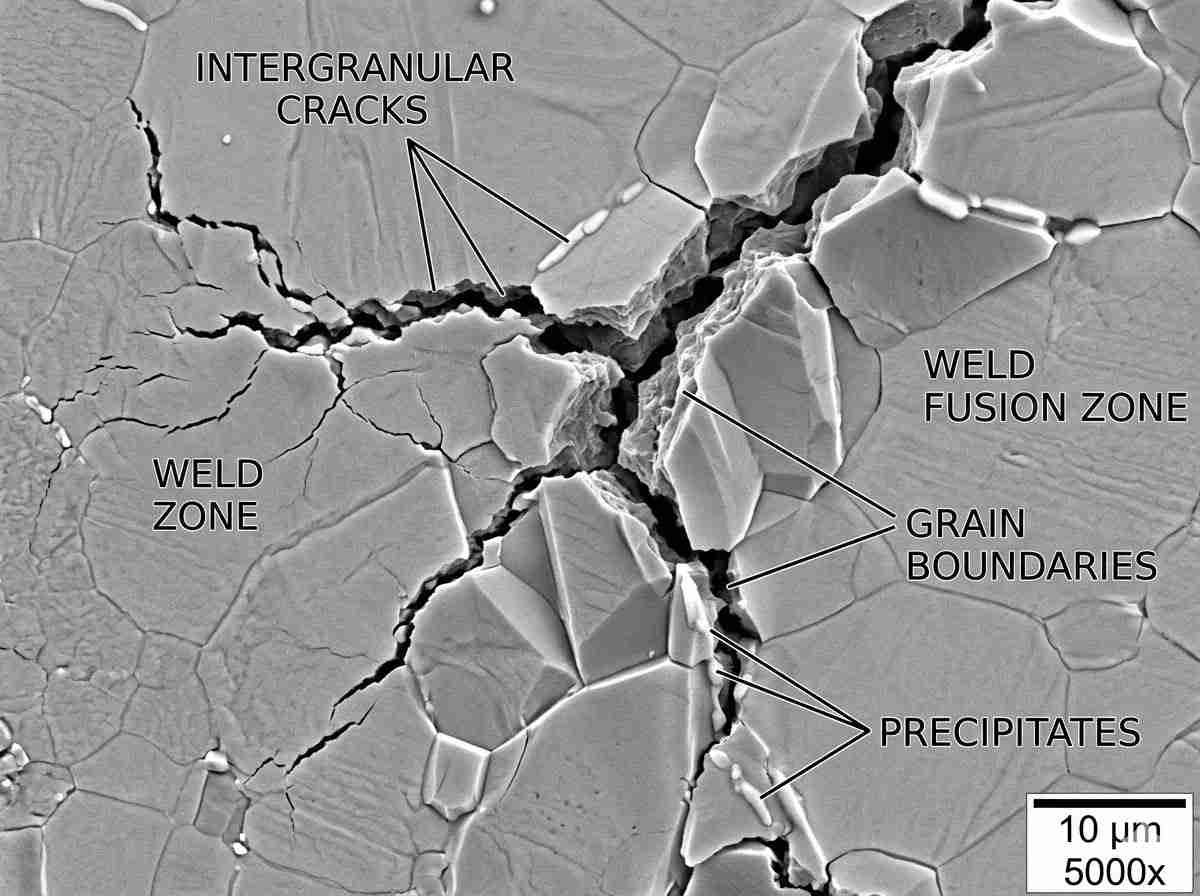
Engineers must carefully audit the heat treatment history of the chosen nickel alloy for high pressure applications. Improper solution annealing or aging profiles can lead to the formation of detrimental delta () phase or brittle Laves phases at the grain boundaries. These continuous precipitate chains drastically reduce impact toughness (measured via Charpy V-notch testing) and create localized elemental depletion zones, making the alloy highly vulnerable to intergranular attack exactly where the mechanical stress concentrates. The material specification must dictate precise thermal processing controls to guarantee the microstructure adequately supports the macro-mechanical pressure boundary.
Whether designing subsea manifolds, supercritical water reactors, or extreme chemical synthesis autoclaves, the ultimate safety factor depends entirely on accurate, empirically verified metallurgical data. Relying on a properly vetted nickel alloy for high pressure applications ensures that the von Mises stresses acting on the structural component remain safely within the elastic region of the material, even after thousands of hours of continuous operation.
Engineering Your Pressure Boundary
Mitigating risk in heavy industry demands structural materials that perform predictably under extreme, combined mechanical and environmental loads. The specification of a nickel alloy for high pressure applications is a highly complex balancing act between yield strength, phase stability, and resistance to environmental cracking. At 28Nickel, our engineering team collaborates deeply with structural designers to align metallurgical properties with your exact operational envelope. If you are currently navigating material selection for high-stress fluid containment, reach out to our technical team to discuss microstructural analysis, load-bearing capacities, and tailored alloy solutions for your next critical project.
Questions et réponses connexes
Q1: How does the gamma double-prime () phase affect the yield strength of a nickel alloy for high pressure applications?
A1: The phase () forms coherent, disk-shaped precipitates within the austenitic matrix during the controlled aging process. These precipitates create localized strain fields that severely restrict dislocation glide under physical load. In a nickel alloy for high pressure applications like Alloy 718, this specific mechanism is responsible for doubling or even tripling the yield strength compared to its annealed state, allowing it to withstand extreme pressure containment requirements without plastic deformation.
Q2: Why is NACE MR0175 compliance critical when selecting materials for sour gas environments?
A2: NACE MR0175 dictates the maximum hardness and specific heat treatment conditions allowable to prevent Sulfide Stress Cracking (SSC) in environments containing hydrogen sulfide (). Even ultra-high-strength structural materials will fail catastrophically under high pressure if hydrogen embrittlement occurs at the grain boundaries. Compliance ensures the microstructure of the chosen alloy is inherently resistant to this environmentally assisted cracking mechanism.
Q3: Can cold-working replace precipitation hardening in high-stress containment designs?
A3: Yes, but with strict thermal limitations. Solid-solution alloys like Inconel 625 can be heavily cold-worked to increase their yield strength significantly, making them suitable for certain high-pressure tubulars. However, cold-worked strength drops off sharply at elevated temperatures (typically above 400°C) as the material undergoes stress relaxation and recrystallization, whereas precipitation-hardened alloys maintain their engineered strength at much higher thermal thresholds.