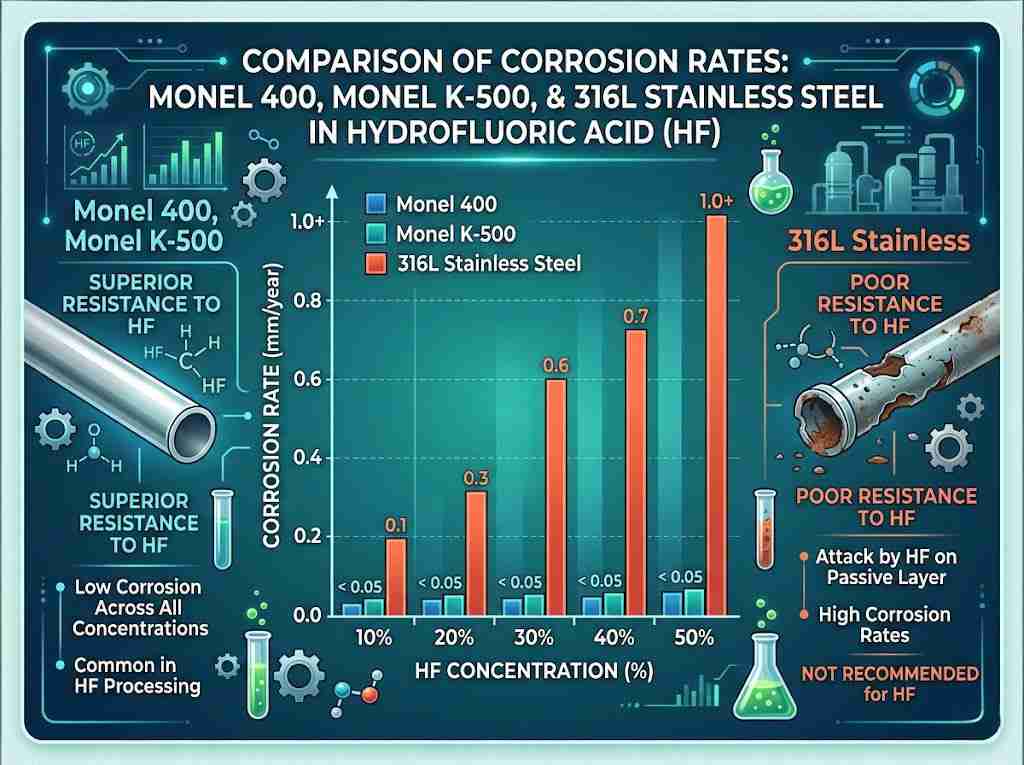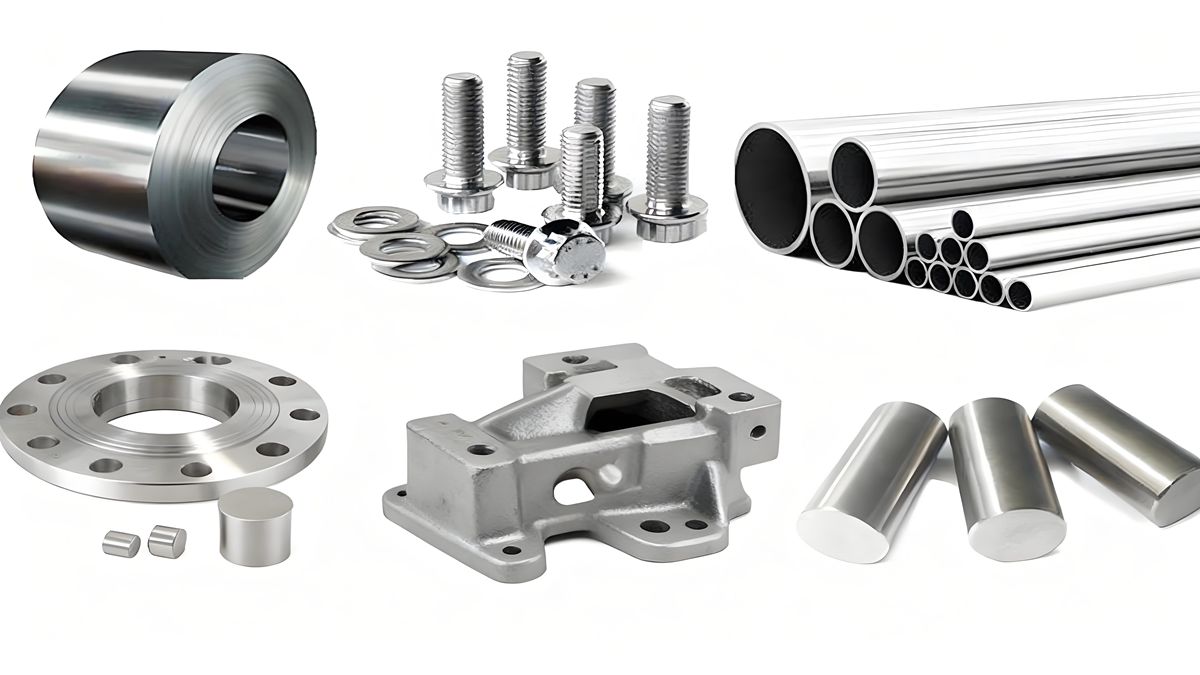
Engineers frequently face the dilemma of specifying the optimal superalloy for severe industrial environments. The debate of Monel vs Inconel is a constant material engineering challenge. Both nickel-based alloy families offer exceptional resistance to degradation, but their underlying metallurgical mechanisms and thermal boundaries differ significantly. Specifying the wrong matrix can lead to rapid localized pitting, galvanic corrosion, or stress corrosion cracking (SCC) under load. Let us examine the core differences in their phase stability and chemical profiles to ensure structural integrity and prevent costly process interruptions.
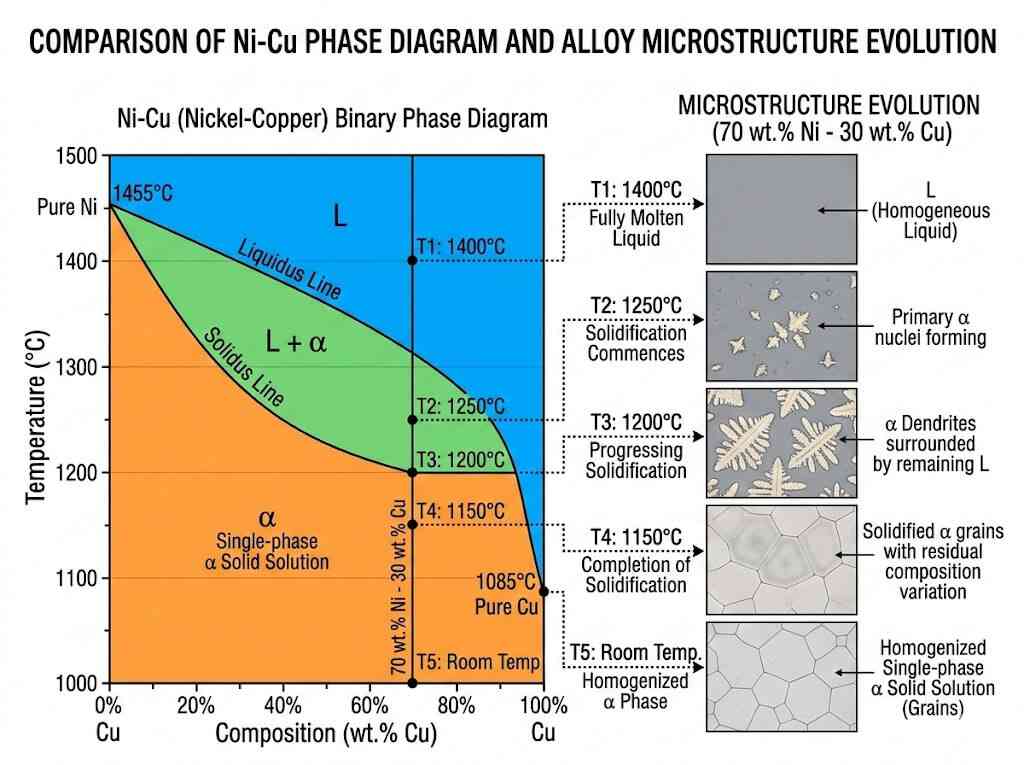
Phase Stability and Chemical Composition
The fundamental variance between these alloys lies in their primary alloying elements. Monel is essentially a nickel-copper solid solution (typically 63% Ni, 30% Cu). It is a single-phase alloy that relies on solid-solution strengthening, making it remarkably stable in reducing environments. The high copper content provides near immunity to chloride-ion SCC.
Conversely, Inconel relies on a nickel-chromium base. Depending on the specific grade, it achieves mechanical strength either through solid-solution mechanisms or precipitation hardening via $\gamma^\prime$ e $\gamma^{\prime\prime}$ phases. The heavy chromium addition generates a passive, self-repairing oxide layer, ensuring high integrity in oxidizing atmospheres.
| Property/Metric | Monel 400 | Inconel 625 |
| Primary Base Elements | Nichel, rame | Nichel, cromo, molibdeno |
| Strengthening Mechanism | Soluzione solida | Soluzione solida |
| Max Operating Temp | 480°C (900°F) | 982°C (1800°F) |
| Yield Strength (Typical) | 240 MPa | 414 – 517 MPa |
| Il migliore per | Reducing acids, flowing seawater | High-temp oxidation, sour gas |
Application Engineering and Yield Resistance
Application engineering requires looking at specific failure modes. Monel excels in deaerated hydrofluoric acid, high-concentration alkalines, and fast-flowing marine environments. However, in highly oxidizing liquids like nitric acid, evaluating a Monel vs Inconel substitution is unnecessary; Monel’s copper content becomes a distinct liability, leading to rapid material dissolution.
Inconel alloys, fortified with molybdenum and niobium, withstand severe pitting in sour gas (H₂S) environments. The strength retention of Inconel at cryogenic temperatures and extreme thermal loads makes it the default for aerospace turbine blades and chemical reactor cores. Thermal cycling often dictates the final decision; Monel’s mechanical yield strength drops off sharply above 480°C, whereas Inconel maintains its structural matrix.
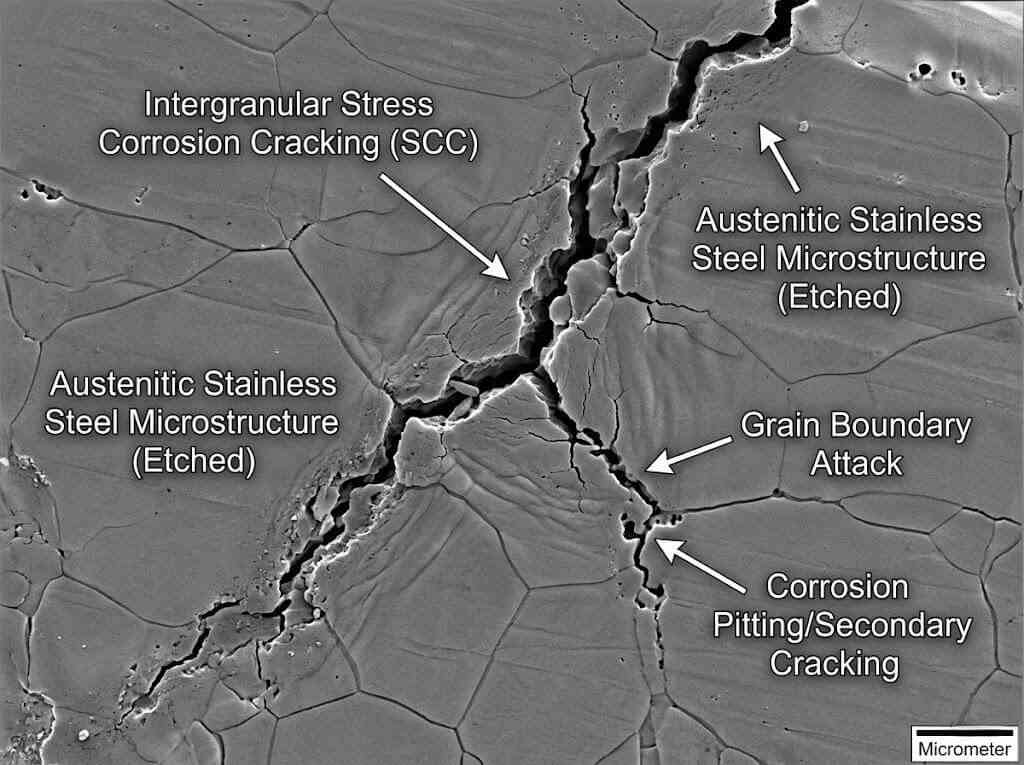
Specifying the correct metallurgy requires rigorous analysis of your precise operating envelope. You must account for baseline chloride concentration, process pH, thermal cycling parameters, and fluid velocity. A theoretical understanding of Monel vs Inconel is only the baseline; empirical testing and exact material grade matching are where true operational reliability is achieved. At 28Nickel, our materials engineering team works directly with your schematics to specify the exact grade needed for your demanding process parameters.
Domande e risposte correlate
1. Is Monel physically harder than Inconel?
Generally, no. While both can be work-hardened, precipitation-hardened Inconel grades (like 718) exhibit significantly higher hardness and tensile strength than Monel alloys due to the formation of microscopic precipitates in the crystal lattice.
2. Why does Monel fail rapidly in highly oxidizing acids?
Monel lacks chromium. Without chromium to form a protective passive oxide layer, the high copper content in Monel reacts aggressively with oxidizing agents (like nitric or chromic acid), causing the metal matrix to dissolve rapidly.
3. Can Inconel be welded directly to Monel components?
Yes, dissimilar metal welding is possible, but it requires careful filler metal selection. Typically, a highly alloyed nickel filler, such as ERNiCrMo-3 (Inconel 625 filler), is chosen to ensure a robust, crack-free metallurgical bond and a matched thermal expansion coefficient.