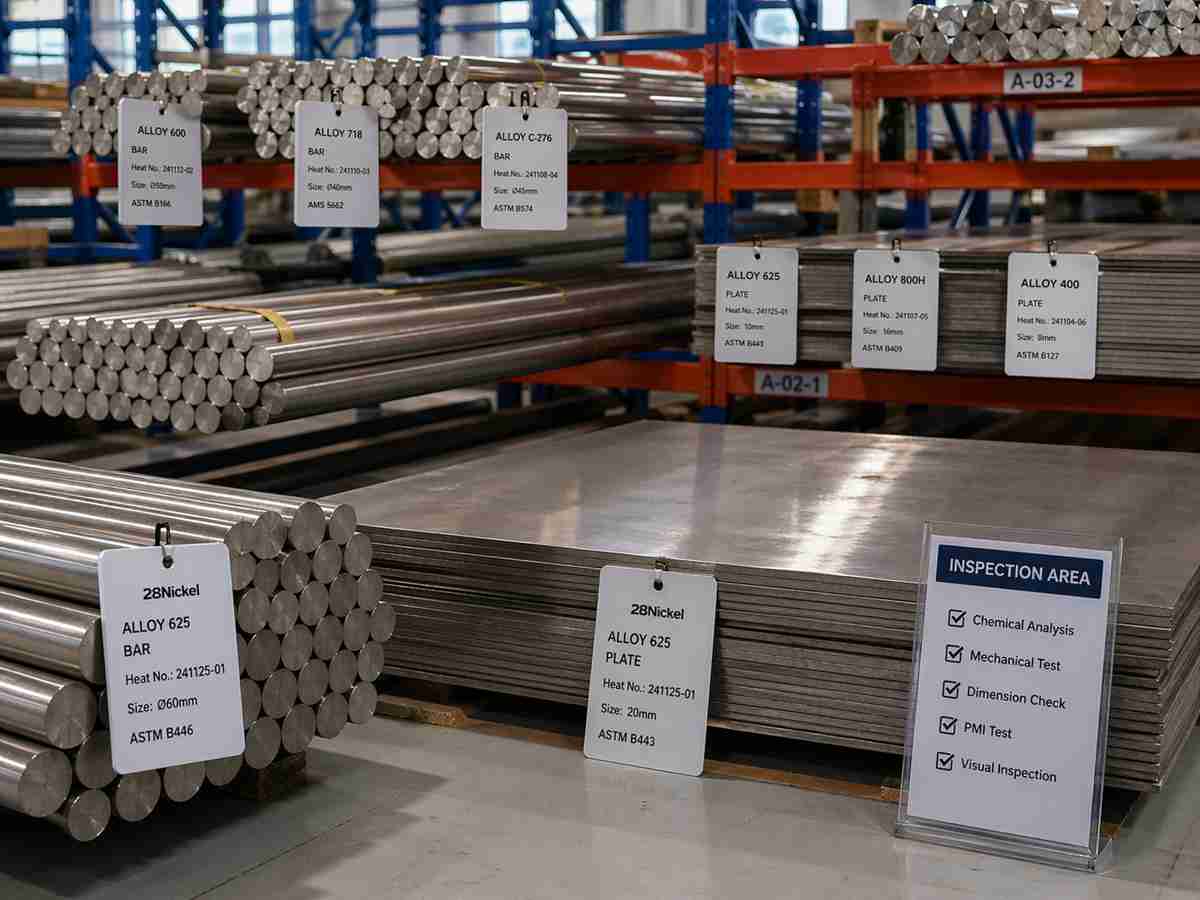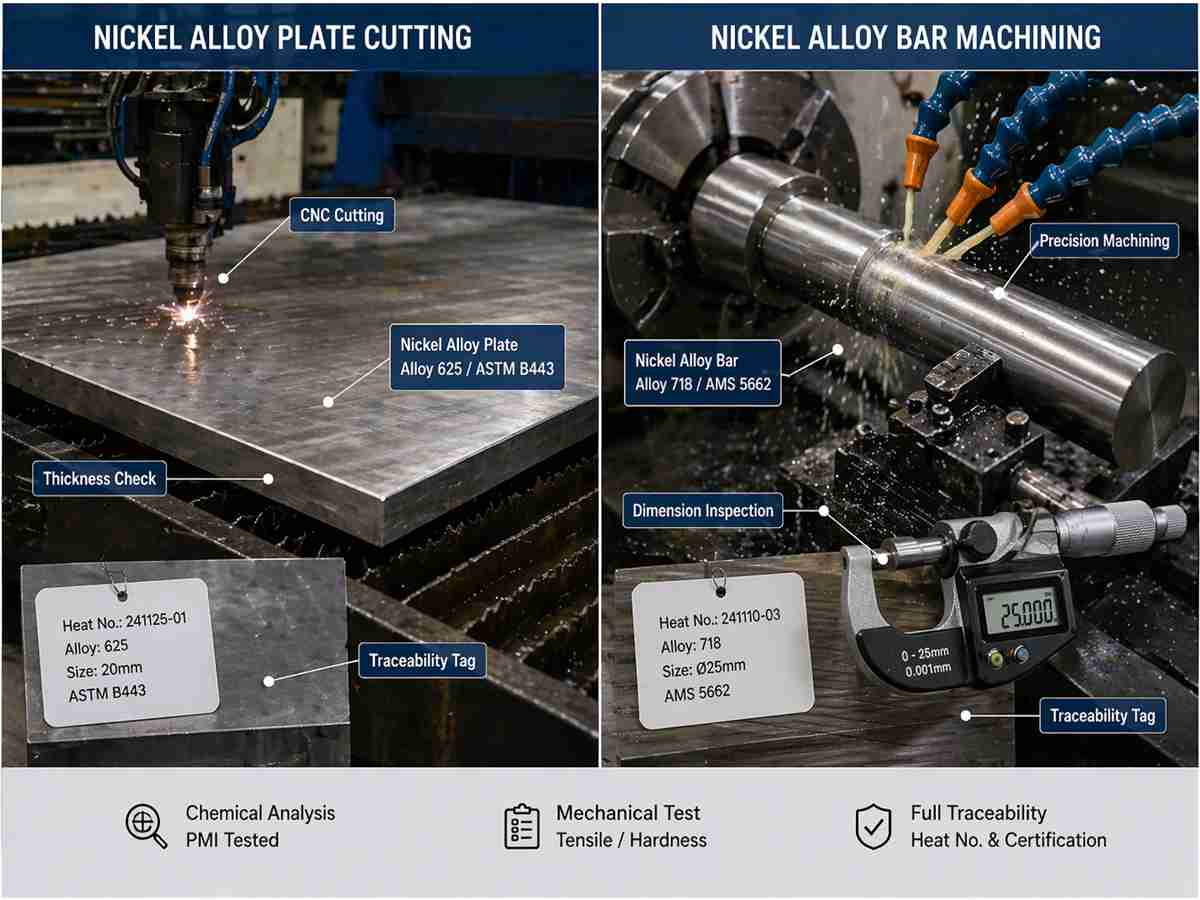










In real projects, material selection is rarely the only problem. Delivery discipline often decides whether a shutdown stays on plan, whether a pressure part gets released on time, and whether procurement avoids a very expensive substitution loop. That is why many engineers and buyers do not simply look for a stockist; they look for a nickel alloy bar and plate supplier with fast delivery that can combine inventory depth, grade knowledge, and documentation control.
について ニッケル合金, the supply question is more technical than it appears. A bar or plate is not interchangeable just because the UNS number looks close. Heat treatment condition, thickness route, grain structure, mechanical-property window, and corrosion-service fit all matter. A capable nickel alloy bar and plate supplier with fast delivery should therefore do more than quote a price. The supplier should help reduce engineering uncertainty before the material enters fabrication.

Why fast delivery matters in nickel alloy procurement
Nickel alloys are typically specified for conditions where failure is not tolerable: chloride-bearing media, sour service, elevated temperature oxidation, caustic systems, reducing acids, mixed-acid environments, or high-pressure equipment. In those applications, delays cascade quickly. A late plate can block cutting, forming, WPS qualification, and final assembly. A late bar can stop machining of stems, shafts, ファスナー, nozzles, or precision support components.
This is where a nickel alloy bar and plate supplier with fast delivery creates real value. Speed is not only about shipping the same day. It is about delivering technically correct material, in the required size range, with traceable MTCs, and with enough communication discipline to support quality teams. When engineers are forced to re-check chemistry, mechanicals, or product form because the supplier is vague, the “fast” quotation becomes a slow project.
From a materials-engineering standpoint, stock availability is especially important for grades such as Alloy 400, Alloy 600, Alloy 625, Alloy 718, Alloy 800H/HT, C-276, and certain duplex-adjacent corrosion-resistant materials that are stocked for cross-industry use. A practical nickel alloy bar and plate supplier with fast delivery understands which grades move by petrochemical demand, which sizes are mill-only, and which dimensions are most likely to trigger long lead times.
What engineers should verify before ordering bar or plate
First, confirm the specification route. Many procurement mistakes start when a buyer requests “625 plate” without confirming whether the job requires ASTM B443, ASME SB443, NACE-related review, or additional project-specific testing. For bar, the same problem occurs with machining stock when straightness, hardness range, ultrasonic testing, or cold-finished condition was never aligned.
Second, verify form-dependent properties. Plate behavior during forming and welding is different from bar behavior during machining and stress redistribution. A reliable nickel alloy bar and plate supplier with fast delivery should be able to explain not only the nominal alloy, but also the practical implications of supply condition, especially for downstream fabrication.
Third, ask how traceability is maintained after cutting. In many export orders, customers need cut pieces rather than full plates or full-length bars. That sounds simple, but remarking discipline, label retention, and certificate mapping become critical. A professional nickel alloy bar and plate supplier with fast delivery should have a clear process for heat-number transfer and release documents.
Typical technical checkpoints when evaluating a supplier
| Evaluation Item | Why It Matters in Nickel Alloys | What a Strong Supplier Should Provide |
|---|---|---|
| Grade and UNS accuracy | Similar trade names can cause ordering errors | Clear grade/UNS/standard cross-reference |
| Product form control | Bar and plate follow different processing routes | Product-specific technical confirmation |
| Heat traceability | Critical for QA release and end-user audits | MTCs linked to heat number and cut pieces |
| Size availability | Non-standard thickness or diameter adds lead time | Stock list transparency and realistic lead-time advice |
| Condition and testing | Annealed, cold-finished, UT, PMI may be required | Optional testing with stated scope |
| Export documentation | Delays often occur at document-review stage | Packing list, invoice, COO, MTCs, marking photos |
| Response quality | Technical ambiguity creates rework | Clear answers from engineering-aware sales staff |
A buyer may think price is the main screening variable. In reality, total procurement cost includes delay exposure, fabrication disruption, document resubmission, and the risk of receiving material that is technically compliant on paper but unsuitable in use. That is why the best nickel alloy bar and plate supplier with fast delivery is usually the one that shortens the full approval cycle, not just the transit time.
How stock range affects real delivery performance
Not all “fast delivery” claims mean the same thing. Some traders rely almost entirely on back-to-back mill orders. That model may work for standard stainless products, but for nickel alloys it often fails when the project needs immediate cutting stock, odd sizes, or mixed-item consolidation. A serious nickel alloy bar and plate supplier with fast delivery usually keeps a targeted inventory strategy: common corrosion-resistant grades in commercially useful diameters and thicknesses, plus relationships with processors for sawing, waterjet cutting, leveling, and surface finishing.
This matters because nickel alloy projects are frequently mixed-form orders. A single package may require plate for welded structures and bar for machined fittings or support parts. Coordinating those items through one nickel alloy bar and plate supplier with fast delivery reduces document fragmentation and simplifies technical communication.
There is also the issue of replacement sourcing. During maintenance or shutdown work, original OEM lead times are often unacceptable. Engineers then need equivalent 製品フォーム with verified chemistry and property compliance. In that scenario, the supplier’s value lies in responsiveness, but also in caution. A credible nickel alloy bar and plate supplier with fast delivery will not casually recommend substitutions without checking code, service environment, and fabrication route.

Choosing a supplier for long-term project support
For serious buyers, the question is not only “Can you ship quickly?” but “Can you ship correctly, repeatedly, and with technical confidence?” That is the standard a nickel alloy bar and plate supplier with fast delivery must meet. In practice, the strongest suppliers help customers align grade, form, certification, and delivery plan before the PO becomes a problem.
At 28Nickel, that is the conversation worth having. If your team is comparing Alloy 625 plate versus C-276 plate for corrosion service, or deciding whether a machined bar component needs tighter property verification, a technical discussion early in the sourcing cycle usually saves more time than any expedited freight later.
関連Q&A
Q1: What documents should I request when buying nickel alloy bar and plate for export projects?
At minimum, request the Mill Test Certificate, heat-number traceability, product marking details, dimensions, quantity list, and any agreed supplementary tests such as PMI, UT, or hardness. For code-driven projects, confirm the exact ASTM/ASME designation before release.
Q2: Why does nickel alloy plate sometimes have a much longer lead time than bar?
Plate availability depends heavily on rolling schedule, thickness range, and whether the item is stocked or mill-produced. Bars in common diameters may be more readily available, while non-standard plate thicknesses often require mill planning and therefore longer lead times.
Q3: Can a fast-delivery supplier also help with alloy selection?
A good one should. A competent supplier can narrow options based on corrosion mechanism, operating temperature, fabrication method, and documentation requirements, while still making clear that final material approval remains with the customer or project engineer.