When selecting materials for extreme environments, engineers consistently turn to nickel-based superalloys. Among these, インコネル625 properties stand out as a benchmark for versatility, offering a unique combination of high strength, excellent fabricability, and superior corrosion resistance. Developed in the 1960s, this alloy has become a cornerstone in aerospace, marine, and chemical processing industries. In this comprehensive guide, we will analyze the technical nuances of Inconel 625 properties to help you understand why it remains the preferred choice for critical components.
Chemical Composition and Its Impact on Inconel 625 Properties
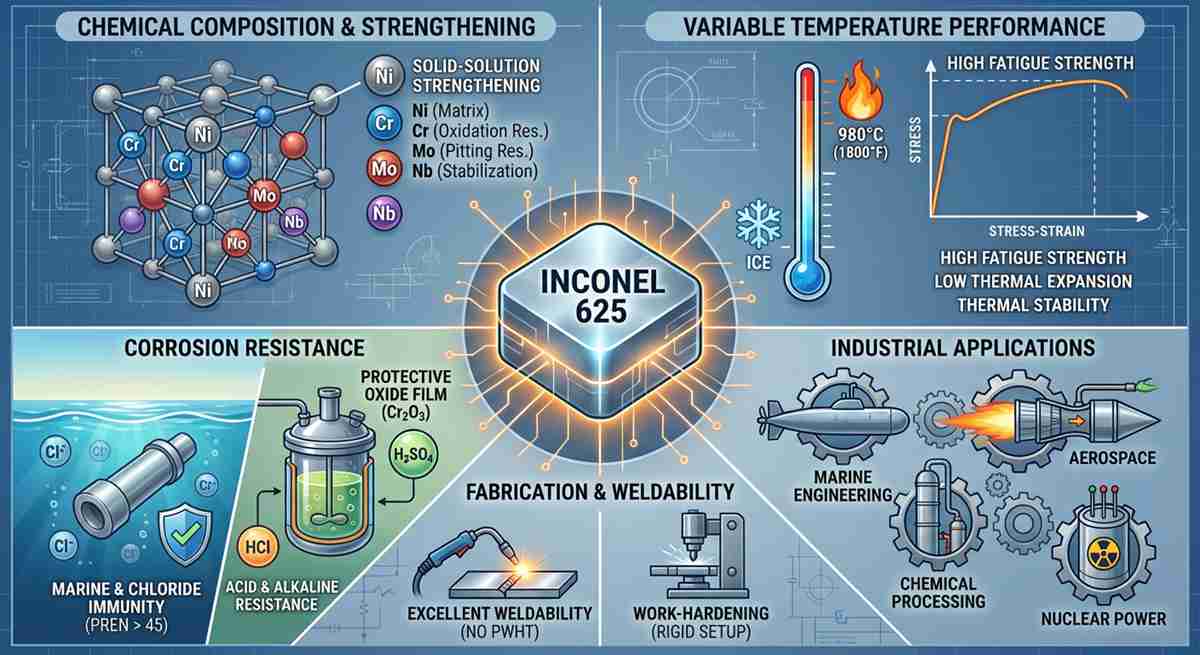
The remarkable performance of Alloy 625 is a direct result of its sophisticated chemistry. Unlike many other superalloys, it is not primarily strengthened by precipitation hardening (gamma prime). Instead, its strength is derived from the solid-solution strengthening effect of molybdenum and niobium within the nickel-chromium matrix.
| エレメント | コンテンツ(%) | Role in Alloy Performance |
| ニッケル(Ni) | 58.0分 | Provides the stable FCC matrix and high-temperature resistance. |
| クロム(Cr) | 20.0 - 23.0 | Enhances oxidation and high-temperature corrosion resistance. |
| モリブデン (Mo) | 8.0 - 10.0 | Contributes to solid-solution strengthening and pitting resistance. |
| ニオブ (Nb) + Ta | 3.15 - 4.15 | Stabilizes the alloy against sensitization during welding. |
| 鉄(Fe) | 最大5.0 | Maintains cost-effectiveness while allowing for structural integrity. |
Mechanical Inconel 625 Properties at Variable Temperatures
One of the most defining Inconel 625 properties is its ability to maintain high mechanical integrity across a wide temperature spectrum—from cryogenic temperatures to over ().
At room temperature, the alloy exhibits a minimum yield strength of approximately () and a tensile strength exceeding (). What makes it truly exceptional is its fatigue strength. The interaction between molybdenum and niobium effectively distorts the crystal lattice, making it incredibly difficult for dislocations to move, even under high-stress cycles. This resistance to fatigue is a key reason why it is used in bellows, expansion joints, and aircraft exhaust systems.
Corrosion Resistance: A Core Pillar of Inconel 625 Properties
In aqueous environments, Inconel 625 properties provide nearly unmatched protection. The high molybdenum content yields a high Pitting Resistance Equivalent Number (PREN), typically above 45. This ensures that the material remains immune to chloride-induced pitting and crevice corrosion, which are common failures for standard stainless steels in seawater.
Furthermore, the chromium content forms a tenacious protective oxide film (). This film prevents oxidation and carburization at elevated temperatures. Because the alloy is stabilized by niobium, it resists intergranular corrosion even after being subjected to the heat-affected zone (HAZ) during welding processes.
Thermal and Physical Inconel 625 Properties
For heat exchange applications, understanding thermal Inconel 625 properties is vital. The alloy has a melting range of . Its coefficient of thermal expansion is relatively low compared to other ニッケル合金, which reduces the risk of thermal fatigue during rapid heating and cooling cycles.
-
Density:
-
Specific Heat: (at )
-
磁気透過性: (Essentially non-magnetic, ideal for sensitive electronics).
Industrial Applications Driven by Inconel 625 Properties
The diverse range of Inconel 625 properties translates into broad industrial utility:
-
Marine Engineering: Used for propeller blades, submarine quick-disconnect fittings, and exhaust ducts due to its immunity to seawater and “sea-air” environments.
-
Aerospace: High fatigue strength makes it ideal for engine exhaust systems, fuel lines, and turbine shroud rings.
-
Chemical Processing: Excellent for handling highly corrosive acids (hydrochloric, sulfuric, and phosphoric) and alkaline media.
-
Nuclear Power: Used in reactor core components and control rod mechanisms where high strength and radiation resistance are required.
加工と溶接性
A common concern when discussing Inconel 625 properties is how the material handles manufacturing. Fortunately, Alloy 625 is highly weldable. It does not require post-weld heat treatment (PWHT) to maintain corrosion resistance. It can be joined using GTAW (TIG), GMAW (MIG), and SMAW methods. However, due to its high work-hardening rate, machining requires rigid setups, sharp tools, and slow speeds to prevent tool chatter and premature wear.
結論
In summary, the synergy of nickel, chromium, molybdenum, and niobium creates a material that thrives where others fail. Whether you are dealing with the corrosive depths of the ocean or the intense heat of a jet engine, Inconel 625 properties offer a reliable, long-term solution. For high-quality nickel alloy procurement, 28Nickel provides the expertise and inventory to support your most demanding projects.
関連Q&A
1. Is Inconel 625 stronger than インコネル718?
While Inconel 625 properties offer excellent strength, Inconel 718 is generally stronger at temperatures below because it is precipitation-hardened. However, 625 offers better weldability and superior corrosion resistance in specific acidic environments.
2. Can Inconel 625 be used in sour gas environments?
Yes. Due to its high nickel and molybdenum content, it is highly resistant to sulfide stress cracking and hydrogen embrittlement, making it a top choice for “downhole” oil and gas applications.
3. Does Inconel 625 rust?
No, in the traditional sense. It forms a protective passive layer that prevents iron-oxide (rust) formation. Even in harsh saltwater, it exhibits a negligible corrosion rate.