When it comes to extreme environments—where temperatures soar and corrosive elements threaten structural integrity—few materials command as much respect as Inconel. Developed to withstand conditions that would cause ordinary steel to fail, the various inconel alloy grades represent a family of nickel-chromium-based superalloys designed for high-performance applications. At 28Nickel, we understand that selecting the right grade is not just about cost; it is about ensuring the safety and longevity of critical infrastructure in aerospace, chemical processing, and marine engineering.
Understanding the Chemistry of Inconel Alloy Grades
The “secret sauce” of Inconel lies in its austenitic crystal structure. Most inconel alloy grades contain a high percentage of nickel, typically combined with chromium and iron. This combination creates a thick, stable, Passivating oxide layer when heated, which protects the metal from further attack. Unlike many metals that lose strength as they approach their melting points, Inconel maintains its mechanical properties across a vast thermal range, from cryogenic temperatures to well over .
Deep Dive into Popular Inconel Alloy Grades
To navigate the market effectively, one must understand that each of the inconel alloy grades is tailored for specific stressors. Here, we break down the most commonly utilized variants in the industry today.
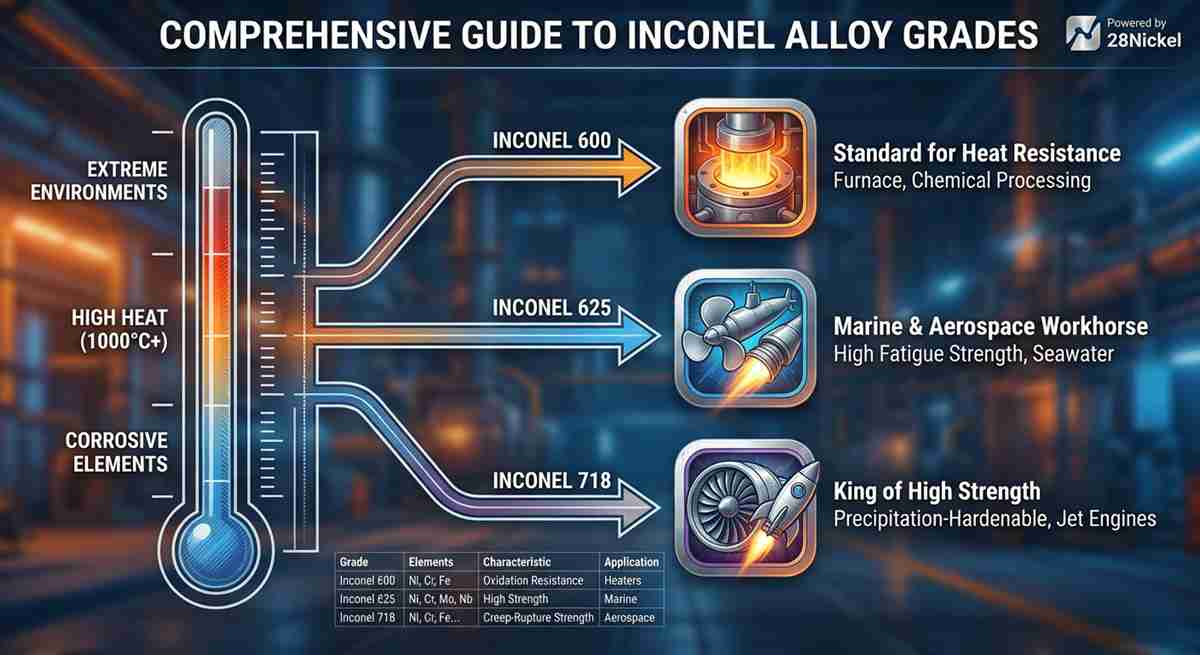
Inconel 600: The Standard for Heat Resistance
インコネル 600 is the “foundational” member of the family. It is primarily used for its resistance to oxidation and chloride-ion stress corrosion cracking. Because it maintains high strength at elevated temperatures, it is a staple in furnace components and chemical processing equipment.
Inconel 625: The Marine and Aerospace Workhorse
What sets 625 apart from other inconel alloy grades is the addition of molybdenum and niobium. These elements stiffen the alloy’s matrix, providing high strength without the need for heat treatment. Its fatigue strength and resistance to seawater make it the go-to choice for naval exhaust systems and underwater cabling.
Inconel 718: The King of High Strength
If you are looking for the most versatile of all inconel alloy grades, 718 is the answer. It is a precipitation-hardenable alloy, meaning it can be strengthened through a specific aging process. It is used extensively in jet engines and high-speed airframe parts because it can handle temperatures up to while maintaining incredible tensile and impact strength.
Comparing Key Inconel Alloy Grades
Choosing between these materials requires a side-by-side comparison of their chemical footprints and primary uses. The following table summarizes the core differences:
| グレード | 主な合金元素 | 主な特徴 | 一般的なアプリケーション |
| インコネル 600 | Ni、Cr、Fe | 耐高温酸化性 | Heat treat muffles, heaters |
| インコネル601 | Ni, Cr, Al | Superior resistance to spalling | Gas-turbine components |
| インコネル625 | Ni、Cr、Mo、Nb | High fatigue strength & pitting resistance | Marine engineering, Flare stacks |
| インコネル718 | Ni, Cr, Fe, Nb, Mo | 優れたクリープ破断強度 | Jet engines, Liquid rocket fuel |
| インコネル X-750 | Ni、Cr、Ti、Al | Resistance to relaxation | Springs, Gas turbine rotors |
Why Precision Matters in Selecting Inconel Alloy Grades
At 28Nickel, we often encounter clients who struggle with “over-engineering.” While it might be tempting to always choose Inconel 718 for its strength, it is significantly harder to machine than Inconel 600. Miscalculating the specific requirements of your project can lead to unnecessary costs or premature component failure.
The diversity of inconel alloy grades ensures that there is a solution for nearly every corrosive or thermal challenge. Whether you are dealing with the highly acidic environments of a pharmaceutical plant or the high-pressure demands of a deep-sea oil rig, there is a specific nickel alloy chemistry designed to thrive where others perish.
Future Trends in Inconel Utilization
As additive manufacturing (3D printing) continues to evolve, we are seeing a surge in the use of powdered inconel alloy grades. Inconel 718, in particular, has become a favorite for 3D-printed aerospace components, allowing for complex geometries that were previously impossible to cast or machine. This technological leap is making these high-cost alloys more efficient to use, as “buy-to-fly” ratios improve and material waste is minimized.
関連Q&A
Q1: Which of the inconel alloy grades is best for welding?
A: Inconel 625 is generally considered the most weldable. Unlike 718, which can be prone to cracking in the heat-affected zone if not handled carefully, 625 offers excellent weldability and is often used as a filler metal for cladding or joining dissimilar metals.
Q2: How do inconel alloy grades differ from Monel?
A: The primary difference lies in the alloying elements. While Inconel is a nickel-chromium alloy designed for high-temperature and oxidative environments, Monel is a nickel-copper alloy designed for high-strength resistance to seawater and acids at lower temperatures.
Q3: Is Inconel 718 magnetic?
A: No, like most high-nickel inconel alloy grades, Inconel 718 is non-magnetic under standard conditions. This makes it ideal for specialized electronic equipment and instrumentation where magnetic interference must be avoided.