









PMI tested nickel alloy bars and tubes are often specified only after a fabricator has already suffered through one expensive material mix-up. ニッケル合金 that look almost identical on a rack can behave very differently in service. Substituting Alloy 600 for 625, confusing 825 with a stainless grade, or blending different corrosion-resistant heats into one fabrication lot can destroy welding plans, trigger NCRs, and force a customer to stop work while the material is sorted out again. That is why PMI tested nickel alloy bars and tubes are not merely a quality upgrade for critical jobs; they are a practical barrier against avoidable rework.
Bars and tubes deserve special attention because they are repeatedly cut, moved, bundled, and reassigned inside shops. Every handling step increases the chance that paint markings disappear or that one short remnant slips into the wrong bundle. Once a tube has been beveled or a round bar has been machined into fittings, proving the original alloy family becomes more difficult and more costly. Specifying PMI tested nickel alloy bars and tubes at receiving, before issue to fabrication, and on high-risk cut pieces helps lock material identity in place while the evidence is still easy to capture.
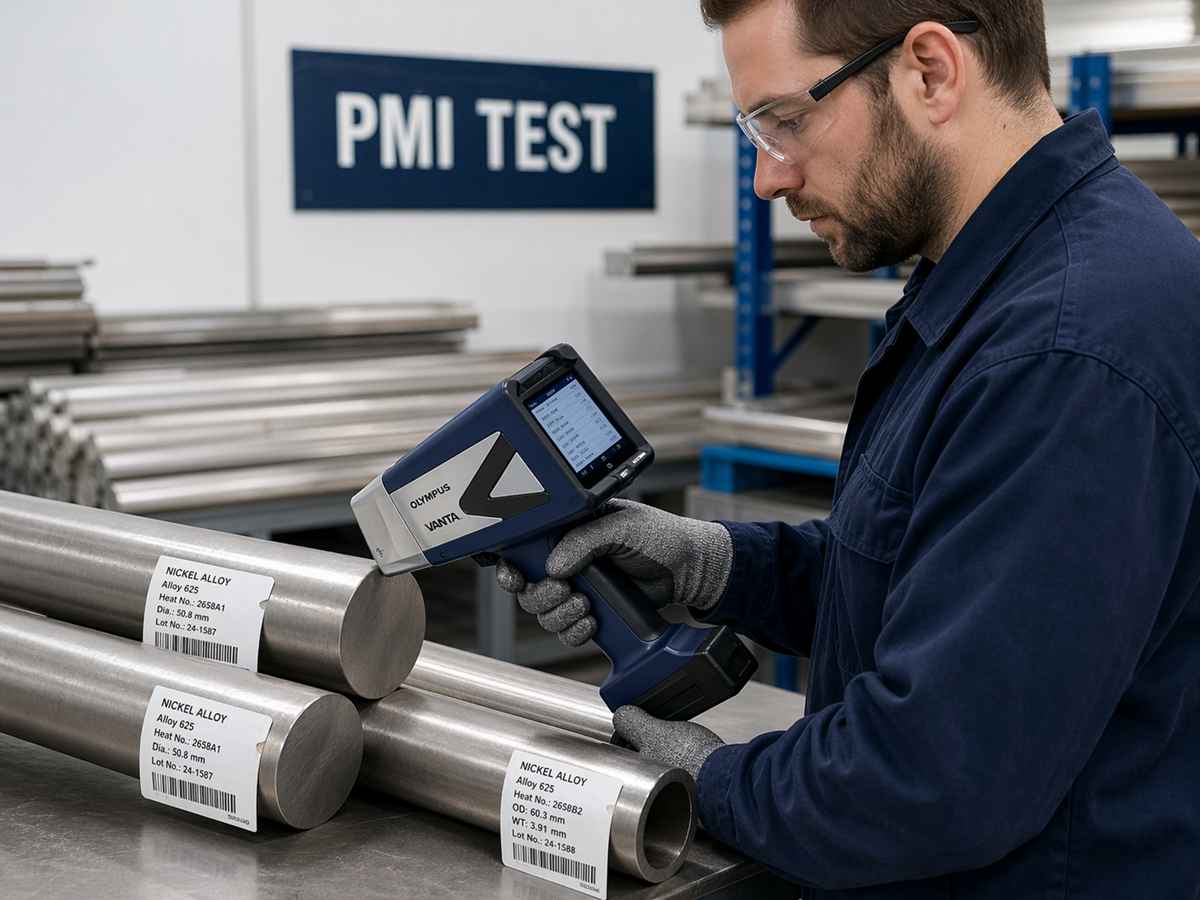
Suggested image: an engineer using a handheld XRF analyzer on tagged nickel alloy bars and tubes in a clean inspection area.

What PMI Testing Confirms in Nickel Alloy Bars and Tubes
Positive Material Identification is most useful when it is understood correctly. In day-to-day nickel alloy supply, handheld XRF is the common first-line tool because it can quickly read key alloying elements such as chromium, molybdenum, niobium, tungsten, copper, iron, and nickel. That makes it effective for sorting many commercial grades and checking whether delivered stock matches the expected alloy family. For example, PMI tested nickel alloy bars and tubes can quickly reveal whether a bundle labeled as Alloy 625 is behaving chemically more like Alloy 600 or whether a corrosion-resistant grade has been swapped with a lower-alloy substitute.
PMI still has limits. Standard XRF is not strong on light elements such as carbon, and it does not prove mechanical properties, grain structure, or heat-treatment condition. In some specifications, OES or laboratory wet chemistry is needed to verify elements that XRF cannot handle with enough precision. Serious buyers therefore use PMI tested nickel alloy bars and tubes as one layer in a broader control plan that also includes mill certificates, heat-number traceability, visual marking checks, and clear sampling rules. The reading itself matters, but just as important are surface cleanliness, calibration, the alloy library inside the instrument, and the discipline used to record where each test was taken.
| Method | Best at detecting | Main limitation | Best use in supply control |
| Handheld XRF | Major alloying elements such as Cr, Mo, Nb, W, Cu, Fe | Weak on light elements; does not prove heat treatment | Fast receiving checks and bundle sorting |
| OES | Broader chemistry including some light elements | More surface prep and more controlled operation | Higher-precision grade verification on critical lots |
| Laboratory chemistry | Definitive composition validation | Slow and more expensive | Dispute resolution and qualification cases |
When PMI Tested Nickel Alloy Bars and Tubes Reduce Real Risk
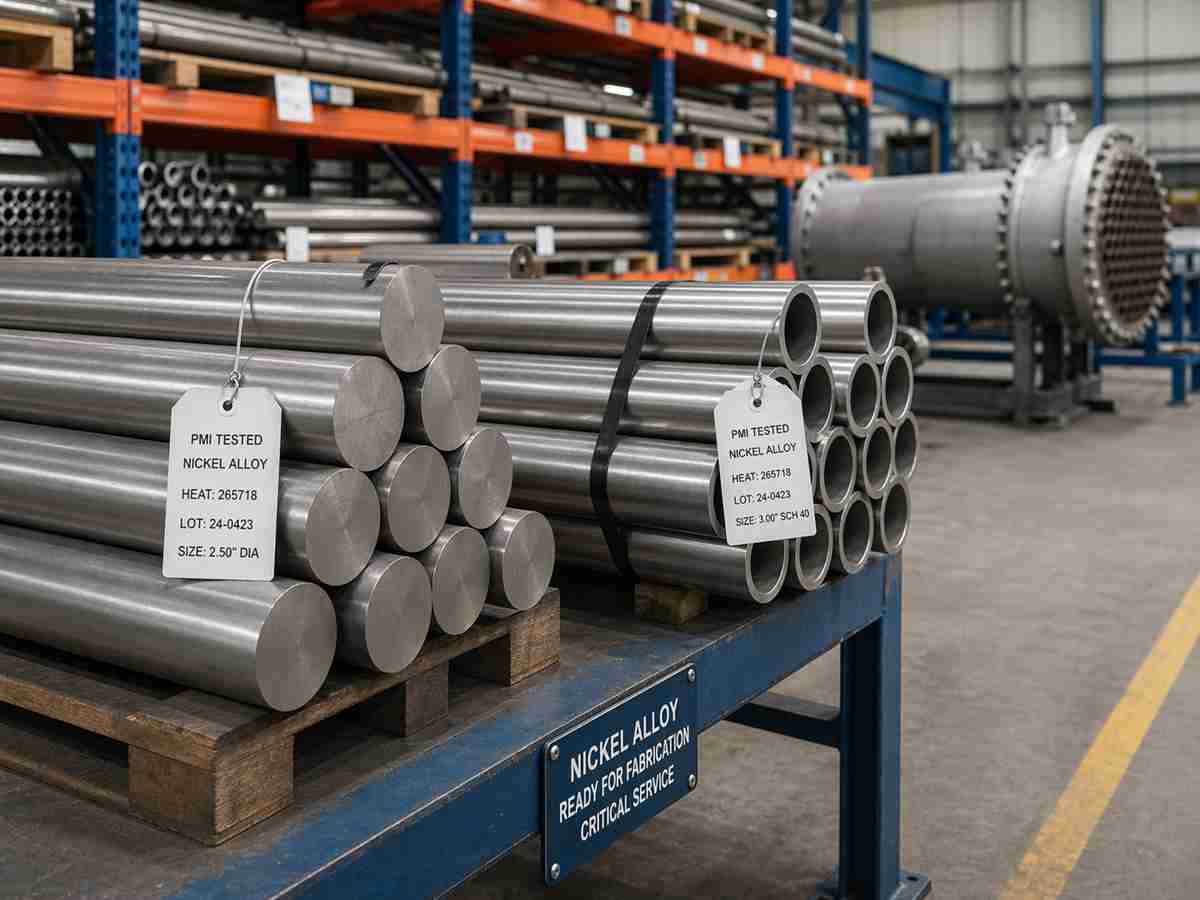
The strongest case for PMI tested nickel alloy bars and tubes appears when the material will feed machining, welded spools, heat exchanger work, or owner-witnessed packages. Cylindrical stock is particularly vulnerable to identity loss because offcuts and remnants can be physically similar even when the grades are not. A disciplined workflow will therefore test incoming bundles, preserve photo evidence of markings, and repeat PMI after cutting when short pieces are detached from the original bundle. For fabricated tube systems, it is also wise to connect the PMI record to spool or piece numbers so that documentation remains usable during final dossier review.
Buyers should ask suppliers how the PMI is performed, how many pieces per heat are sampled, and whether the report links the reading to the delivered bundle numbers or only to a generic order number. The best suppliers of PMI tested nickel alloy bars and tubes will share not just a pass statement but a readable test log, photos, and a clear explanation of any sampling logic. In mixed-grade warehouses, PMI tested nickel alloy bars and tubes are often the fastest way to stop a silent substitution before it reaches the welding bay. At 28Nickel, we normally recommend combining mill documentation with risk-based PMI on higher-value bars and tubes, especially when multiple grades are stored in one warehouse. That combination catches grade substitutions early, protects weld integrity, and prevents a small receiving problem from turning into a full fabrication shutdown.
Suggested image: a simple fabrication or receiving scene showing traceable nickel alloy bars and tubes prepared for machining or piping work.

結論
If the cost of one wrong alloy is high, PMI is cheap. The smartest place to spend that budget is before cutting, welding, and machining make traceability harder to recover. Properly specified PMI tested nickel alloy bars and tubes give buyers a compositional checkpoint exactly where mistakes are easiest to contain. If you want help defining a practical PMI scope for your nickel alloy order, 28Nickel can help map the inspection level to the real process risk instead of adding random tests that do not improve control.
関連Q&A
Q: Can PMI reliably distinguish Alloy 625 from Alloy 825?
Usually yes, because the nickel, chromium, molybdenum, niobium, and iron balance is different enough for a competent instrument and operator to separate the grades. The exact confidence still depends on surface condition, calibration, and the method used.
Q: Should every tube or bar be PMI tested?
Not always. The right sampling rate depends on service criticality, end-user requirements, warehouse mixing risk, and whether the supply chain is already tightly controlled. High-risk or mixed-grade stock deserves more coverage than routine replenishment from a tightly audited source.
Q: Does PMI replace corrosion testing or mechanical testing?
No. PMI tested nickel alloy bars and tubes verify composition identity, not long-term corrosion performance, tensile properties, impact values, or heat-treatment history. Those controls still require the proper mill data and, where needed, additional testing.