엔지니어가 다음을 비교할 때 Incoloy 800H vs Hastelloy C-22 for heat exchanger tubing, the real issue is rarely “which alloy is better” in a general sense. The harder question is which alloy gives the safer margin against the actual failure mechanism in service. In one plant, the dominant risk is chloride-driven localized corrosion. In another, it is creep rupture under prolonged exposure above 600°C. And in many procurement cases, the hidden problem is more basic: paying for a corrosion-resistant alloy when the duty is actually governed by high-temperature strength, or doing the opposite and underestimating a wet-side corrosion load that will attack tubing long before the design life is reached.
For heat exchanger tubing, material selection is never just a catalog exercise. Tube-side medium, shell-side contaminants, startup and shutdown transients, weldability, scaling tendency, carburization, sulfidation, and inspection strategy all affect the answer. That is why the Incoloy 800H vs Hastelloy C-22 for heat exchanger tubing comparison deserves a disciplined engineering review rather than a one-line substitution rule.
Incoloy 800H vs Hastelloy C-22 for Heat Exchanger Tubing: What Really Drives Selection?
At first glance, both are nickel-based alloys used in demanding process environments. That surface similarity causes confusion. But their design logic is different.
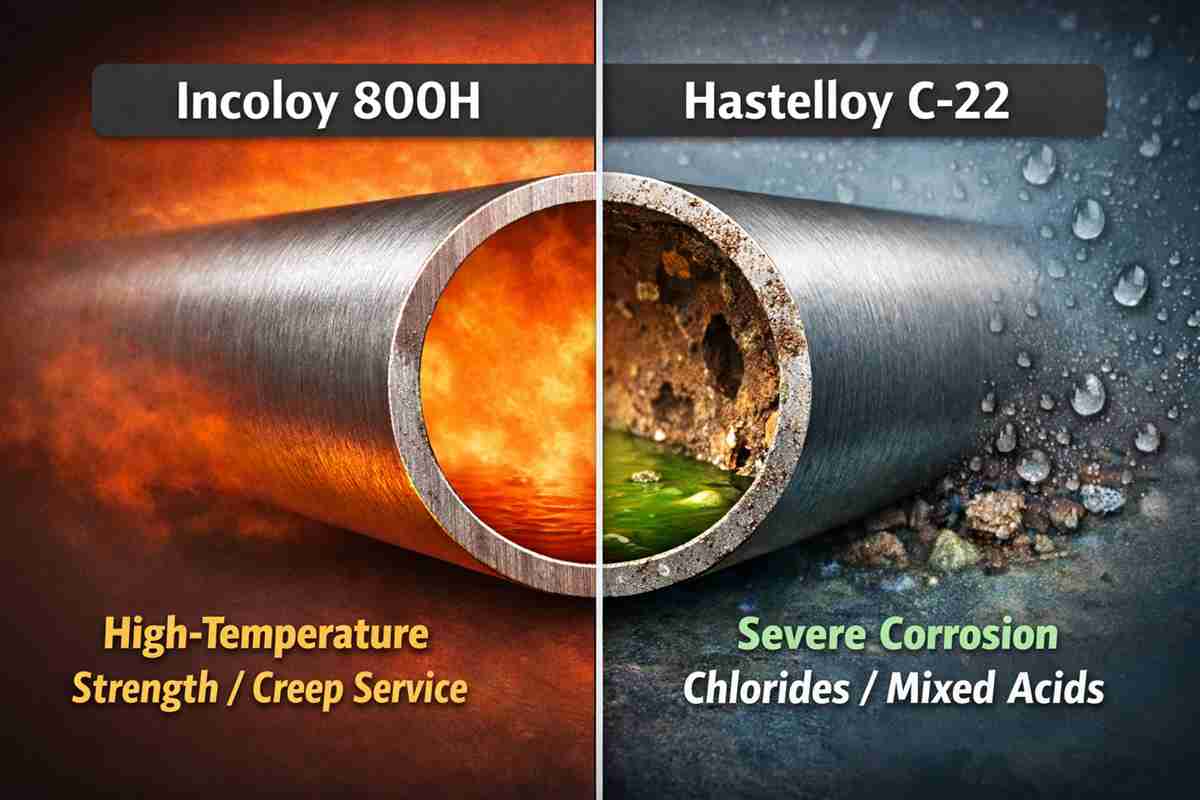
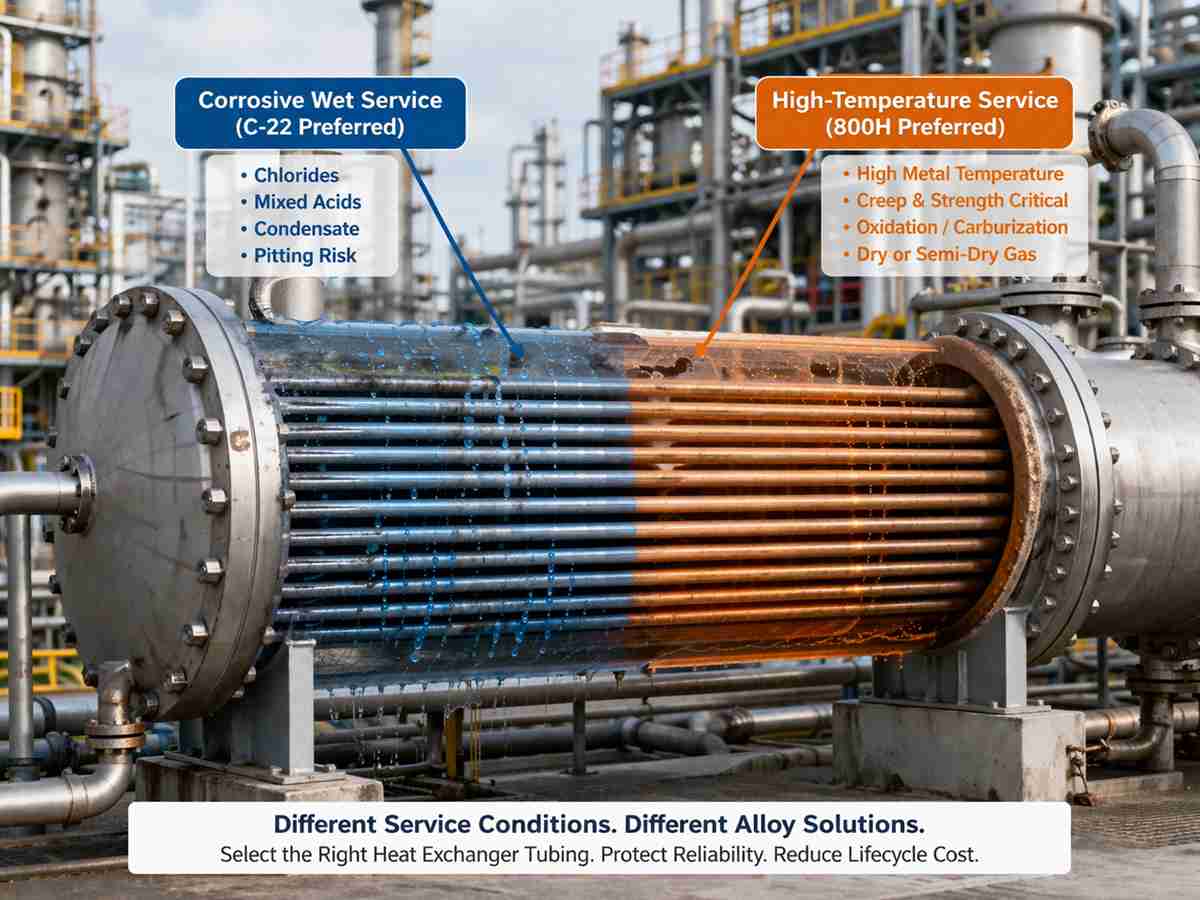
Incoloy 800H is fundamentally chosen for elevated-temperature structural stability. It is an iron-nickel-chromium alloy with controlled carbon, aluminum, and titanium chemistry to improve creep and rupture properties at high temperature. In practical terms, 800H becomes attractive when the heat exchanger or heater tubing sees sustained thermal exposure where ordinary stainless grades lose too much strength or become metallurgically unstable. Think reformer convection sections, high-temperature gas coolers, and petrochemical services where metal temperature, not just corrosion rate, controls life.
Hastelloy C-22, by contrast, is selected because corrosion is the first-order design constraint. It is a nickel-chromium-molybdenum-tungsten alloy known for very broad resistance to oxidizing and reducing media, especially where chlorides, wet halides, mixed-acid streams, or aggressive process upsets are present. If pitting, crevice corrosion, or chemically induced attack is the dominant threat, C-22 usually enters the discussion very quickly.
So, in the Incoloy 800H vs Hastelloy C-22 for heat exchanger tubing decision, 800H answers the question, “Can the tube survive the temperature and retain strength?” C-22 answers, “Can the tube survive the chemistry without localized attack?”
Corrosion Behavior: C-22 Usually Wins, But Context Still Matters
For wet corrosion service, Hastelloy C-22 is typically the stronger candidate. It offers excellent resistance to pitting and crevice corrosion in chloride-bearing environments and handles a wide range of oxidizing contaminants that would challenge many 니켈 합금 and stainless steels. In bleach systems, scrubbers, sour chemical streams, mixed acid environments, and contaminated process water, C-22 gives engineers a wider safety window. That wider window matters. Plant chemistry is rarely as clean in year eight as it was in year one.
Incoloy 800H does contain chromium and has useful resistance to oxidation and carburization in the right high-temperature environments, but it is not a universal answer for aggressive aqueous corrosion. If the exchanger spends meaningful time in condensed phases containing chlorides, sulfur species, or acidic contaminants, 800H can become a risky choice unless the process chemistry is tightly controlled.
A common mistake is assuming that “high nickel” automatically means “high corrosion resistance” across all media. It does not. The alloy system and the damage mechanism must match. In the Incoloy 800H vs Hastelloy C-22 for heat exchanger tubing comparison, C-22 generally has the advantage when water chemistry or chemical attack dominates.
Direct Comparison Table: Incoloy 800H vs Hastelloy C-22 for Heat Exchanger Tubing
| 속성 / 선택 요소 | 인콜로이 800H | 하스텔로이 C-22 | 엔지니어링 코멘트 |
|---|---|---|---|
| Primary design strength | High-temperature strength and creep resistance | Broad corrosion resistance in severe chemical media | Start with the governing failure mode |
| Typical service focus | Elevated-temperature dry or semi-dry process duty | Wet corrosive duty, chlorides, mixed acids, upset chemistry | They solve different problems |
| Resistance to chloride pitting / crevice corrosion | Moderate to limited for aggressive wet chloride service | 우수 | C-22 is usually preferred in chloride-bearing aqueous service |
| Elevated-temperature creep performance | Strong | Not the main reason to select it | 800H is usually the better fit for prolonged high-temperature stress |
| 내산화성 | 고온에 적합 | Good, but usually selected for corrosion rather than creep duty | Atmosphere and metal temperature must be reviewed together |
| Fabrication and welding | Good, but heat input and post-fabrication condition matter | Good, widely used in corrosive equipment fabrication | Qualified procedures remain essential for both |
| Relative material cost | Lower than C-22 in most cases | Higher | Cost must be weighed against failure risk and shutdown impact |
| Best use case in tubing | High-temperature exchanger tubing where strength retention is critical | Corrosive exchanger tubing where localized attack is the main risk | Match alloy to actual damage mechanism |
| Risk if misapplied | Premature corrosion in wet aggressive chemistry | Overspecification and unnecessary cost in temperature-driven duty | Wrong alloy selection hurts either reliability or budget |
Temperature, Metallurgy, and Life-Cycle Cost
This is where the discussion becomes more nuanced. If the exchanger tube wall runs hot for long periods, creep deformation and metallurgical stability are not abstract textbook concerns; they determine remaining life. Incoloy 800H was developed precisely for that sort of service. Its composition and grain structure support better stress-rupture behavior than many general-purpose corrosion alloys in high-temperature duty.
That does not mean C-22 cannot operate at elevated temperature. It can. But in the Incoloy 800H vs Hastelloy C-22 for heat exchanger tubing decision, C-22 is rarely the most economical choice when temperature strength is the real driver and corrosive condensates are not severe. In those cases, specifying C-22 may simply buy expensive corrosion resistance you do not need.
The reverse mistake is more dangerous. Choosing 800H for a duty with intermittent condensation, chlorides, cleaning chemicals, or contaminated aqueous phases may look economical on the purchase order, but the lifecycle cost can become brutal once pitting, wall loss, leaks, unplanned shutdowns, and retubing enter the picture.
Engineers should also account for weld zones. Tube-to-tubesheet joints, autogenous orbital welds, and fabrication thermal cycles can shift local performance. A base alloy that looks acceptable on paper may become the weak link at the joint if the real environment was underestimated.
Which Alloy Should You Specify?
If your exchanger tubing operates in high-temperature service where creep strength, oxidation resistance, and structural stability dominate, Incoloy 800H is often the more rational engineering choice. If the tubing faces chlorides, mixed acids, oxidizing contaminants, or uncertain wet corrosion conditions, Hastelloy C-22 is usually the safer specification.
That is the practical conclusion of Incoloy 800H vs Hastelloy C-22 for heat exchanger tubing. The right answer is not found by comparing brochure claims. It comes from identifying the real limiting factor: temperature, corrosion, or both. If both mechanisms are credible, the selection should be validated against the full operating envelope, including startup, shutdown, cleaning chemistry, upset scenarios, and weld details.
At 28Nickel, we recommend that buyers do not finalize tubing material based on nominal process descriptions alone. Share the design temperature, maximum metal temperature, pressure class, process composition, chloride level, condensate conditions, and expected upset chemistry. A short technical review at the sourcing stage can prevent a costly mismatch later. If your team is weighing Incoloy 800H vs Hastelloy C-22 for heat exchanger tubing, sending your duty sheet for an engineering check is usually the fastest way to reduce both technical risk and procurement waste.
관련 Q&A
1. Is Hastelloy C-22 always better than Incoloy 800H for heat exchanger tubing?
No. C-22 is usually better for severe corrosive service, especially wet chloride or mixed-chemical environments. But if the main challenge is long-term exposure to high temperature and the need for creep strength, Incoloy 800H may be the better engineering fit.
2. When should I avoid Incoloy 800H in heat exchanger tubing?
You should be cautious with 800H when the service includes aggressive aqueous corrosion, chloride-bearing condensate, acidic cleaning chemicals, or process upsets that create wet corrosive phases. In those conditions, localized attack can become the life-limiting mechanism.
3. How do buyers make the right choice between Incoloy 800H and Hastelloy C-22?
Start from the dominant failure mode, not the alloy price. Review actual metal temperature, stress level, fluid chemistry, contaminant range, condensate risk, and fabrication method. If needed, ask a qualified alloy supplier to review the duty sheet before ordering tubing.