






Quando os engenheiros especificam a liga Inconel para a indústria aeroespacial, estão normalmente a tentar ganhar tempo — literalmente. As secções das turbinas, os componentes do sistema de escape, os elementos de fixação próximos do ar de purga e os suportes das estruturas a altas temperaturas estão todos sujeitos a uma combinação de calor, tensão, vibração e gases agressivos que rapidamente revelam os limites dos aços comuns. A família Inconel (um grupo de superligas de níquel-crómio protegido por marca registada, normalmente identificado por números UNS e especificações de material) foi concebida para este nicho de aplicação: manter a resistência a altas temperaturas, resistir à oxidação e suportar ciclos térmicos repetidos sem transformar os intervalos de manutenção num jogo de adivinhas.
Porque é que a liga inconel para a indústria aeroespacial domina o hardware quente
O “calor” aeroespacial não é apenas um pico de temperatura. É um longo tempo de permanência em carga (fluência), transições rápidas (choque térmico) e vibração em cima de ambos. Os engenheiros selecionam a liga inconel para a indústria aeroespacial porque gere vários modos de falha ao mesmo tempo:
-
Resistência à deformação e à rutura por tensão para uma exposição prolongada à carga
-
Resistência à oxidação e à corrosão a quente em ambientes de combustão e de escape
-
Desempenho por fadiga quando as peças aquecem, arrefecem e repetem esse ciclo durante anos
-
Retenção previsível das propriedades após exposição ao calor, para que as peças se mantenham dentro da tolerância
Uma lição prática do terreno: a escolha da liga só funciona se a especificação e a condição forem igualmente claras. “Equivalente a 718” não é um requisito de compra - são as normas UNS, a forma do produto, a condição e o nível de inspeção.
Como a microestrutura orienta a seleção da liga de inconel para a indústria aeroespacial
A forma mais útil de comparar notas é perguntar como é que eles obtêm a sua força.
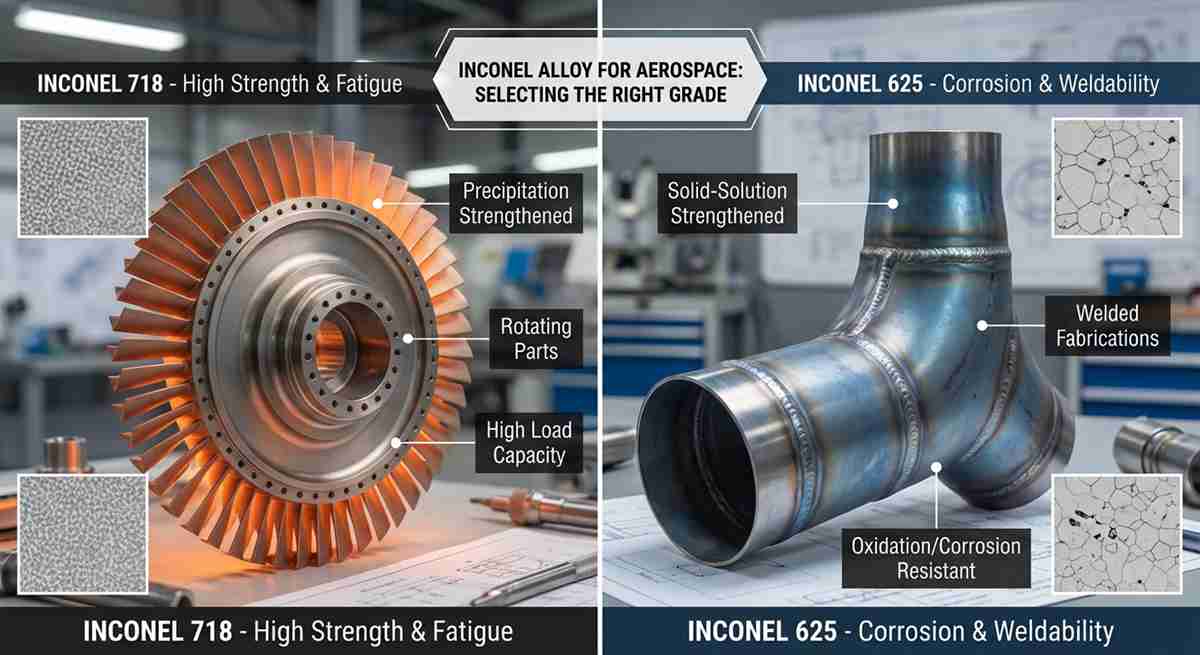
Graus reforçados por precipitação (abordagem 718)
Nos graus de precipitação, o tratamento térmico faz parte do projeto. Um passo de solução seguido de um envelhecimento controlado forma precipitados finos que aumentam o limite de elasticidade e a resistência à fadiga. É por isso que os requisitos da liga inconel para a indústria aeroespacial incluem frequentemente não só a química, mas também a condição de tratamento térmico, notas sobre a microestrutura e cláusulas de inspeção (especialmente para peças muito carregadas e secções espessas).
Graus reforçados por solução sólida (a abordagem 625)
Nos tipos de solução sólida, os elementos de liga dissolvidos na matriz de níquel proporcionam resistência, preservando a tenacidade e a excelente soldabilidade. Estas qualidades ganham frequentemente quando se trata de fabricos de paredes finas, soldaduras complexas ou requisitos de corrosão em que “suficientemente forte” mais um bom comportamento de união supera a “resistência máxima”.”
Se se lembrar de apenas uma coisa: a liga inconel para a indústria aeroespacial é uma família e não um único material. O grau, a condição e a via de processamento trabalham em conjunto.
Graus comuns de liga de inconel para a indústria aeroespacial e o que esperar
A tabela abaixo é uma visão prática numa fase inicial. As decisões finais devem basear-se nas permissões certificadas e na especificação exacta associada à forma do seu produto (barra vs folha vs tubo).
| Grau (nome comum) | Aplicações típicas no sector aeroespacial | Mecanismo de resistência | Onde é frequentemente a melhor opção (regra geral) | Detalhes de aquisição a bloquear |
|---|---|---|---|---|
| Inconel 718 (UNS N07718) | Discos/eixos, anéis, fixadores, ferragens estruturais a quente | Precipitação (solução + envelhecimento) | Secções a quente a média temperatura onde a resistência e a fadiga dominam | A condição de tratamento térmico, o tamanho do grão e a classe de ultra-sons são frequentemente necessários |
| Inconel 625 (UNS N06625) | Exaustão/condutores, foles, peças de chapa de parede fina, montagens sujeitas a corrosão | Solução sólida | Fabricações soldadas e ferragens a quente sujeitas a corrosão | Confirmar a forma (folha ou chapa) e os ensaios mecânicos para o estado de entrega |
| Inconel 725 (UNS N07725) | Fixadores, molas, ferragens de alta resistência em zonas corrosivas | Precipitação | Nicho de força + resistência à corrosão | As condições de envelhecimento e os requisitos de resistência à corrosão devem ser explícitos |
| Inconel 706 (UNS N09706) | Peças forjadas de grandes dimensões onde o tamanho da secção e a maquinabilidade são importantes | Precipitação | Peças estruturais intermédias de secção quente | O tamanho da secção afecta as propriedades; verificar a inspeção para secções transversais pesadas |
Uma regra comum que os engenheiros utilizam nas conversas sobre aquisições: se a peça tiver uma carga elevada, o 718 é frequentemente o ponto de partida; se for fina, soldada e exposta à corrosão, o 625 é frequentemente a resposta prática.
Realidades de processamento da liga de inconel para peças aeroespaciais
As vantagens da liga de inconel para a indústria aeroespacial têm consequências a nível do fabrico. O planeamento antecipado destas consequências evita surpresas de custos e prazos na fase final.
Limpeza e percurso de fusão
Para hardware de segurança crítica, o controlo da inclusão é importante. Muitos fluxos aeroespaciais especificam rotas de fusão/refusão a vácuo para garantir a consistência e a limpeza. Se a peça for rotativa ou sujeita a grandes esforços, pergunte desde logo como é que a limpeza é controlada e que provas serão fornecidas (não apenas “cumpre os requisitos químicos”).
Forjamento e tratamento térmico
Os graus de precipitação são normalmente comprados como barras forjadas, biletes ou anéis, sendo depois tratados termicamente para cumprir os requisitos de resistência. As secções espessas podem arrefecer de forma diferente ao longo da peça, pelo que as especificações podem incluir controlos mais rigorosos da microestrutura, do tamanho do grão ou da inspeção ultra-sónica.
Soldadura e conformação
Os tipos de solução sólida como o 625 são populares para condutas e escapes porque soldam bem, mas o controlo da distorção continua a ser um importante fator de custo - especialmente em chapas finas. A rigidez do acessório, a conceção da junta e o aporte térmico determinam se uma soldadura é “única” ou um ciclo de retrabalho iterativo.
Maquinação
As ligas de níquel conduzem mal o calor e podem endurecer rapidamente, o que reduz a janela do processo. Uma fixação estável, ferramentas afiadas, velocidades de corte conservadoras e um forte fornecimento de líquido de refrigeração são típicos. Se o seu desenho for exigente quanto à qualidade dos furos e ao acabamento dos bordos, reserve tempo para o acabamento e a inspeção.
O que pedir quando se abastece de liga de inconel para a indústria aeroespacial
As aquisições no sector aeroespacial são, em última análise, uma questão de provas e de rastreabilidade. No caso da liga de inconel para a indústria aeroespacial, a falta de pormenores - mais do que a falta de stock - gera atrasos. Uma lista de controlo do comprador que evita a maioria dos problemas:
-
Relatório de ensaio de moagem (MTR) com número de calor/lote, química completa e forma do produto
-
Resultados dos ensaios mecânicos para o estado de entrega (tração, dureza, por vezes impacto)
-
Conformidade com as especificações (AMS/ASTM ou especificações do cliente) e nível de revisão
-
Requisitos de inspeção/NDT (UT/PT, conforme aplicável), incluindo classe de aceitação, quando especificado
-
Tolerâncias dimensionais e estado da superfície (crítico para chapas/fitas e barras de precisão)
-
Rastreabilidade ao nível da peça: marcação do número de calor e embalagem que sobreviva ao trânsito internacional
Na 28Nickel, vemos frequentemente os programas abrandarem quando um pedido de compra diz “barra 718” mas omite a condição e o nível de inspeção. Requisitos claros à partida mantêm a certificação sem problemas a jusante.
Perguntas e respostas relacionadas
Q1: O 718 é sempre a liga de inconel correta para peças aeroespaciais de secção quente?
R: Nem sempre. O 718 é uma base comum para componentes altamente carregados, mas os fabricos soldados e o hardware sujeito a corrosão podem ser melhor servidos pelo 625 ou outras ligas de níquel, dependendo do ambiente e do método de união.
Q2: Porque é que duas remessas do “mesmo grau” se podem comportar de forma diferente na maquinagem?
R: A condição, o tamanho da secção, a microestrutura e o histórico de processamento afectam o endurecimento por trabalho e o desgaste da ferramenta. É por isso que as especificações consistentes e os calores rastreáveis são importantes.
Q3: Qual é o maior risco na importação de superligas de níquel?
R: Aceitar descrições vagas (“equivalente a”) sem uma especificação, condição e rastreabilidade claras. A química, por si só, não garante o desempenho aeroespacial.