





Selecionar a superliga certa para ambientes extremos é uma decisão que define a longevidade e a segurança dos componentes industriais. Neste guia de seleção de materiais inconel, exploramos a razão pela qual estas ligas à base de níquel-crómio são o padrão de ouro para aplicações de alta temperatura e alta corrosão. Quer esteja a lidar com as temperaturas criogénicas da indústria aeroespacial ou com os ambientes ácidos do processamento químico, compreender as nuances de cada tipo de Inconel é fundamental para otimizar o desempenho e a rentabilidade.
Porque é que a seleção de materiais é importante
As ligas Inconel são caracterizadas pela sua capacidade de manter a integridade estrutural a temperaturas em que a maioria dos aços inoxidáveis perderia a sua resistência mecânica. Isto deve-se em grande parte à formação de uma camada de óxido estável e passivante quando aquecida. No entanto, devido ao facto de “Inconel” se referir a uma família de ligas, a escolha do grau errado pode levar a falhas prematuras ou a despesas desnecessárias. Este guia de seleção de materiais inconel visa colmatar essa lacuna de conhecimentos.
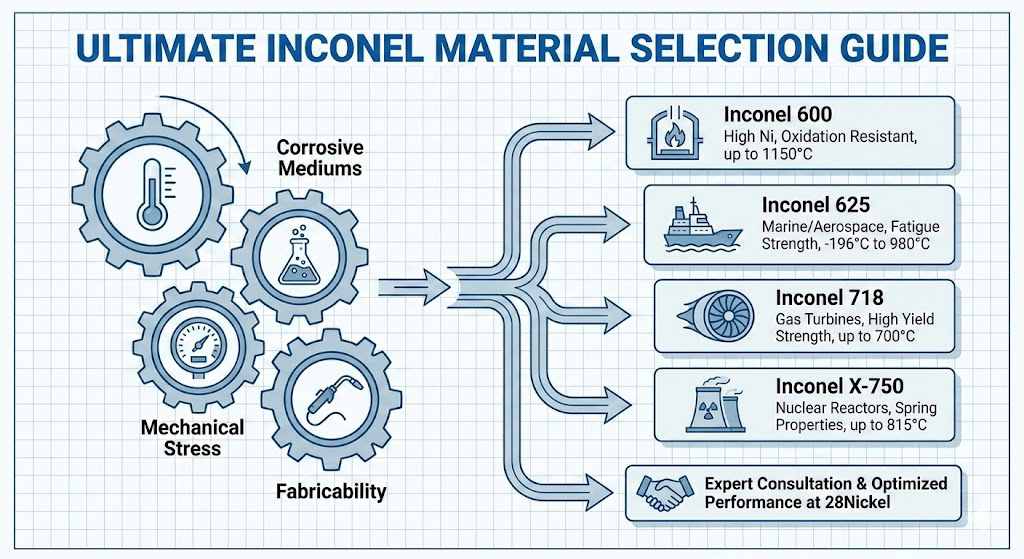
Factores primários num guia de seleção de material Inconel
Ao avaliar o tipo de aço a fornecer pela 28Nickel, os engenheiros devem dar prioridade a quatro variáveis principais:
-
Temperatura de funcionamento: As diferentes qualidades utilizam mecanismos de reforço diferentes (como o endurecimento por solução sólida ou por precipitação).
-
Meios corrosivos: Embora todas as ligas Inconel resistam à oxidação, algumas são especificamente formuladas para ácido sulfúrico, água do mar ou gás ácido.
-
Tensões mecânicas: A tensão de cedência e a vida útil de rutura por fluência necessárias a temperaturas elevadas.
-
Capacidade de fabrico: Alguns tipos são mais fáceis de soldar ou maquinar do que outros.
Mergulho profundo: Comparação de graus comuns de Inconel
Para tornar prático o seu guia de seleção de material inconel, vamos comparar os “Quatro Grandes” tipos normalmente utilizados na indústria pesada:
| Grau | Caraterísticas principais | Melhor caso de utilização | Gama de temperaturas |
| Inconel 600 | Elevado teor de Ni, boa resistência à oxidação. | Componentes de fornos, processamento químico. | Até 1150°C |
| Inconel 625 | Excelente resistência à fadiga/fadiga térmica. | Marinha, aeroespacial, petróleo e gás offshore. | -196°C a 980°C |
| Inconel 718 | Elevado limite de elasticidade, endurecível por envelhecimento. | Turbinas a gás, motores de foguetões, fixadores. | Até 700°C |
| Inconel X-750 | Excelentes propriedades de mola, resistente à corrosão. | Reactores nucleares, pás de turbinas a gás. | Até 815°C |
Insights estratégicos: Guia de seleção de materiais Inconel para a indústria
1. O poder do Inconel 718 na indústria aeroespacial
O Inconel 718 é talvez o mais versátil da família. Se o seu guia de seleção de material inconel se centra em elevadas relações resistência/peso, o 718 é a resposta. É único porque pode ser soldado sem estar sujeito a “fissuras pós-soldadura por deformação”, uma dor de cabeça comum noutras ligas endurecidas pelo envelhecimento.
2. Domínio da corrosão com Inconel 625
Se o seu projeto envolve água do mar ou condutas submarinas de alta pressão, o Inconel 625 é a primeira escolha. A sua adição de molibdénio e nióbio proporciona uma resistência excecional à corrosão por picadas e em fendas. Em muitos cenários do guia de seleção de materiais inconel, o 625 é a “apólice de seguro” contra ambientes químicos imprevisíveis.
Aprofundamento técnico: A metalurgia da seleção
Compreender a metalurgia por detrás do guia de seleção de material inconel envolve olhar para o (gama primo) e (gama double prime). Em ligas como a 718, a precipitação destas fases proporciona a incrível resistência necessária para os discos de turbina. No entanto, isto também torna o material mais difícil de maquinar, exigindo velocidades mais lentas e ferramentas especializadas - um fator de custo que deve ser incluído no seu guia de seleção de material inconel.
Finalizar a sua decisão
Na 28Nickel, compreendemos que a aquisição de materiais não tem apenas a ver com o preço - tem a ver com fiabilidade. Ao utilizar um guia de seleção de material inconel, consulte sempre os especialistas metalúrgicos para garantir que o grau escolhido corresponde aos seus factores de tensão ambiental específicos (pressão, temperatura e acidez).
Perguntas e respostas relacionadas
Q1: O Inconel é melhor do que o aço inoxidável?
O Inconel é superior para aplicações de alta temperatura e altamente corrosivas. Embora o aço inoxidável seja económico para utilização geral, perde a sua força e resistência à oxidação a temperaturas superiores a 600°C, onde o Inconel continua a prosperar.
Q2: Que tipo de Inconel é melhor para soldar?
O Inconel 625 é amplamente considerado como o tipo mais soldável. O Inconel 718 também é soldável, mas requer protocolos específicos de tratamento térmico para manter as suas propriedades mecânicas.
Q3: Porque é que o Inconel é tão caro?
O custo é determinado pelo elevado teor de níquel e crómio, bem como pelos complexos processos de fabrico necessários para produzir estas superligas de elevado desempenho.