





Os engenheiros que operam em ambientes agressivos de gás ácido ou em plataformas offshore enfrentam uma batalha constante contra a corrosão localizada. Quando o aço inoxidável austenítico 316L padrão começa a apresentar fissuração por corrosão sob tensão induzida por cloreto (SCC), a atualização da metalurgia torna-se inegociável. No entanto, a seleção do grau exato requer uma rigorosa comparação de materiais de ligas de níquel para evitar uma falha catastrófica prematura. Escolher às cegas com base em folhas de dados básicas conduz frequentemente a um desempenho inferior em fluxos corrosivos multi-variáveis. Este artigo mergulha profundamente nas realidades metalúrgicas, concentrando-se nas propriedades químicas e mecânicas específicas que ditam a capacidade de sobrevivência nas aplicações industriais mais severas.
Principais métricas numa comparação de materiais de liga de níquel
A base de qualquer projeto robusto comparação de materiais de ligas de níquel O objetivo do presente estudo é analisar o número equivalente de resistência à corrosão (PREN) juntamente com as propriedades mecânicas a altas temperaturas. Ao avaliar a matriz austenítica, a adição de molibdénio (Mo) e tungsténio (W) retarda significativamente a cinética da dissolução anódica localizada. Por exemplo, comparar a liga 625 com a liga C-276 não é apenas um exercício de correspondência de números de limite de elasticidade; requer uma compreensão profunda da estabilidade das fases durante uma exposição térmica prolongada. Altas concentrações de crómio (Cr) fornecem a camada passiva de óxido, mas é a sinergia de Ni, Cr e Mo que dita o desempenho sob condições severas da NACE MR0175/ISO 15156.
Para executar uma comparação de materiais de ligas de níquel, Para que os engenheiros possam isolar iões agressivos específicos. Os cloretos e o sulfureto de hidrogénio (H2S) exigem um teor excecionalmente elevado de molibdénio para manter a integridade estrutural.
| Grau da liga | Ni (%) | Cr (%) | Mo (%) | PREN (típico) | Resistência mínima ao escoamento (MPa) | Foco principal da aplicação |
| Liga C-276 | Equilíbrio | 14.5 - 16.5 | 15.0 - 17.0 | ~68 | 340 | Fissuras graves, cloro gasoso húmido |
| Liga 625 | 58,0 min | 20.0 - 23.0 | 8.0 - 10.0 | ~45 | 414 | Elevada resistência à fadiga, marinha |
| Liga 825 | 38.0 - 46.0 | 19.5 - 23.5 | 2.5 - 3.5 | ~31 | 241 | Produção de ácido, poços de gás ácido |
| Liga 400 | 63.0 min | N/A | N/A | N/A | 195 | Ácido fluorídrico, água do mar |
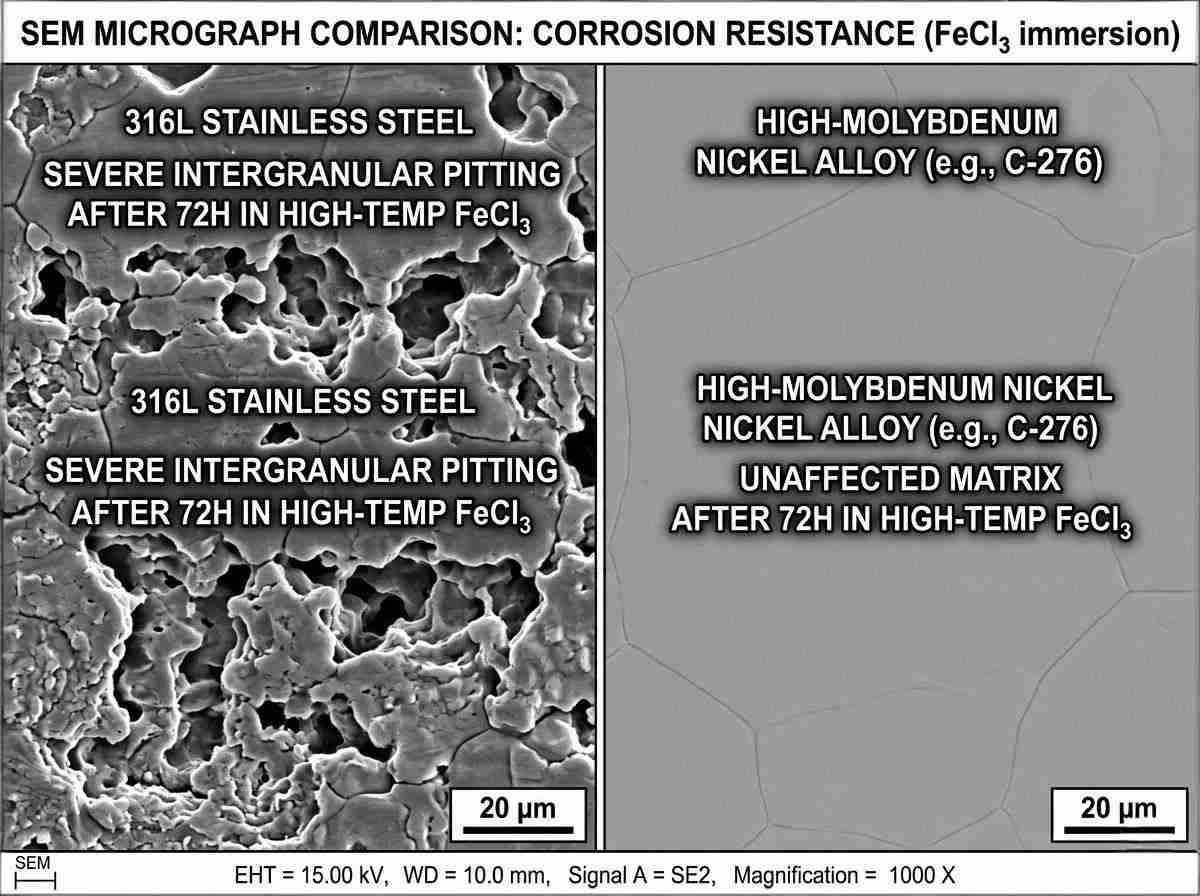
Conforme demonstrado nos dados acima, o Hastelloy C-276, com o seu teor de Mo de ~16%, elimina praticamente a suscetibilidade a ataques localizados induzidos por cloretos em ambientes oxidantes. Por outro lado, a liga 825, embora seja altamente económica e eficaz contra o ácido sulfúrico, apresenta uma resistência inferior em ambientes com corrosão por pite severa, devido ao seu PREN mais baixo. Cada comparação de materiais de ligas de níquel que realizamos para o projeto de vasos de pressão ou de tubos de permutadores de calor devem ter em conta estes limites químicos distintos. A tentativa de substituir uma liga de nível inferior num ambiente com elevado teor de cloreto irá inevitavelmente acelerar o ataque intergranular.
Integridade mecânica sob tensão térmica
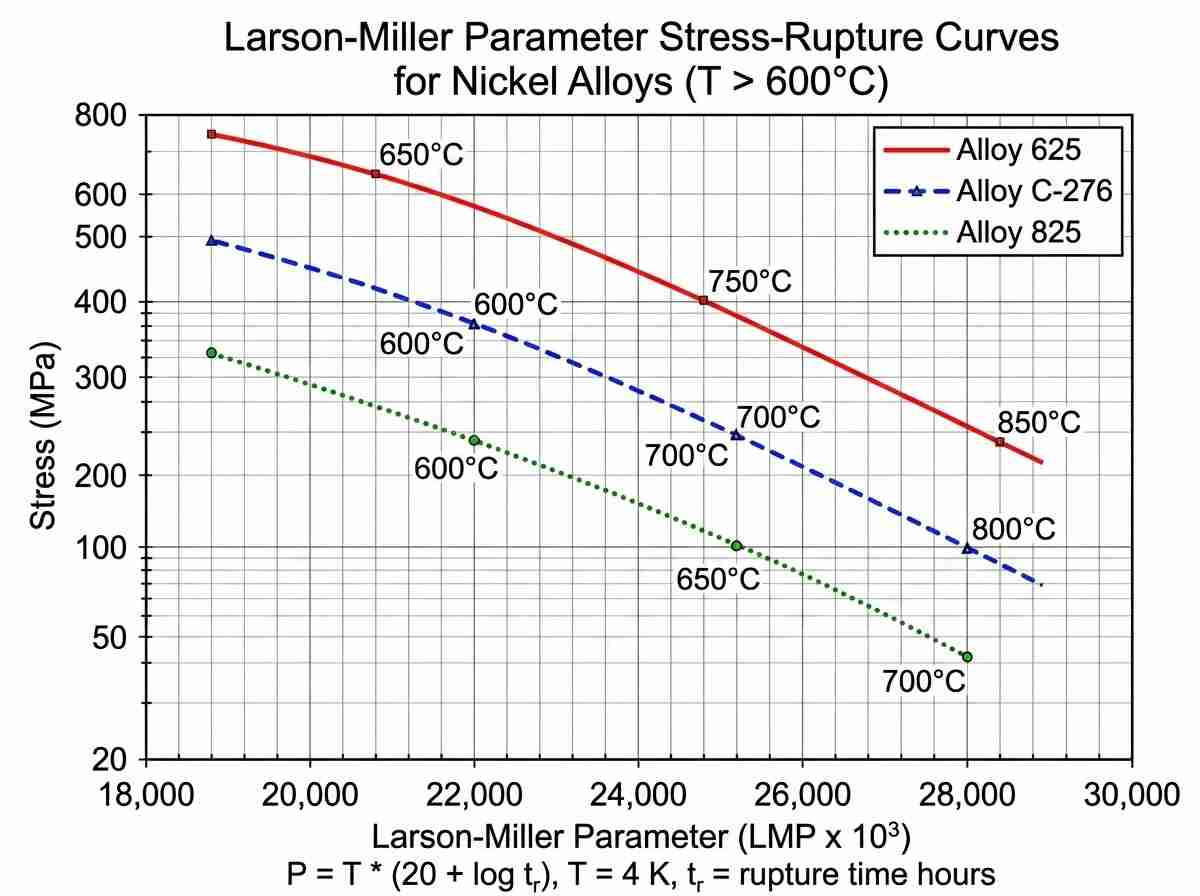
Para além da resistência à corrosão aquosa, a degradação mecânica a alta temperatura determina a seleção do material. Os elementos de reforço de solução sólida, como o nióbio (Nb) e o molibdénio, influenciam fortemente a resistência à fluência. Ao efetuar uma comparação de materiais de ligas de níquel Para obter informações sobre a resistência à fadiga da liga 625 para chaminés de combustão, componentes de turbinas a gás ou tubos de pirólise, é necessário avaliar o tempo de rutura a temperaturas superiores a 600°C. A liga 625 apresenta excelente resistência à fadiga e resistência à oxidação, mas a exposição prolongada na faixa de 650°C a 900°C pode levar à fragilização devido à precipitação de fases intermetálicas deletérias (como as fases sigma ou mu). Por conseguinte, confiar numa análise estática comparação de materiais de ligas de níquel à temperatura ambiente é fundamentalmente deficiente; é necessária uma modelação dinâmica da degradação a alta temperatura.
Em última análise, a especificação da metalurgia correta é um exercício complexo de mitigação de riscos. Confiar apenas na química teórica pode induzir em erro as equipas de engenharia que lidam com caudais voláteis e picos de temperatura. Uma especificação comparação de materiais de ligas de níquel preenche a lacuna entre os dados laboratoriais brutos e a fiabilidade comprovada no terreno. Na 28Nickel, a nossa equipa de engenharia ajuda ativamente com avaliações metalúrgicas aprofundadas, adaptadas às suas composições de fluidos, classificações de pressão e perfis térmicos exactos. Se os seus materiais actuais estão a falhar ou se está a projetar um novo sistema altamente corrosivo, contacte hoje mesmo os nossos engenheiros de materiais com os seus parâmetros operacionais para obter apoio técnico dedicado e orientação precisa na seleção de materiais.
Perguntas e respostas relacionadas
Q1: De que forma é que a presença de tungsténio (W) altera o resultado de uma comparação de materiais de ligas de níquel?
R: O tungsténio actua de forma semelhante ao molibdénio no aumento da resistência à corrosão localizada, mas é mais pesado e mais eficaz na estabilização da solução sólida a temperaturas elevadas. Em um comparação de materiais de ligas de níquel, Em ligas como o C-276, utiliza-se o W (normalmente 3-4,5%) para suprimir ainda mais a corrosão por pite e em fendas em ambientes oxidantes e redutores severos, levando a fórmula PREN a incluí-lo (PREN = %Cr + 3,3(%Mo + 0,5%W) + 16%N).
Q2: Porque é que a liga 825 é frequentemente preferida em relação à liga 625 em determinadas aplicações de gás ácido, apesar de ter um PREN mais baixo?
R: Embora a liga 625 tenha uma resistência superior à corrosão por pite, a liga 825 foi especificamente concebida com um equilíbrio exato de Ni, Fe, Cr e Cu para resistir aos ácidos sulfúrico e fosfórico. O seu teor de ferro mais elevado torna-a uma solução altamente rentável para ambientes NACE específicos em que a corrosão extrema por pites de cloreto não é o principal mecanismo de falha, mas a corrosão ácida geral e o SCC são as principais preocupações.
Q3: A sensibilização na zona afetada pelo calor (HAZ) pode invalidar as comparações iniciais de materiais?
R: Sem dúvida. Uma liga pode parecer perfeita no papel, mas um aporte térmico de soldadura inadequado pode causar a precipitação de carboneto de crómio nos limites do grão, levando a uma rápida corrosão intergranular em serviço. As ligas como C-276 e 625 são formuladas com carbono extremamente baixo e elementos estabilizadores para minimizar a sensibilização da ZTA, mantendo a estrutura soldada altamente resistente à corrosão.