No domínio das superligas à base de níquel, a série Nimonic representa uma pedra angular da engenharia de materiais a alta temperatura. Entre os tipos mais frequentemente comparados estão o Nimonic 75 (UNS N06075) e o Nimonic 80A (UNS N07080). Apesar de ambas as ligas partilharem uma base de níquel-crómio concebida para ambientes extremos, as suas estruturas metalúrgicas e os seus envelopes de desempenho diferem significativamente devido aos seus mecanismos de reforço. Este artigo fornece um aprofundamento técnico das suas diferenças para ajudar os engenheiros e especialistas em aquisições a tomar decisões informadas.
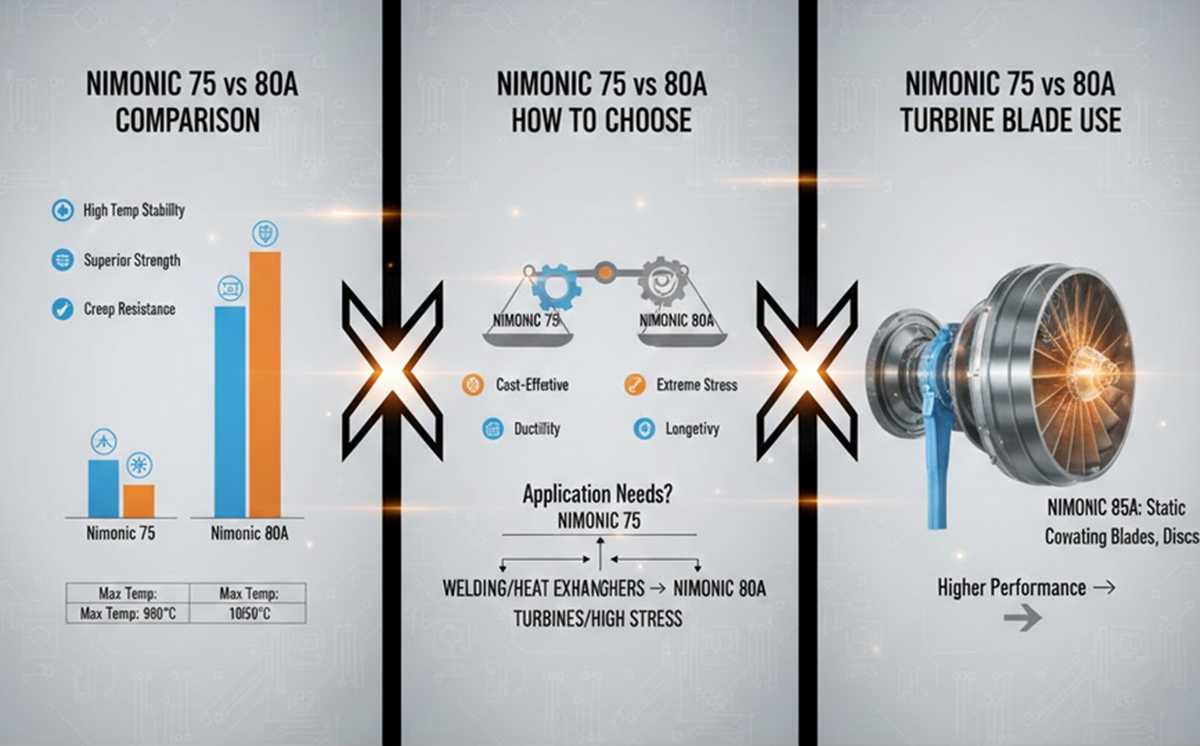
Comparação entre Nimonic 75 e 80A
A distinção fundamental entre o Nimonic 75 e o Nimonic 80A reside na sua composição química e no método de reforço resultante.
-
O Nimonic 75 é uma liga reforçada por solução sólida. Trata-se essencialmente de uma matriz de níquel-crómio 80/20 com adições controladas de titânio e carbono. É valorizada principalmente pela sua excelente resistência à oxidação e facilidade de fabrico, em vez de resistência mecânica a cargas elevadas.
-
O Nimonic 80A é uma liga endurecível por precipitação (endurecida pelo envelhecimento). Ao aumentar os teores de alumínio e titânio, forma uma liga de gama-prime () fase intermetálica () durante o tratamento térmico. Esta fase actua como uma barreira ao movimento de deslocação, aumentando significativamente a sua resistência à fluência e à fadiga.
Tabela 1: Comparação da composição química (% típico)
| Elemento | Nimonic 75 (Liga 75) | Nimonic 80A (Liga 80A) |
| Níquel (Ni) | Equilíbrio | Equilíbrio |
| Crómio (Cr) | 18.0 - 21.0 | 18.0 - 21.0 |
| Titânio (Ti) | 0.2 - 0.6 | 1.8 - 2.7 |
| Alumínio (Al) | – | 1.0 - 1.8 |
| Ferro (Fe) | 5.0 max | 3.0 max |
| Carbono (C) | 0.08 - 0.15 | 0,10 max |
Tabela 2: Propriedades mecânicas à temperatura ambiente
| Imóveis | Nimonic 75 (recozido) | Nimonic 80A (endurecido pela idade) |
| Resistência à tração (MPa) | ~750 | ~930 - 1000 |
| 0,2% Resistência ao escoamento (MPa) | ~300 | ~600 - 700 |
| Alongamento (%) | 35 - 45 | 20 - 30 |
| Dureza (HB) | 150 - 200 | 250 - 300 |
Nimonic 75 vs 80A: Como escolher?
A seleção entre estas duas ligas depende do principal modo de falha da aplicação: Stress mecânico vs. oxidação ambiental.
1. Temperatura vs. Carga
Se a sua aplicação envolver temperaturas até mas que exige uma tensão mecânica relativamente baixa (por exemplo, componentes de fornos), o Nimonic 75 é a melhor escolha. A sua química mais simples torna-o mais estável contra a oxidação e a incrustação em várias atmosferas industriais.
Por outro lado, para aplicações em que o material deve resistir à deformação sob cargas elevadas a temperaturas até , o Nimonic 80A é indispensável. A sua elevada resistência à rutura por fluência assegura a estabilidade dimensional sob tensão térmica e mecânica prolongada.
2. Capacidade de fabrico e soldadura
O Nimonic 75 é conhecido pela sua excelente soldabilidade e facilidade de conformação a frio. Pode ser unido utilizando a maioria das técnicas normais de soldadura por fusão (TIG/MIG) sem risco significativo de fissuração.
O Nimonic 80A, sendo uma liga endurecida por precipitação, é mais sensível. Requer um tratamento de solução preciso antes da soldadura e um tratamento térmico pós-soldadura (PWHT) para evitar a fissuração por deformação. Se for necessário um trabalho complexo de fabrico ou de chapa metálica, a liga 75 é significativamente mais fácil de utilizar.
3. Eficiência de custos
Devido à ausência de alumínio e ao menor teor de titânio, o Nimonic 75 é geralmente mais económico. Utilize-o, a menos que as exigências mecânicas do projeto exijam estritamente a resistência a altas temperaturas do 80A.
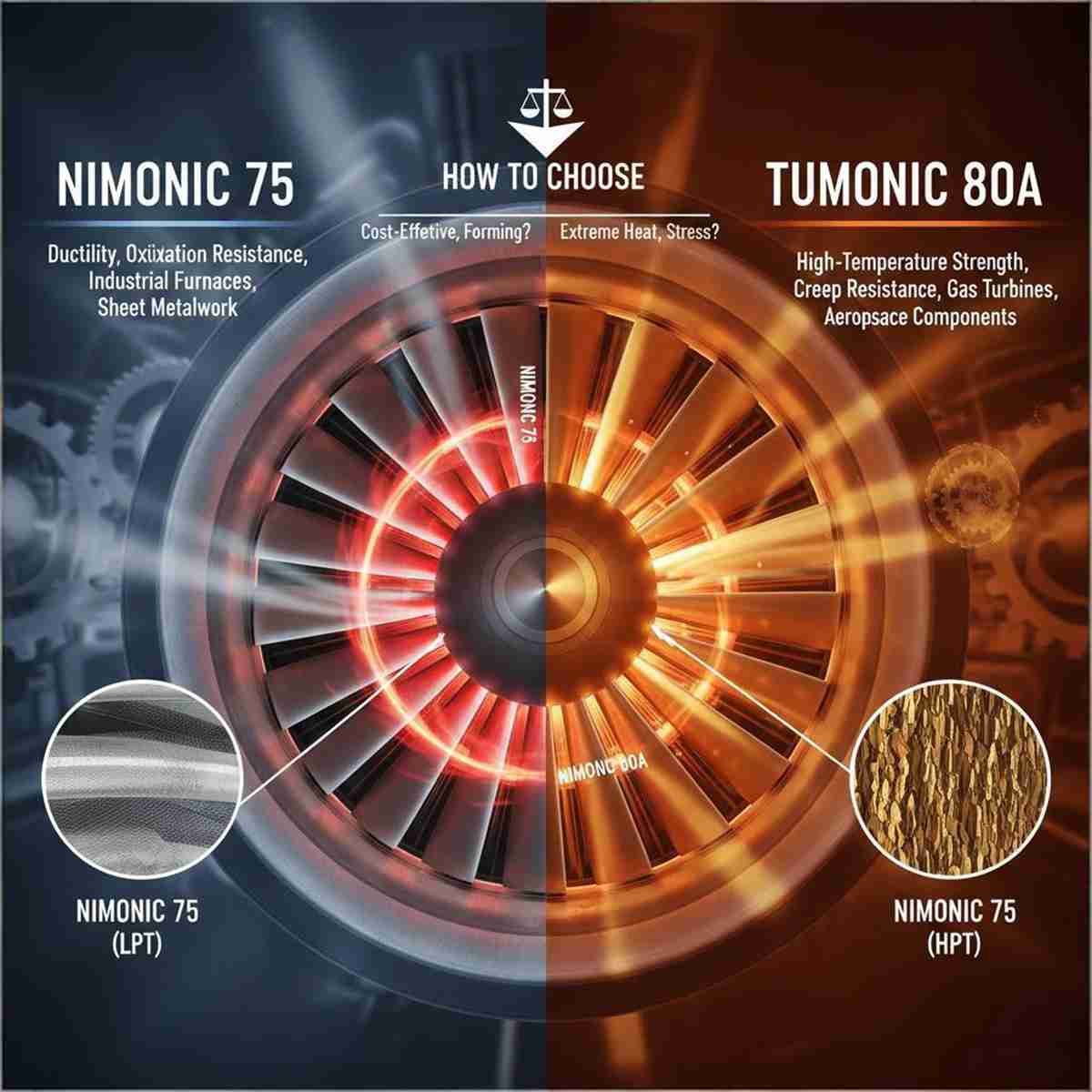
Utilização de lâminas de turbina em Nimonic 75 vs 80A
A história da engenharia das turbinas a gás é essencialmente a história da série Nimonic. Nos primeiros motores a jato (como o motor Whittle), o Nimonic 75 era o material original para as pás das turbinas. No entanto, à medida que as temperaturas e as velocidades de rotação do motor aumentavam, a liga 75 atingia o seu limite mecânico.
A mudança para o Nimonic 80A
O design moderno das pás das turbinas requer materiais que possam suportar as forças centrífugas da rotação a alta velocidade. O Nimonic 80A tornou-se o padrão da indústria para:
-
Lâminas de turbina de alta pressão: Onde a resistência à fluência é o fator crítico.
-
Válvulas de escape: Em motores de combustão interna de alto desempenho (especialmente nos desportos motorizados).
-
Discos e anéis de turbina: Requerem uma elevada resistência à fadiga.
Embora o Nimonic 75 tenha sido em grande parte eliminado das aplicações em pás rotativas, continua a ser um “cavalo de batalha” para componentes estáticos na secção da turbina. É amplamente utilizado para revestimentos de câmaras de combustão, condutas de exaustão e tubos de chama, onde a sua capacidade de resistir à oxidação e aos ciclos térmicos é mais valiosa do que a sua resistência à fluência.
Perguntas e respostas relacionadas
Q1: Qual é a temperatura máxima de serviço do Nimonic 80A? Para aplicações de alta tensão, como lâminas de turbina, o Nimonic 80A é normalmente limitado a (). Acima disso, o os precipitados começam a ficar mais grosseiros, levando a uma perda de resistência mecânica.
Q2: O Nimonic 75 pode ser endurecido por tratamento térmico? Não, o Nimonic 75 é uma liga de solução sólida e não pode ser significativamente endurecido por tratamento térmico. Pode, no entanto, ser reforçado através de trabalho a frio (endurecimento por trabalho), se necessário.
Q3: Qual é a melhor liga para resistência a atmosferas sulfúricas? Ambas as ligas oferecem uma boa resistência devido ao seu elevado teor de crómio. No entanto, o Nimonic 75 é muitas vezes preferido em ambientes de fornos industriais porque a sua camada de óxido superficial (crómio) é excecionalmente estável e menos propensa a fragmentação durante o ciclo térmico.