When selecting high-performance materials for extreme industrial environments, understanding the specific инконель 600 properties is essential for engineers and procurement specialists. Inconel 600 (UNS N06600) is a nickel-chromium alloy renowned for its versatility and resistance to various forms of corrosion and high-temperature oxidation. At 28Nickel, we recognize that choosing the right alloy can determine the longevity and safety of a project. This guide delves deep into the metallurgical characteristics that make this “workhorse” alloy a staple in the chemical, aerospace, and nuclear industries.
Chemical Composition and Its Impact on Inconel 600 Properties
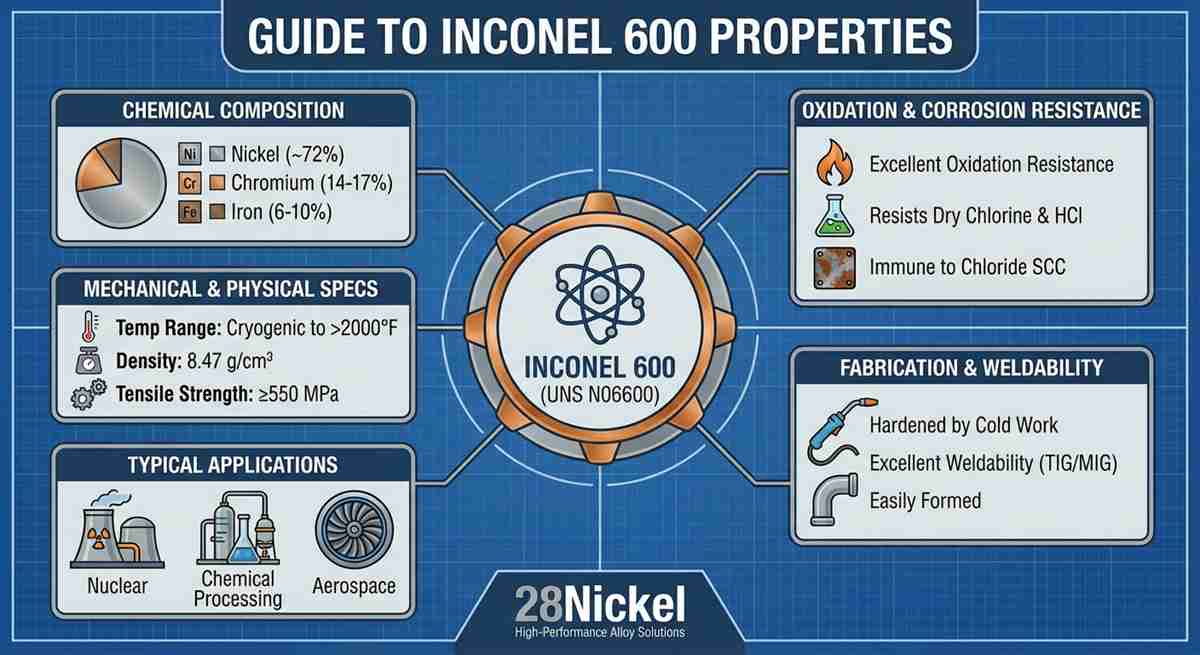
The unique balance of elements within this alloy defines the core inconel 600 properties. Primarily composed of nickel (minimum 72%), chromium (14–17%), and iron (6–10%), this composition provides a dual benefit. The high nickel content offers excellent resistance to reducing environments and alkaline solutions, while also making the material virtually immune to chloride-ion stress-corrosion cracking.
Conversely, the chromium content provides resistance to sulfur compounds and various oxidizing environments. This synergy allows the alloy to maintain its structural integrity where other metals might fail.
Mechanical and Physical Inconel 600 Properties
The mechanical inconel 600 properties allow it to perform consistently from cryogenic temperatures up to service temperatures exceeding 2000°F (1093°C). Unlike many austenitic steels, Inconel 600 does not become brittle at low temperatures, making it excellent for specialized cryogenic applications.
Key Physical and Mechanical Specifications:
| Недвижимость | Value (Metric) | Value (Imperial) |
| Плотность | 8.47 g/cm³ | 0.306 lb/in³ |
| Диапазон плавления | 1354–1413°C | 2470–2575°F |
| Прочность на разрыв (отожженная) | ≥ 550 MPa | ≥ 80,000 psi |
| Предел текучести (смещение 0,2%) | ≥ 240 MPa | ≥ 35,000 psi |
| Удлинение | 30–50% | 30–50% |
| Specific Heat | 444 J/kg·°C | 0.106 Btu/lb·°F |
| Модуль упругости | 206 GPa | 30 x 10⁶ psi |
Oxidation and Corrosion Resistance
One of the most sought-after inconel 600 properties is its remarkable resistance to oxidation. In high-temperature settings, the alloy forms a tightly adherent oxide scale that prevents further material degradation. This makes it a preferred choice for furnace components, heat-treating baskets, and trays.
Beyond oxidation, the alloy demonstrates superior resistance to dry chlorine and hydrogen chloride. In the chemical processing industry, where volatile substances are handled at high heat, the stability of inconel 600 properties ensures that equipment maintains its dimensional stability and resists pitting or intergranular attack.
Изготовление и свариваемость
Engineers often prioritize inconel 600 properties related to fabricability. The alloy can be hardened and strengthened only by cold work. It exhibits excellent weldability using common processes like TIG (GTAW) and MIG (GMAW), provided the correct filler metals (typically Inconel Filler Metal 82 or Welding Electrode 182) are used.
Its ability to be easily formed and joined without losing its corrosion-resistant characteristics is a major reason why it remains a top-tier choice for complex piping systems and reactor vessels.
Typical Applications Driven by Inconel 600 Properties
The diverse range of inconel 600 properties leads to its use in several critical sectors:
-
Nuclear Engineering: Used for steam generator tubing and control rod components due to its resistance to high-purity water corrosion.
-
Chemical Processing: Ideal for heaters, stills, and condenser towers involving fatty acids or magnesium chloride.
-
Aerospace: Utilized in engine components and airframe structures that must withstand high exhaust temperatures.
Заключение
In summary, the robust inconel 600 properties—including high-temperature strength, resistance to chloride stress-corrosion cracking, and excellent oxidation resistance—make it an indispensable material for modern industry. At 28Nickel, we provide high-quality никелевые сплавы tailored to your specific technical requirements, ensuring your operations run smoothly under the most demanding conditions.
Связанные вопросы и ответы
1. Does Inconel 600 become magnetic?
Inconel 600 is non-magnetic at room temperature. However, it can become slightly magnetic at very low temperatures (its Curie temperature is approximately -192°F or -124°C).
2. How do Inconel 600 properties compare to Инконель 625?
While both are nickel-chromium alloys, Inconel 625 contains molybdenum and niobium, which provide higher strength and better resistance to pitting/crevice corrosion compared to the standard inconel 600 properties. Inconel 600 is generally preferred for its better performance in high-temperature nitriding environments.
3. Is Inconel 600 suitable for saltwater applications?
While it has good general corrosion resistance, it is not the primary choice for stagnant seawater where pitting can occur. However, it performs excellently in flowing seawater and marine atmospheres.