









In the realm of superalloys, the Nickel-Chromium-Iron family remains the gold standard for environments requiring extreme heat and corrosion resistance. Among these, Inconel 600 (UNS N06600) and Inconel 601 (UNS N06601) are frequently compared. While they share a metallurgical lineage, their specific alloying elements dictate vastly different performance profiles in thermal processing and chemical engineering. Understanding these nuances is critical for preventing premature component failure.
Inconel 600 vs 601 differences
The fundamental distinction between these two grades lies in their chemical metallurgy, specifically the manipulation of Chromium (Cr) and Aluminum (Al) content.
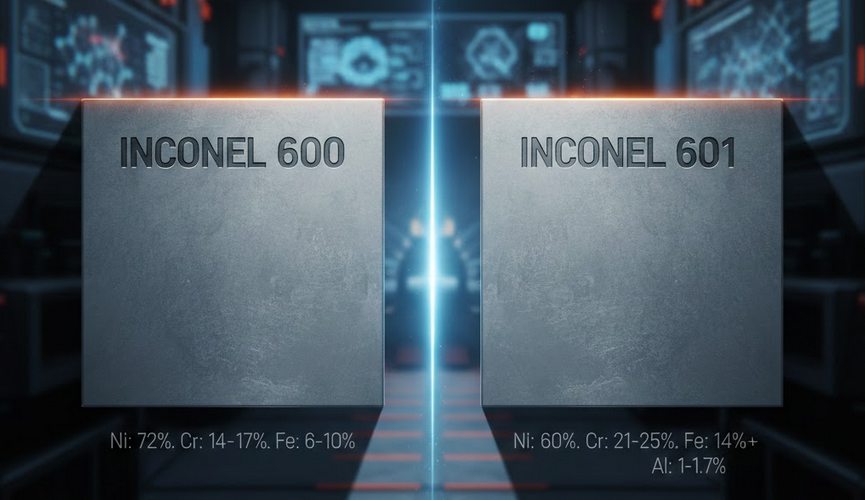
Inconel 600 is a standard engineering material designed with a high Nickel content (minimum 72%). This high nickel base provides the alloy with exceptional resistance to chloride-ion stress-corrosion cracking (SCC) and alkaline environments. Its Chromium content typically sits between 14-17%, which is sufficient for sulfur resistance but primarily optimized for reducing environments.
Inconel 601, conversely, is a modification of the 600 chemical profile. The Nickel content is lowered (58-63%) to allow for a higher Chromium concentration (21-25%) and, most importantly, the addition of Aluminum (1.0-1.7%). This addition of Aluminum is not merely a tweak; it fundamentally alters the alloy’s oxide formation mechanism. While Inconel 600 relies purely on chromium oxide for protection, Inconel 601 utilizes the aluminum to enhance mechanical properties and high-temperature stability.
Inconel 600 vs 601 oxidation resistance
When evaluating Inconel 600 vs 601 oxidation resistance, Inconel 601 is the unequivocal superior choice for extreme thermal cycling.
Inconel 600 performs admirably up to approximately (). However, under cyclic heating and cooling, the oxide layer on Inconel 600 can become brittle and spall (flake off), exposing fresh metal to further attack.
In contrast, the Aluminum content in Inconel 601 facilitates the formation of a tightly adherent oxide scale, primarily utilizing Aluminum Oxide () in conjunction with Chromium Oxide. This composite scale is exceptionally resistant to spalling, even under severe thermal shock. Consequently, Inconel 601 retains structural integrity in oxidizing atmospheres up to ().
Furthermore, in environments containing sulfur, the higher Chromium content in 601 offers better protection against sulfidation compared to 600, provided the conditions are oxidizing.
Inconel 600 vs 601 how to choose
Deciding Inconel 600 vs 601 how to choose requires analyzing the specific corrosive mechanism of your application:
-
Select Inconel 600 if:
-
The application involves Chemical Processing. Its high nickel content makes it superior in handling organic and inorganic compounds, particularly in the presence of dry chlorine or hydrogen chloride.
-
Stress Corrosion Cracking is the primary threat. If the environment is a pressurized water reactor or involves caustic alkalis, 600 is the industry standard.
-
The atmosphere is Reducing (low oxygen).
-
-
Select Inconel 601 if:
-
The application involves Thermal Processing. For radiant tubes, muffles, flame shields, and heat-treating baskets, the oxidation resistance of 601 extends service life significantly.
-
Thermal Cycling is frequent. If the equipment turns on and off rapidly, 601 will not lose its protective layer as quickly as 600.
-
You require resistance to Carburization. The stable oxide layer of 601 hinders carbon diffusion into the material matrix.
-
Related Q&A
Q1: Is Inconel 601 magnetic?
A: No, both Inconel 600 and Inconel 601 are non-magnetic austenitic alloys at room temperature. However, cold working during fabrication can sometimes induce very slight magnetic permeability, though this is generally negligible for industrial applications.
Q2: Can I weld Inconel 601 to Inconel 600?
A: Yes, dissimilar welding between these two alloys is common. The generally recommended filler metal is typically matching the higher-alloyed grade, such as Inconel 82 (ERNiCr-3) or Inconel 617, to ensure the weld zone maintains adequate high-temperature strength and oxidation resistance matching the base metals.
Q3: Which alloy is more expensive, Inconel 600 or 601?
A: Historically, Inconel 600 can be slightly more expensive solely due to its higher Nickel content (min 72% vs ~60%), as Nickel is a high-cost commodity. However, market availability and specific product forms (tube vs. plate) can cause price fluctuations where 601 commands a premium due to its specialized processing requirements.