










In the realm of high-performance austenitic stainless steels, the choice between Alloy 20 (UNS N08020) and 904L (UNS N08904) often defines the longevity of critical industrial equipment. While both alloys were engineered to bridge the gap between standard 316L stainless steel and high-cost nickel-based superalloys, they occupy distinct niches in corrosion resistance, particularly in acidic environments.
Alloy 20 vs 904L Comparison: Chemical and Physical Nuances
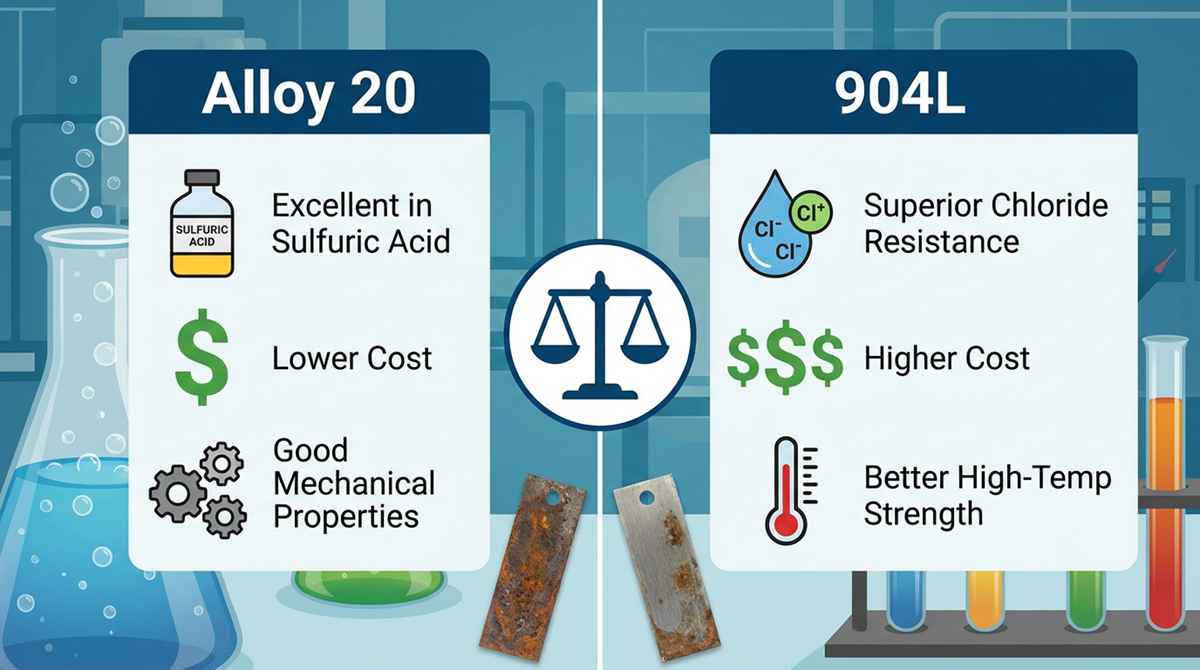
Understanding the Alloy 20 vs 904L comparison begins with their chemical signatures. Alloy 20 is frequently classified as a “super-austenitic” stainless steel or a nickel alloy because of its high nickel content (approx. 35%). This high nickel concentration, combined with copper and molybdenum, provides exceptional resistance to sulfuric acid at various temperatures and concentrations.
In contrast, 904L is a high-alloy austenitic stainless steel with a nickel content of roughly 25%. While it also contains copper to enhance resistance to strong reducing acids, it was primarily developed to resist pitting and crevice corrosion in dilute sulfuric acid and phosphoric acid environments.
Technical Specification Table
| Property | Alloy 20 (UNS N08020) | 904L (UNS N08904) |
| Nickel (Ni) | 32.5% – 35.0% | 23.0% – 28.0% |
| Chromium (Cr) | 19.0% – 21.0% | 19.0% – 23.0% |
| Molybdenum (Mo) | 2.0% – 3.0% | 4.0% – 5.0% |
| Copper (Cu) | 3.0% – 4.0% | 1.0% – 2.0% |
| PREN Value | ~24 – 26 | ~34 – 36 |
| Yield Strength | 35,000 psi (241 MPa) | 31,000 psi (215 MPa) |
Alloy 20 vs 904L: How to Choose the Right Material
When deciding Alloy 20 vs 904L: how to choose, the primary factor is the specific nature of the corrosive media.
-
Chloride vs. Acid Concentration: If your application involves high chloride concentrations where pitting is the primary concern, 904L is often the superior choice due to its higher Molybdenum content and higher Pitting Resistance Equivalent Number (PREN).
-
Sulfuric Acid Purity: Alloy 20 is the industry standard for “Sulfuric Acid Service.” It excels in 20% to 40% sulfuric acid concentrations where other steels fail. Its niobium (columbium) stabilization also prevents intergranular corrosion during welding.
-
Cost Efficiency: Generally, 904L is more cost-effective for general-purpose chemical handling, while Alloy 20 is a specialized investment for aggressive acid boiling points and heat exchanger tubing.
Alloy 20 vs 904L: Chemical Plant Selection Strategies
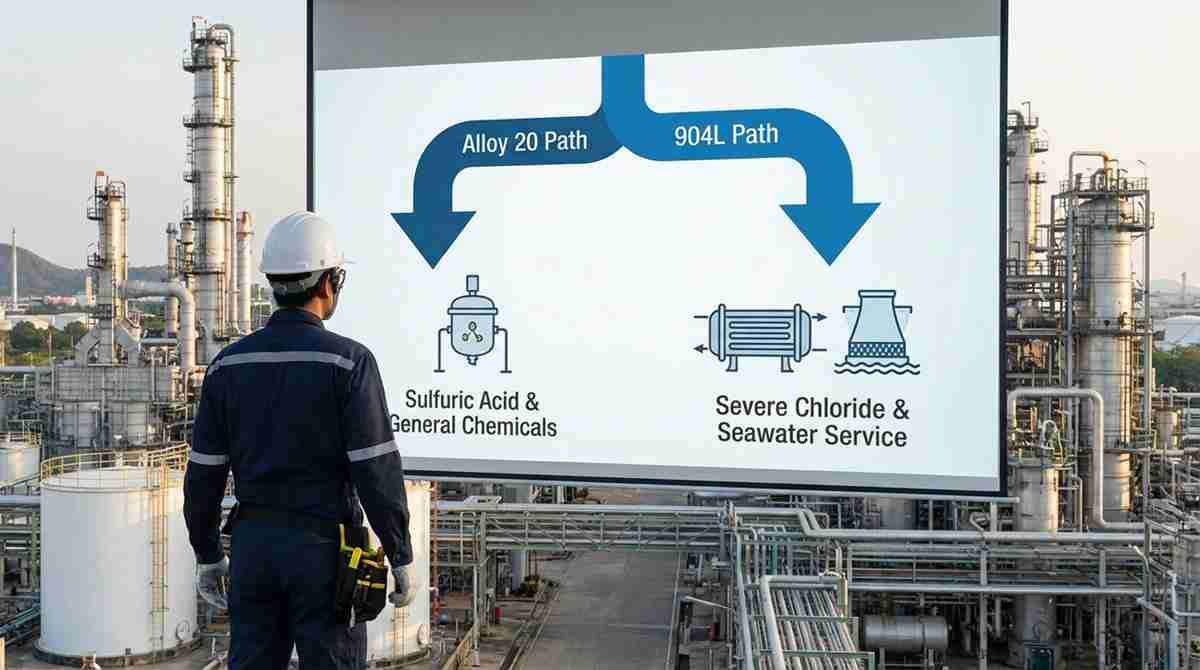
In the context of Alloy 20 vs 904L chemical plant selection, engineers must look at the total lifecycle cost. In chemical processing plants, Alloy 20 is the preferred material for pickling tanks, mixing tanks, and heat exchangers dealing with sulfuric acid concentrations up to 95% at elevated temperatures.
Conversely, 904L is the go-to for flue-gas desulfurization (FGD) systems, pharmaceutical manufacturing, and paper pulp processing. It provides a robust defense against “warm sea water” and brackish water, making it ideal for coastal chemical facilities where external salt spray adds an extra layer of corrosive stress to the piping.
Related Q&A
Q1: Can Alloy 20 be used in seawater applications? A1: While Alloy 20 has decent resistance, 904L is generally preferred for seawater or high-chloride environments due to its higher PREN (34-36), which offers better protection against pitting.
Q2: Why is Alloy 20 called “The Carpenter 20” alloy? A2: It was originally developed by Carpenter Technology Corporation. Today, many manufacturers produce it under the UNS N08020 specification, but it remains the benchmark for sulfuric acid resistance.
Q3: Which alloy is easier to weld in a chemical plant setting? A3: Both exhibit good weldability using common methods like TIG or MIG. However, Alloy 20’s niobium stabilization makes it slightly more resistant to carbide precipitation in the heat-affected zone (HAZ) compared to 904L.