











In the world of high-performance nickel-based superalloys, Inconel 625 and Inconel 600 stand out as industry standards. While both belong to the same family developed by Special Metals Corporation, their chemical compositions lead to vastly different mechanical behaviors and environmental resistances. Understanding these nuances is critical for engineers working in aerospace, marine, and chemical processing sectors.
625 vs 600 Differences: Chemical Composition and Metallurgy
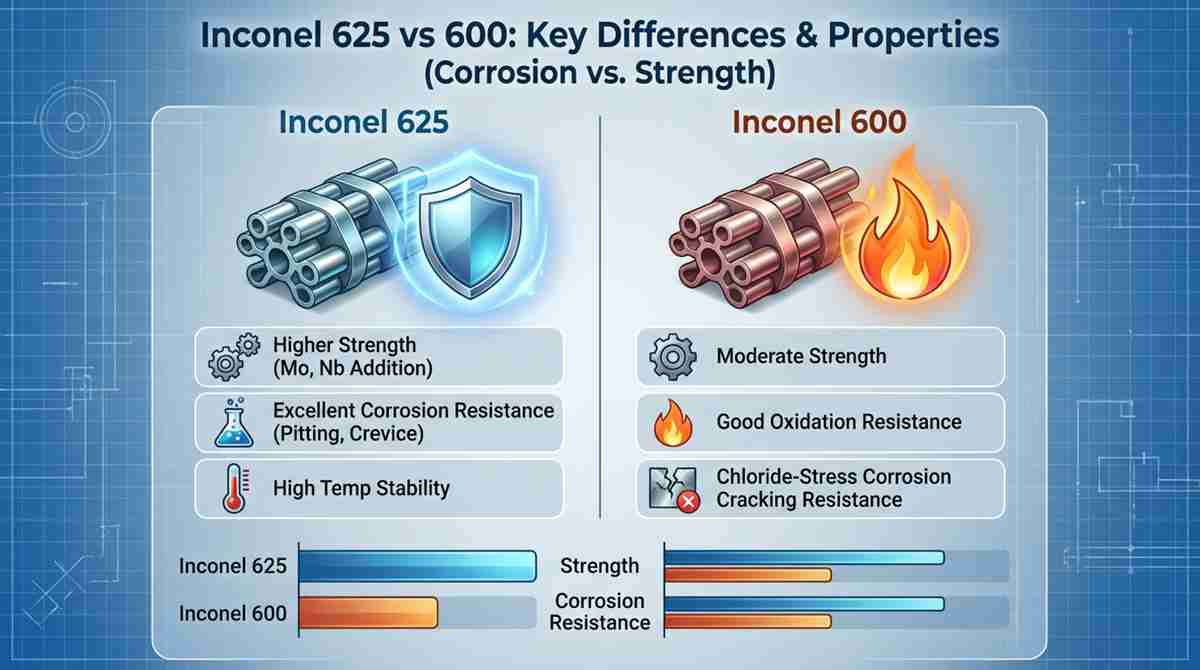
The fundamental difference between these two alloys lies in their alloying elements. Inconel 600 is essentially a nickel-chromium alloy designed for high-temperature oxidation resistance. In contrast, Inconel 625 includes significant additions of molybdenum and niobium.
-
Inconel 600 (UNS N06600): High nickel content (72% min) provides excellent resistance to chloride-ion stress corrosion cracking and alkaline solutions.
-
Inconel 625 (UNS N06625): The addition of molybdenum ( to ) and niobium ( to ) stiffens the alloy matrix, providing high strength without the need for precipitation-hardening heat treatments.
| Property | Inconel 600 | Inconel 625 |
| Primary Elements | Ni, Cr, Fe | Ni, Cr, Mo, Nb, Fe |
| Density | $8.47 \text{ g/cm}^3$ | $8.44 \text{ g/cm}^3$ |
| Melting Point | $1354-1413^\circ\text{C}$ | $1290-1350^\circ\text{C}$ |
| Yield Strength (0.2% Offset) | $\approx 240 \text{ MPa}$ | $\approx 414 \text{ MPa}$ |
| Tensile Strength | $\approx 550 \text{ MPa}$ | $\approx 827 \text{ MPa}$ |
Inconel 625 vs 600 Corrosion vs Strength
When evaluating Inconel 625 vs 600 corrosion vs strength, 625 is the clear winner in aggressive environments.
Strength: The “stiffening” effect of molybdenum and niobium in Inconel 625 gives it nearly double the yield strength of Inconel 600 at room temperature. More importantly, 625 maintains superior fatigue strength and creep-rupture properties at elevated temperatures (up to ).
Corrosion Resistance:
-
Pitting and Crevice Corrosion: Inconel 625 is highly resistant to localized attack in seawater and acidic chlorides, whereas Inconel 600 is more susceptible to pitting in stagnant chloride environments.
-
Oxidation: Both perform well, but Inconel 600 is specifically prized for its stability in dry chlorine and pure water systems in nuclear reactors.
-
Stress Corrosion Cracking (SCC): Inconel 600 is the go-to for resisting SCC in high-purity water, though Inconel 625 offers broader resistance in varied chemical media.
625 vs 600 How to Choose?
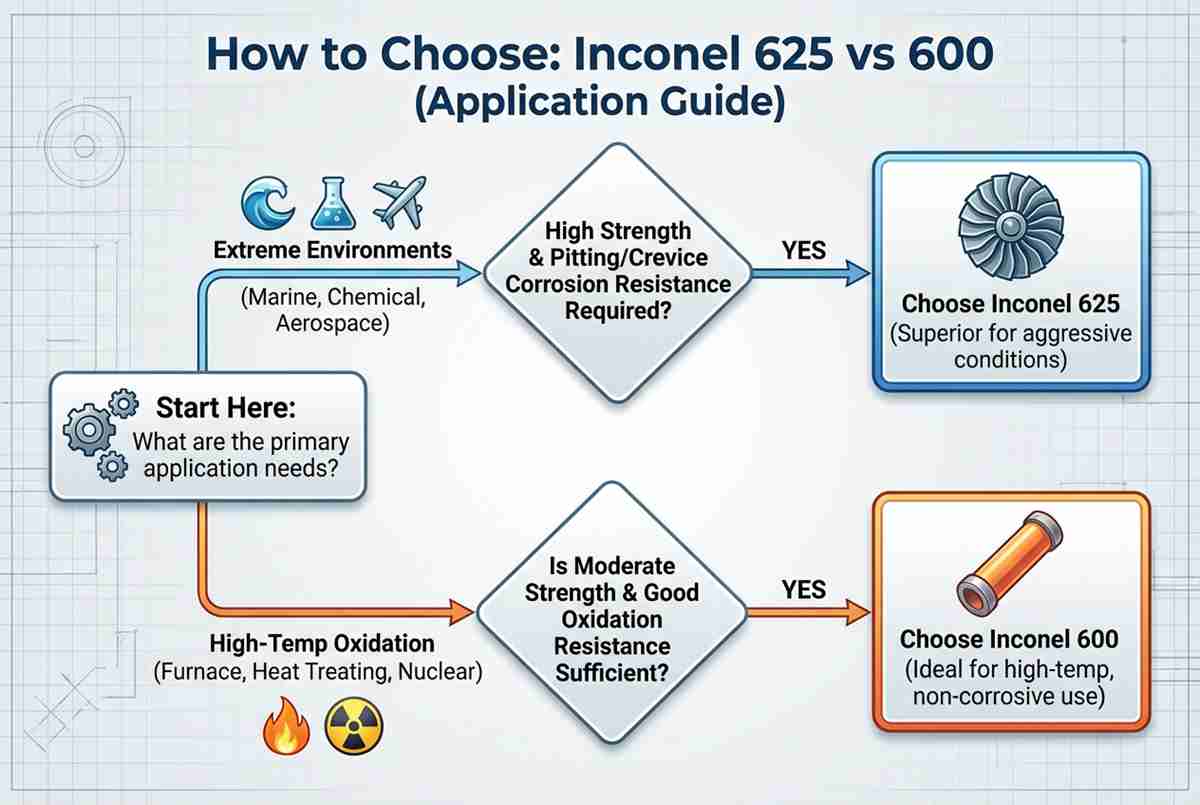
Deciding on 625 vs 600 how to choose depends on your specific application constraints—primarily temperature, corrosive media, and mechanical load.
-
Choose Inconel 600 if: Your application involves heat-treating muffles, furnace components, or nuclear steam generator tubing. It is the more cost-effective choice when extreme tensile strength and molybdenum-based corrosion resistance aren’t required.
-
Choose Inconel 625 if: You are operating in marine environments (subsea piping), aerospace exhaust systems, or chemical plants involving highly contaminated mineral acids. If your design requires high fatigue strength and resistance to pitting, 625 is indispensable.
Related Q&A
Q1: Is Inconel 625 harder to machine than Inconel 600? Yes. Due to its higher work-hardening rate and molybdenum content, Inconel 625 is more challenging to machine. It requires heavy-duty equipment, slow speeds, and high-quality carbide tooling compared to the relatively more “workable” Inconel 600.
Q2: Can these alloys be welded together? Yes, they are both weldable using common methods like TIG (GTAW) or MIG (GMAW). Generally, Inconel 625 filler metal (like ERNiCrMo-3) is used because its high alloy content helps prevent “weld dilution” issues and ensures the joint’s corrosion resistance.
Q3: Which alloy is better for cryogenic applications? Both alloys maintain excellent mechanical properties at sub-zero temperatures. However, Inconel 625 is often preferred in cryogenic tanks and aerospace components due to its superior toughness and tensile properties in extreme cold.