










In the demanding world of aerospace and gas turbine engineering, selecting the right nickel-based superalloy is a critical decision that balances mechanical performance, thermal stability, and cost-efficiency. Inconel 718 and Waspaloy are two of the most prominent materials in this category, both prized for their exceptional strength at elevated temperatures. However, their metallurgical profiles and performance ceilings differ significantly.
718 vs. Waspaloy Comparison: Composition and Metallurgy
While both are age-hardenable nickel-based superalloys, the fundamental difference lies in their strengthening phases.
-
Inconel 718 is primarily strengthened by the (gamma double prime) phase, a niobium-rich precipitate (). This allows for excellent weldability and resistance to post-weld age cracking.
-
Waspaloy relies on the (gamma prime) phase, enriched with aluminum and titanium (). This phase is more thermally stable at extreme temperatures compared to the phase found in 718.
Key Material Properties
| Property | Inconel 718 | Waspaloy |
| Primary Strengthening Phase | $\gamma”$ (Gamma Double Prime) | $\gamma’$ (Gamma Prime) |
| Density | 8.19 g/cm³ | 8.19 g/cm³ |
| Melting Range | 1260°C – 1336°C | 1330°C – 1360°C |
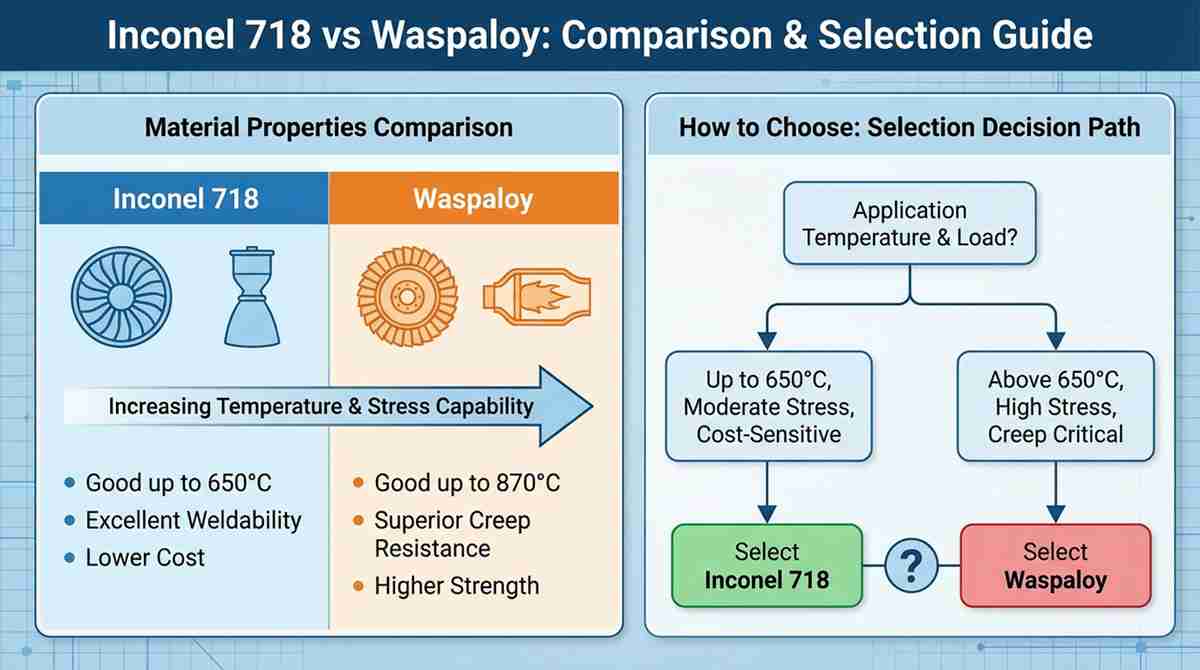
| Maximum Service Temp | ~650°C (1200°F) | ~870°C (1600°F) |
| Fabricability | Excellent (Weldable) | Difficult (Strain-age cracking prone) |
718 vs. Waspaloy Creep Performance: The Temperature Threshold
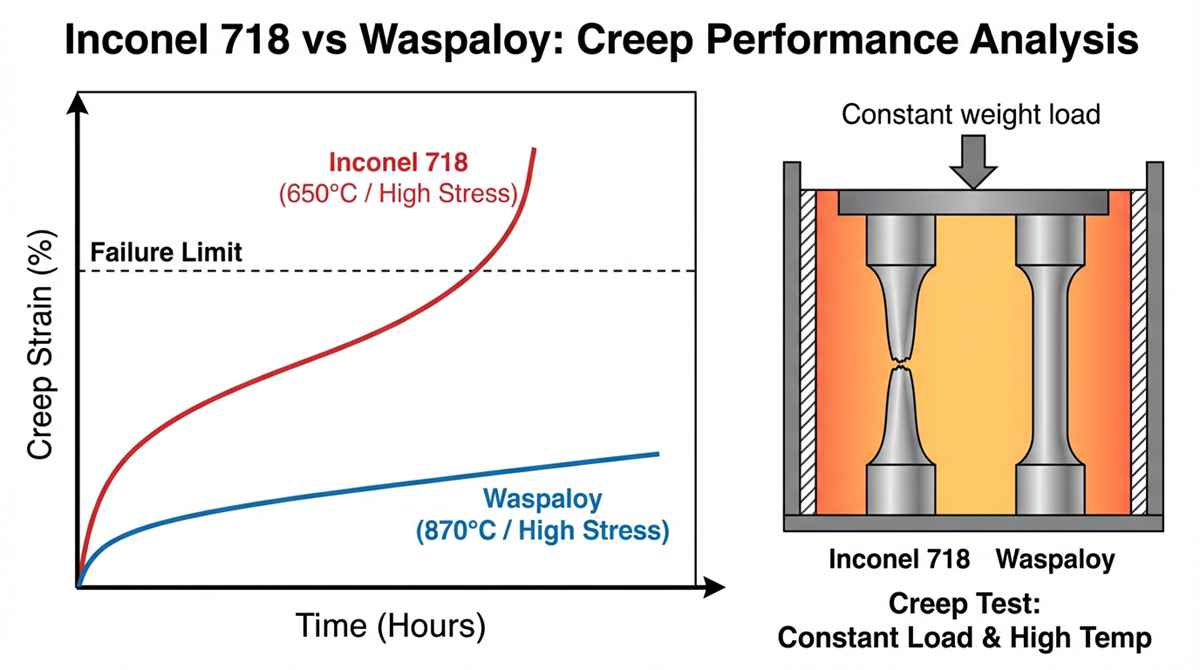
When evaluating 718 vs. Waspaloy creep performance, the “service ceiling” becomes the deciding factor.
Inconel 718 exhibits superb tensile and creep-rupture strength at temperatures up to 650°C (1200°F). Beyond this point, the phase begins to transform into the stable but brittle (delta) phase, leading to a rapid loss of mechanical properties.
Conversely, Waspaloy is engineered for the long haul in hotter environments. Because the phase is more resistant to overaging, Waspaloy maintains its structural integrity and creep resistance at temperatures reaching 870°C (1600°F). In high-stress applications like turbine disks and spacers, Waspaloy provides the necessary durability where 718 would simply lose its “temper.”
718 vs. Waspaloy: How to Choose the Right Alloy
Choosing between these two powerhouses depends on three primary pillars: Operating Temperature, Budget, and Manufacturability.
-
Temperature Requirements: If your application operates consistently below 650°C, Inconel 718 is often the gold standard due to its high yield strength and fatigue resistance. If the environment exceeds 700°C, Waspaloy is virtually mandatory.
-
Cost and Availability: Inconel 718 is more widely produced, making it generally more cost-effective and easier to source in various forms (sheet, bar, plate). Waspaloy is a premium alloy with higher processing costs.
-
Fabrication Complexity: If the component requires extensive welding, 718 is the safer bet. Waspaloy is notoriously difficult to weld and often requires complex heat treatment cycles to prevent cracking during the fabrication process.
Related Q&A
Q1: Can Inconel 718 be used in jet engine exhaust sections? Only in the cooler sections. While 718 is great for compressors and some turbine parts, the extreme heat of the exhaust usually requires Waspaloy or even cobalt-based alloys to prevent creep deformation.
Q2: Which alloy is harder to machine? Both are “difficult-to-machine” materials. However, Waspaloy tends to work-harden more rapidly than 718, requiring rigid setups and specific carbide tooling to manage tool wear effectively.
Q3: Does Waspaloy offer better corrosion resistance than 718? Both offer excellent oxidation resistance. However, Waspaloy’s higher cobalt and molybdenum content can provide a slight edge in certain high-temperature corrosive environments found in gas turbines.