










In the demanding world of thermal processing and aerospace engineering, selecting the right nickel-based superalloy is critical for component longevity. Haynes 230 and Inconel 601 (UNS N06601) are two of the most prominent materials used in high-heat environments. While both offer exceptional performance, their distinct metallurgical compositions—specifically the use of tungsten in Haynes 230 versus aluminum in Inconel 601—dictate their suitability for specific industrial applications.
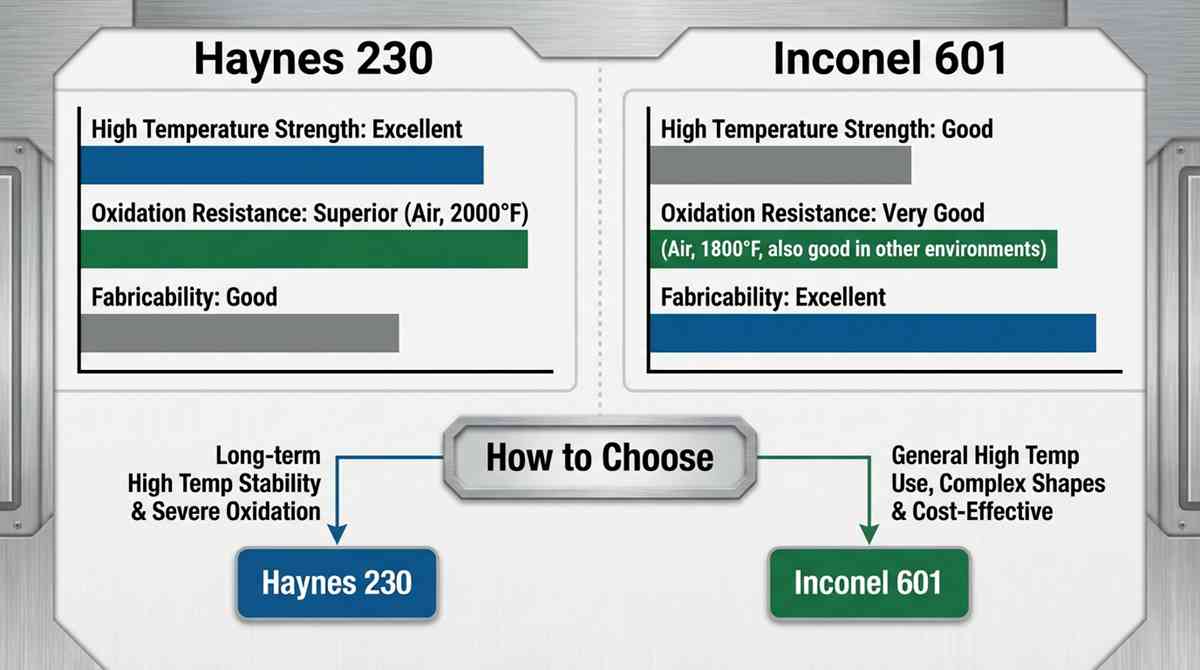
Haynes 230 vs 601 Comparison
When conducting a Haynes 230 vs 601 comparison, the primary difference lies in their strengthening mechanisms. Haynes 230 is a nickel-chromium-tungsten-molybdenum alloy. The addition of tungsten (14%) provides superior solid-solution strengthening, making it one of the strongest non-age-hardenable alloys available.
In contrast, Inconel 601 is a nickel-chromium-iron alloy with a significant aluminum (1.4%) addition. While 601 possesses respectable mechanical strength, its design focus is geared more toward environmental stability than pure load-bearing capacity at the highest temperature ranges.
Technical Specification Table
| Property | Haynes 230 (UNS N06230) | Inconel 601 (UNS N06601) |
| Base Composition | Ni-Cr-W-Mo | Ni-Cr-Fe-Al |
| Density | 8.97 g/cm³ | 8.11 g/cm³ |
| Max Service Temp (Oxidation) | 2100°F (1149°C) | 2282°F (1250°C) |
| Key Alloying Elements | 22% Cr, 14% W, 2% Mo, La | 23% Cr, 60% Ni, 1.4% Al |
| Strengthening Method | Solid Solution (Tungsten) | Solid Solution (Al/Cr) |
| Thermal Expansion (at 1000°C) | 14.2 µm/m°C | 17.5 µm/m°C |
Haynes 230 vs 601 How to Choose
Understanding Haynes 230 vs 601 how to choose depends on balancing mechanical stress against environmental factors and budget.
-
Mechanical Load & Creep Resistance: If your application involves high structural stress at temperatures above 1200°F (650°C), Haynes 230 is the superior choice. Its creep-rupture strength is significantly higher than Inconel 601, allowing for thinner wall sections in design without sacrificing safety.
-
Thermal Stability: Haynes 230 exhibits a rare resistance to grain coarsening even after long-term exposure to heat. This makes it ideal for aerospace turbine components where dimensional stability is paramount.
-
Cost-Effectiveness: For general industrial heating applications where “good enough” strength is coupled with a need for extreme oxidation resistance, Inconel 601 is typically more cost-effective. It lacks the expensive tungsten and molybdenum found in Haynes 230, making it the preferred choice for furnace baskets and heat-treating retorts.
-
Thermal Cycling: If the component undergoes frequent heating and cooling cycles, the lower thermal expansion rate of Haynes 230 reduces the risk of thermal fatigue.
Haynes 230 vs 601 Oxidation Resistance
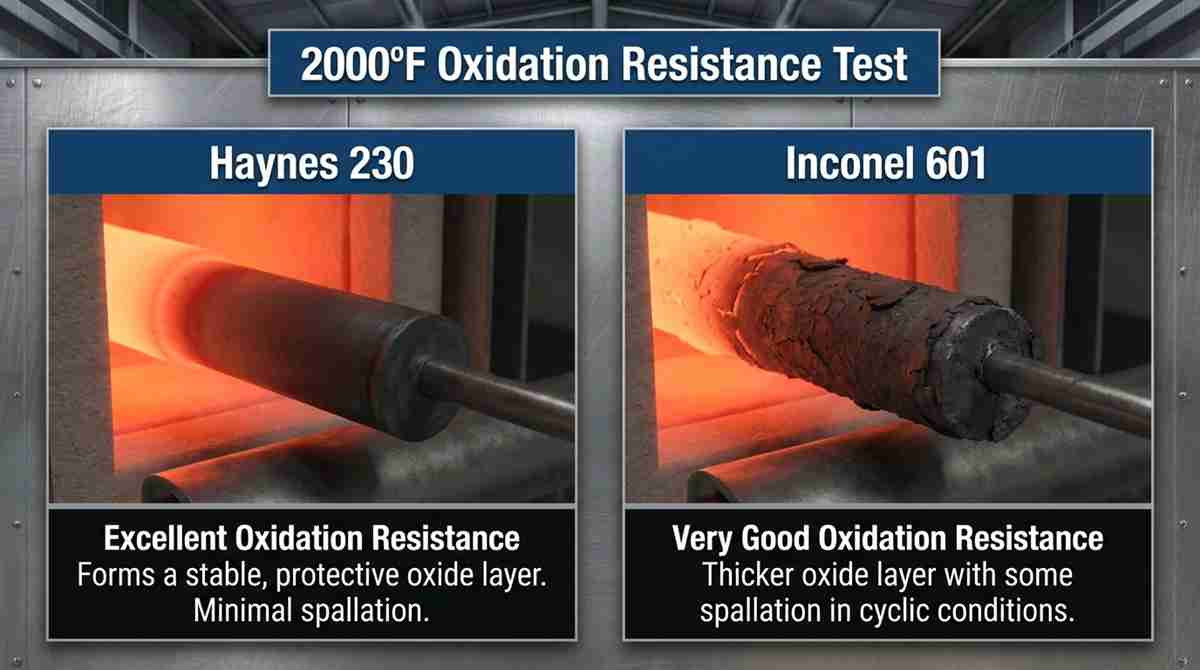
The mechanism of Haynes 230 vs 601 oxidation resistance highlights the different metallurgical philosophies of these alloys.
-
Inconel 601 is renowned for its ability to form a protective, tightly adherent oxide scale. The aluminum content works in tandem with chromium to develop a dense layer that resists spalling, even under severe thermal cycling. It is arguably the gold standard for resistance to oxidation and carburization up to 1250°C.
-
Haynes 230 utilizes a combination of high chromium and a “micro-addition” of Lanthanum. This rare-earth element significantly enhances the tenacity of the protective oxide scale. While its peak oxidation temperature is slightly lower than 601, its resistance to nitriding and specialized chemical attacks is often superior.
Related Q&A
Q1: Which alloy is easier to weld: Haynes 230 or Inconel 601? Both alloys exhibit excellent weldability using common methods like GTAW (TIG) and GMAW (MIG). However, Haynes 230 is often cited for its superior fabricability in complex shapes due to its better ductility and resistance to hot cracking during the welding process.
Q2: Can Inconel 601 replace Haynes 230 in gas turbine combustors? While Inconel 601 has the necessary oxidation resistance, it generally lacks the creep strength required for high-stress turbine environments. Using 601 in place of 230 in these scenarios could lead to premature structural deformation or “creep” failure.
Q3: Is Haynes 230 magnetic? No, Haynes 230 is a non-magnetic, austenitic alloy. Inconel 601 is also non-magnetic under standard conditions but may exhibit slight magnetic properties at very low temperatures (Curie point is roughly -160°F).