











In the demanding world of industrial manufacturing, the integrity of your materials determines the success of your project. When operating in environments characterized by extreme temperatures and corrosive substances, finding a reputable nickel alloy supplier is more than a procurement task—it is a strategic necessity. Nickel-based alloys are renowned for their exceptional heat resistance and ability to withstand oxidation, making them indispensable in sectors ranging from aerospace to chemical processing.
The Role of High-Performance Nickel Alloys
Nickel alloys are engineered to perform where standard stainless steels fail. Whether it is the creep resistance of Inconel or the saltwater corrosion resistance of Monel, these materials require precise metallurgical control. A professional nickel alloy supplier doesn’t just provide raw materials; they offer technical assurance that the chemical composition meets stringent ASTM, ASME, or AMS standards.
Key Considerations for Evaluation
When auditing a potential nickel alloy supplier, look beyond the price per kilogram. Consider these three pillars of reliability:
-
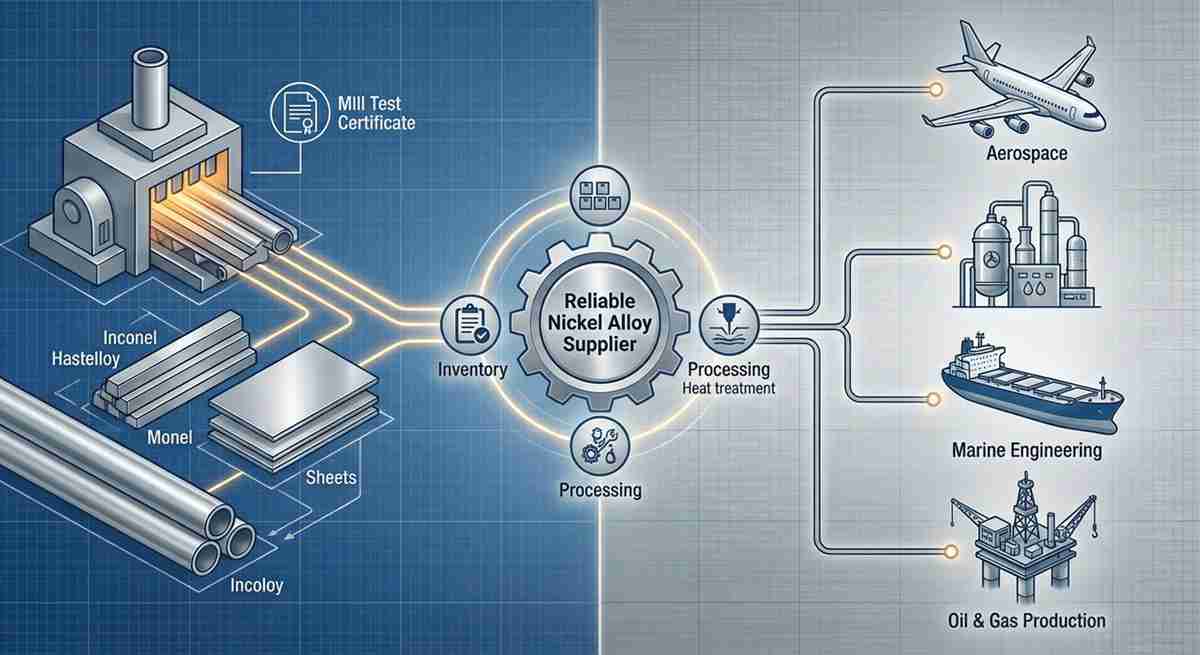
Inventory Depth: Can they provide various forms such as sheets, plates, bars, and pipes?
-
Certification and Traceability: Every batch should come with a Mill Test Certificate (MTC) to ensure material purity.
-
Processing Capabilities: Does the nickel alloy supplier offer value-added services like waterjet cutting or heat treatment?
Comparison of Popular Nickel Alloy Grades
| Grade | Primary Alloying Elements | Key Characteristics | Common Applications |
| Inconel 625 | Ni, Cr, Mo, Nb | High strength, excellent fabricability | Marine & Aerospace |
| Hastelloy C276 | Ni, Mo, Cr, W | Outstanding corrosion resistance | Chemical Processing |
| Monel 400 | Ni, Cu | Resistance to seawater and steam | Marine Engineering |
| Incoloy 825 | Ni, Fe, Cr, Mo, Cu | Resistance to acid corrosion | Oil & Gas Production |
Strengthening the Supply Chain
A top-tier nickel alloy supplier acts as a bridge between the mill and the end-user. With global logistics becoming increasingly complex, a local nickel alloy supplier with a robust global network can mitigate risks associated with lead times and material shortages. By partnering with a knowledgeable nickel alloy supplier, engineers can gain insights into the latest metallurgical advancements, ensuring that the chosen grade is perfectly matched to the application’s thermal and mechanical stressors.
Related Q&A
-
Q: What certifications are essential for a nickel alloy supplier?
-
A: Look for ISO 9001 for quality management and AS9100 if you are in the aerospace sector. Proper MTC (Mill Test Certificate) documentation is non-negotiable.
-
-
Q: Can a nickel alloy supplier provide custom sizes?
-
A: Yes, most professional suppliers offer precision cutting services, including saw cutting and waterjet cutting, to meet specific project dimensions.
-
-
Q: Why do nickel alloy prices fluctuate so much?
-
A: Prices are heavily tied to the London Metal Exchange (LME). A transparent nickel alloy supplier will provide market-indexed pricing to ensure fairness.
-