











The advancement of modern aerospace and power generation technologies is inextricably linked to the development of materials that can withstand extreme thermal and mechanical stress. At the forefront of this material science revolution is the high temperature nickel alloy, a class of superalloys specifically engineered to maintain structural integrity at temperatures often exceeding (). These alloys are not merely metals; they are complex metallurgical masterpieces designed to resist creep, oxidation, and corrosion in environments where most industrial materials would simply fail.
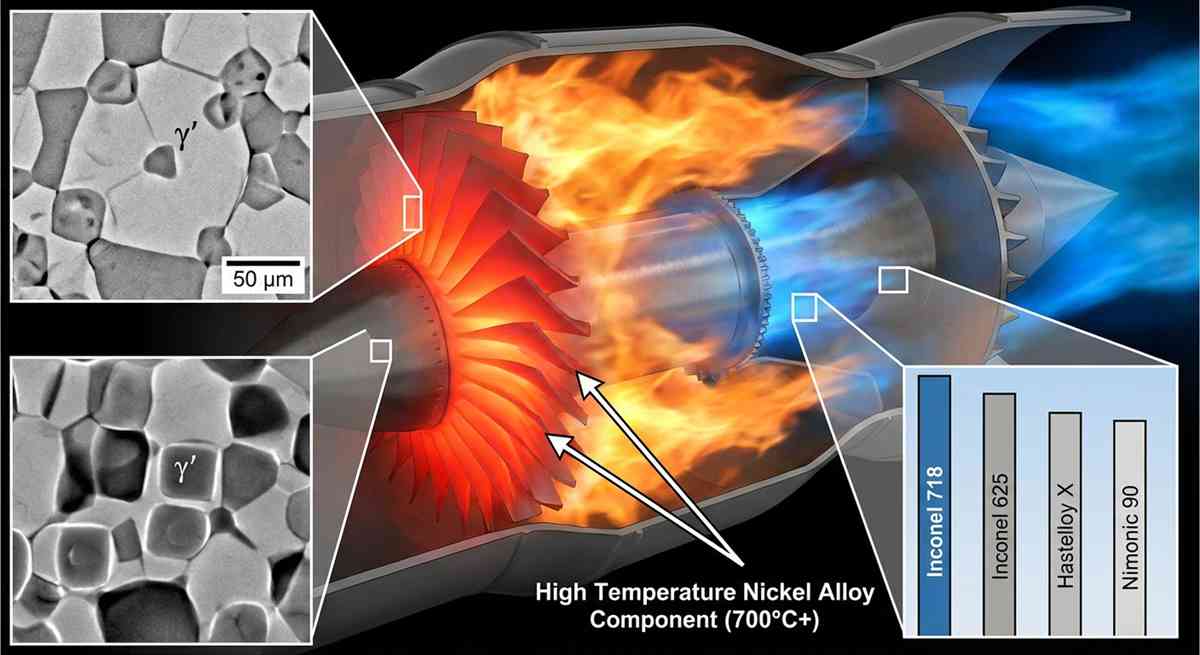
The Metallurgy of High Temperature Nickel Alloy
What sets a high temperature nickel alloy apart from standard stainless steel is its unique microstructural stability. Most of these alloys utilize a face-centered cubic (FCC) austenite matrix. This matrix is often strengthened by the precipitation of a secondary phase, known as gamma prime ().
This phase creates a barrier against dislocation movement—the primary mechanism of metal deformation. Because this strengthening remains effective even as the material approaches its melting point, the high temperature nickel alloy remains the preferred choice for turbine blades and exhaust components.
Comparative Grades of High Temperature Nickel Alloy
To understand the versatility of these materials, it is helpful to compare the most commonly utilized grades in the industry:
| Alloy Grade | Primary Elements | Max Service Temp | Key Characteristic |
| Inconel 718 | Ni, Cr, Fe, Nb | $700^\circ\text{C}$ | Excellent weldability and high strength |
| Inconel 625 | Ni, Cr, Mo, Nb | $980^\circ\text{C}$ | Superior corrosion and fatigue resistance |
| Hastelloy X | Ni, Cr, Fe, Mo | $1200^\circ\text{C}$ | Exceptional oxidation resistance at high heat |
| Nimonic 90 | Ni, Cr, Co, Ti | $920^\circ\text{C}$ | High creep-rupture strength |
Industrial Applications for High Temperature Nickel Alloy
The demand for high temperature nickel alloy is driven by sectors that push the limits of physics. In the aerospace industry, jet engines rely on these alloys for high-pressure turbine disks and combustion chambers. The higher the operating temperature, the better the fuel efficiency of the engine; thus, the evolution of the high temperature nickel alloy directly impacts the sustainability of modern aviation.
Furthermore, in the energy sector, land-based gas turbines and nuclear reactors utilize high temperature nickel alloy components to ensure long-term reliability. The alloy’s ability to resist “creep”—the slow deformation of material under persistent mechanical stress at high temperatures—is vital for components that must operate for thousands of hours without maintenance.
Related Q&A
Q1: Why is nickel chosen as the base for high temperature alloys?
A: Nickel has a high melting point and a stable FCC crystal structure that does not undergo phase changes from room temperature to its melting point, allowing for consistent performance in extreme heat.
Q2: Can high temperature nickel alloy be easily machined?
A: No, these alloys are notoriously difficult to machine because they work-harden rapidly and have low thermal conductivity, which concentrates heat at the cutting tool. Specialized tooling and cooling techniques are required.
Q3: What is the difference between Inconel and a standard high temperature nickel alloy?
A: Inconel is a brand name (owned by Special Metals Corp) for a specific family of nickel-chromium superalloys. While all Inconel is a high temperature nickel alloy, not all nickel alloys are Inconel.