











When selecting materials for extreme environments—whether it’s the corrosive depths of a chemical processing plant or the scorching heat of a jet turbine—the nickel alloy chemical composition is the single most important factor determining performance. At 28Nickel, we understand that “nickel alloy” is a broad term covering a massive spectrum of engineered metals. To the uninitiated, it’s just metal; to an engineer, it is a precisely balanced recipe of elements designed to defy the laws of oxidation and mechanical failure.
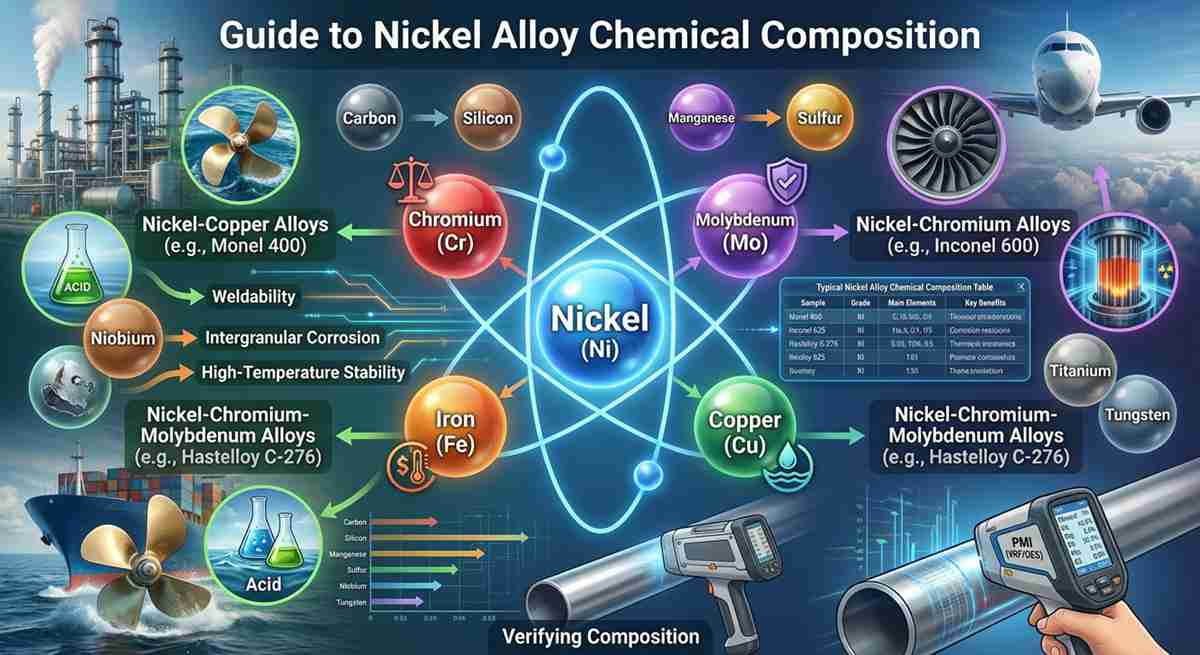
The Science Behind Nickel Alloy Chemical Composition
Nickel itself is a versatile base. It has a face-centered cubic (FCC) structure, which remains stable from cryogenic temperatures up to its melting point. However, pure nickel is rarely enough. By manipulating the nickel alloy chemical composition, metallurgists can “tune” the material to resist specific acids, handle immense pressure, or maintain structural integrity at .
The primary alloying elements usually include Chromium (Cr), Molybdenum (Mo), Iron (Fe), and Copper (Cu). Each serves a distinct purpose. For instance, Chromium is the primary driver for high-temperature oxidation resistance, forming a protective “scale” on the surface. Molybdenum, on the other hand, is the heavy hitter for resisting pitting and crevice corrosion in chloride-rich environments.
Categorizing Alloys by Their Chemical Makeup
To master the market, one must categorize these materials based on their nickel alloy chemical composition. Generally, we break them down into several “families”:
-
Nickel-Copper Alloys (e.g., Monel 400): These focus on resistance to seawater and hydrofluoric acid.
-
Nickel-Chromium Alloys (e.g., Inconel 600): High-strength materials that thrive in heat-treating and nuclear engineering.
-
Nickel-Chromium-Molybdenum Alloys (e.g., Hastelloy C-276): Often called the “universal corrosion-resistant” alloys, their complex nickel alloy chemical composition allows them to survive the most aggressive chemical “soups.”
Technical Data: Typical Nickel Alloy Chemical Composition Table
Below is a breakdown of some of the most common grades traded globally. Note how small shifts in the nickel alloy chemical composition lead to vastly different industrial applications.
| Grade (UNS) | Ni (%) | Cr (%) | Mo (%) | Fe (%) | Other Elements | Key Benefit |
| Monel 400 (N04400) | 63.0 min | – | – | 2.5 max | Cu: 28-34 | Saltwater resistance |
| Inconel 625 (N06625) | 58.0 min | 20-23 | 8-10 | 5.0 max | Nb: 3.15-4.15 | Fatigue strength & oxidation |
| Hastelloy C-276 (N10276) | Balance | 14.5-16.5 | 15-17 | 4.0-7.0 | W: 3.0-4.5 | Extreme acid resistance |
| Incoloy 825 (N08825) | 38-46 | 19.5-23.5 | 2.5-3.5 | 22.0 min | Cu: 1.5-3.0 | Sulfuric acid resistance |
The “Trace” Factor: Why 0.01% Matters
When we talk about nickel alloy chemical composition, we often focus on the big percentages. However, at 28Nickel, we know that the “trace” elements—Carbon, Silicon, Manganese, and Sulfur—are just as vital.
For example, in low-carbon “L” grades, keeping Carbon below is essential to prevent carbide precipitation during welding. If the nickel alloy chemical composition isn’t strictly controlled during the melting process (VIM or VAR melting), the material may pass a basic test but fail prematurely in the field due to “intergranular corrosion.” This is why Mill Test Reports (MTRs) are the “birth certificates” of our industry.
Analyzing the Nickel Alloy Chemical Composition for Procurement
For procurement officers, the challenge isn’t just knowing the nickel alloy chemical composition; it’s verifying it. Modern supply chains require rigorous testing. Positive Material Identification (PMI) using X-ray fluorescence (XRF) or Optical Emission Spectroscopy (OES) has become the gold standard.
When you buy from 28Nickel, you aren’t just buying a pipe or a plate; you are buying a guaranteed nickel alloy chemical composition that has been verified to meet ASTM, ASME, or DIN standards. Whether it’s the Chromium in an Inconel 600 or the Copper in Monel, these elements are the silent guardians of your infrastructure.
Summary and Related Q&A
Understanding the nuances of nickel alloy chemical composition is the difference between a project that lasts forty years and one that fails in four months. As the global industry pushes for higher efficiency and harsher processing conditions, the demand for precise chemical control will only grow.
Related Q&A
Q1: How does the nickel alloy chemical composition affect weldability?
A: Elements like Niobium and Titanium are often added to stabilize the alloy, preventing Chromium carbide precipitation. If the nickel alloy chemical composition has too much Carbon, the “heat-affected zone” of a weld becomes vulnerable to corrosion.
Q2: Why is Iron (Fe) included in many high-nickel alloys?
A: Iron is often used to manage costs and improve the thermal expansion coefficients of the material. However, in “superalloys,” the nickel alloy chemical composition usually keeps Iron low to maximize high-temperature stability.
Q3: Can I verify the nickel alloy chemical composition on-site?
A: Yes. Handheld PMI (Positive Material Identification) guns can provide a non-destructive analysis of the nickel alloy chemical composition in seconds, though full lab analysis remains the most accurate for trace elements.