










In the demanding world of industrial engineering, materials are often pushed to their absolute physical limits. Whether it is the core of a jet engine or the interior of a chemical reactor, the ability to withstand extreme temperatures without structural failure is paramount. This is where nickel alloy heat resistance becomes the deciding factor in operational safety and efficiency. At 28Nickel, we specialize in providing high-performance materials that thrive where others melt, ensuring that your projects maintain integrity under the most grueling thermal conditions.
The Metallurgical Secret of Nickel Alloy Heat Resistance
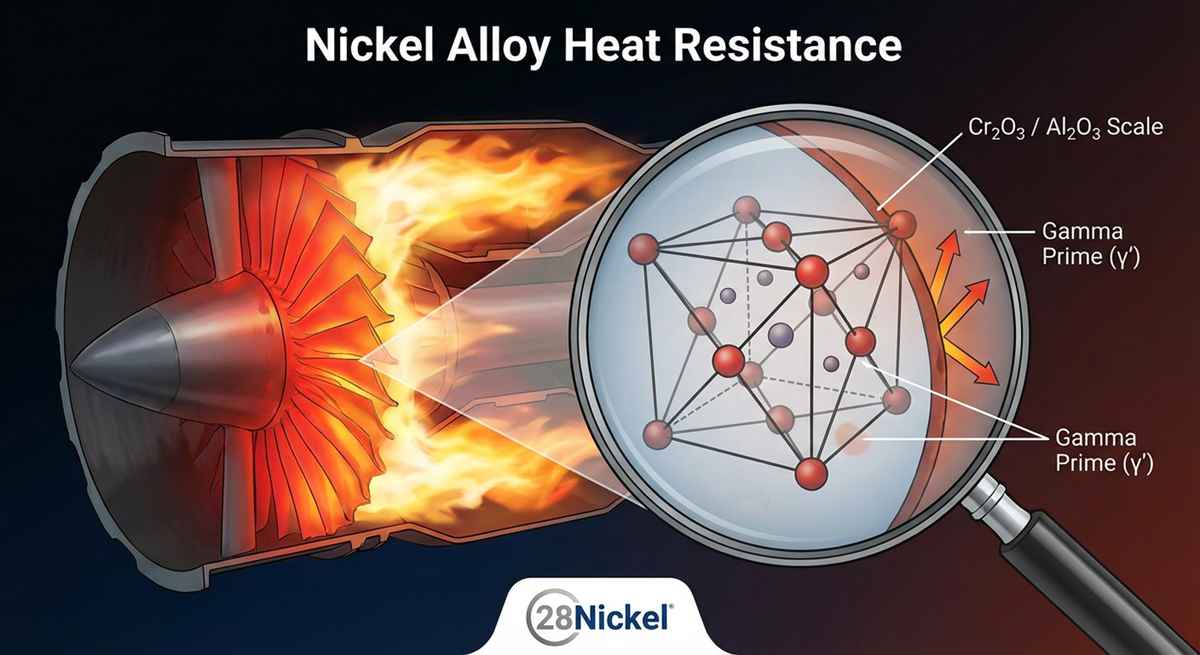
What makes nickel the “gold standard” for high-temperature applications? The answer lies in its unique atomic structure. Nickel possesses a face-centered cubic (FCC) crystal structure, which remains stable from room temperature all the way up to its melting point. Unlike many other metals that undergo phase transformations when heated—leading to brittleness or expansion—the stability of nickel provides a consistent foundation for alloying.
To further enhance nickel alloy heat resistance, elements like chromium, molybdenum, and tungsten are added. These elements contribute to “solid solution strengthening.” Additionally, the formation of a “gamma prime” () precipitate phase in alloys like Inconel 718 creates a barrier against dislocation movement. In simpler terms, it prevents the metal atoms from sliding past each other when they get hot, effectively combatting the phenomenon known as “creep.”
Oxidation and Corrosion at High Temperatures
Heat resistance is not just about staying solid; it is about resisting chemical degradation. When exposed to extreme heat, most metals oxidize rapidly, forming a flaky scale that leads to thinning and eventual failure. However, superior nickel alloy heat resistance is bolstered by the formation of a passive, protective oxide layer.
By adding chromium and aluminum to the mix, nickel alloys develop a tightly adherent “skin” of or . This layer acts as a shield, preventing oxygen from penetrating deeper into the material. This is why industries dealing with carburization or sulfidation—such as waste-to-energy plants—rely heavily on these specialized alloys provided by 28Nickel.
Comparing High-Temp Performance
To better understand which material suits your needs, it is essential to compare how different grades handle thermal stress. The following table highlights the primary characteristics of common grades focused on nickel alloy heat resistance:
| Alloy Grade | Max Operating Temp (Approx.) | Primary Strengthening Mechanism | Best Use Case |
| Inconel 600 | 1100°C (2012°F) | Solid Solution | Furnace components, chemical processing |
| Inconel 625 | 980°C (1800°F) | Molybdenum/Niobium Matrix | Marine engineering, aerospace exhausts |
| Inconel 718 | 700°C (1300°F) | Precipitation Hardening | Gas turbines, rocket motors, high-strength bolts |
| Hastelloy X | 1200°C (2200°F) | Oxidation Resistance | Petrochemical plants, combustion liners |
Key Applications of Nickel Alloy Heat Resistance
The practical applications of these materials are vast. In the aerospace sector, turbine blades must rotate at high speeds while being blasted by burning fuel. Only the highest level of nickel alloy heat resistance can prevent these blades from stretching (creeping) and hitting the turbine casing.
Similarly, in the oil and gas industry, downhole tools are subjected to both high pressure and high temperature (HPHT). Using materials with inferior heat resistance leads to frequent equipment replacement and dangerous leaks. 28Nickel ensures that the alloys we supply are tested to meet these rigorous international standards, providing peace of mind for deep-sea and desert drilling operations.
Why Choose 28Nickel for High-Temp Solutions?
Choosing the right material is a balance of cost, longevity, and safety. While stainless steel might be cheaper initially, its lack of nickel alloy heat resistance means it will fail much faster in environments exceeding 550°C. By investing in premium nickel alloys, companies reduce downtime and long-term maintenance costs. At 28Nickel, we don’t just sell metal; we provide technical expertise to help you select the exact grade—be it Inconel, Monel, or Hastelloy—that fits your specific thermal profile.
Related Q&A
1. At what temperature does a nickel alloy lose its strength?
While it varies by grade, most standard nickel alloys begin to see a decrease in mechanical strength above 650°C (1200°F). However, specialized “superalloys” are designed to retain over 50% of their strength even as they approach 80% of their melting point.
2. Is nickel alloy heat resistance better than that of stainless steel?
Yes. While 300-series stainless steels have some heat resistance, they are prone to oxidation and loss of structural integrity at temperatures where nickel-based alloys remain perfectly stable. Nickel alloys are specifically engineered for environments where stainless steel would fail.
3. How does chromium improve nickel alloy heat resistance?
Chromium reacts with oxygen in the air to form a microscopic, protective layer of chromium oxide on the alloy’s surface. This layer prevents further oxygen penetration, protecting the internal structure from “burning” or corroding at high temperatures.