









When engineering components for extreme environments—whether it’s the high-pressure depths of subsea oil wells or the blistering heat of a jet engine—material integrity is non-negotiable. This nickel alloy selection guide is designed to help engineers and procurement specialists navigate the complex landscape of high-performance alloys. At 28Nickel, we’ve seen how the right choice can extend equipment life by decades, while a slight mismatch in grade can lead to catastrophic failure. Understanding the synergy between nickel, chromium, molybdenum, and iron is the first step in mastering your material strategy.
Why You Need a Nickel Alloy Selection Guide
Nickel alloys are the “superheroes” of the metals world. Unlike standard stainless steels, they maintain their mechanical properties under stresses that would cause other metals to melt, corrode, or crack. However, because these materials represent a significant investment, a precise nickel alloy selection guide is essential to balance performance with cost-efficiency.
Nickel’s primary strength lies in its Face-Centered Cubic (FCC) crystal structure, which remains stable from cryogenic temperatures up to its melting point. This stability allows for the addition of alloying elements that provide specific defenses:
-
Chromium: Enhances resistance to oxidizing environments.
-
Molybdenum: Protects against pitting and crevice corrosion in chloride-rich settings.
-
Copper: Vital for resistance to seawater and reducing acids like sulfuric acid.
Critical Environmental Factors
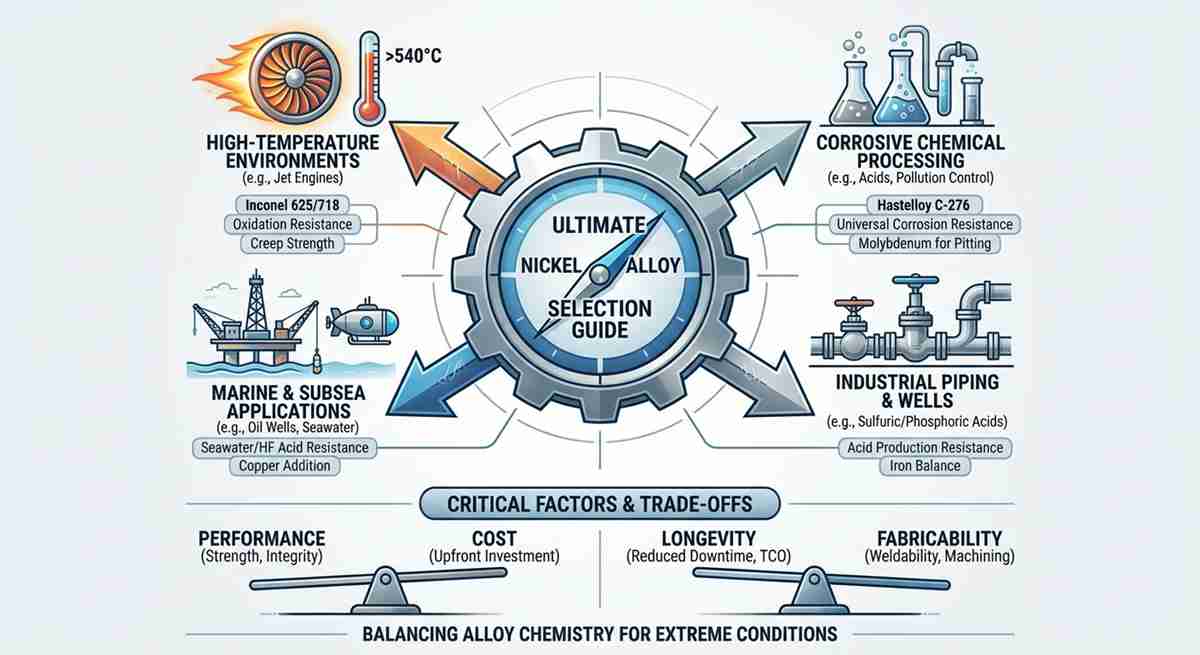
Before consulting any nickel alloy selection guide, you must define your “operating reality.” Metallurgy is always a trade-off.
1. Temperature Extremes
If your application exceeds (), standard steels lose their “creep” resistance. Nickel-chromium alloys, like Inconel, form a protective, stable oxide layer that prevents further degradation at high temperatures. Conversely, for cryogenic applications, nickel alloys remain ductile and tough where carbons steels become brittle.
2. Chemical Aggression
Are you dealing with oxidizing or reducing acids? For reducing environments (like hydrochloric acid), alloys with high nickel and molybdenum content are preferred. For oxidizing environments (like nitric acid), high chromium content is the priority.
Comparing Common Grades: A Quick Reference
To simplify your decision-making, we have compiled the following data into this nickel alloy selection guide table.
| Alloy Family | Common Grade | Key Characteristics | Typical Applications |
| Monel | Alloy 400 | Excellent resistance to seawater and hydrofluoric acid. | Marine engineering, chemical processing. |
| Inconel | Alloy 625 | High strength, excellent fatigue resistance, and fabricability. | Aerospace, offshore oil & gas, nuclear. |
| Inconel | Alloy 718 | Precipitation hardenable; extreme strength up to $700^{\circ}C$. | Gas turbine engines, high-strength bolting. |
| Hastelloy | C-276 | The “universal” corrosion-resistant alloy. | Pollution control, waste treatment, sour gas. |
| Incoloy | Alloy 825 | Resistance to sulfuric and phosphoric acids. | Oil and gas well piping, acid production. |
Mechanical Requirements and Fabricability
A comprehensive nickel alloy selection guide must look beyond chemistry. You must also consider how the part will be made.
-
Weldability: Alloys like Inconel 625 are prized for their excellent weldability without the risk of post-weld cracking.
-
Strength vs. Weight: In aerospace, the high strength-to-weight ratio of age-hardenable alloys (like 718) allows for thinner, lighter components that don’t sacrifice safety.
Cost vs. Longevity
While the upfront cost of a nickel-based solution is higher than stainless steel, the Total Cost of Ownership (TCO) is often lower. By reducing downtime, maintenance, and replacement cycles, the grades highlighted in this nickel alloy selection guide provide a much higher Return on Investment (ROI) for critical infrastructure.
Related Q&A
Q1: Can I use Monel 400 in high-temperature oxidizing environments?
No. While Monel 400 is superb for marine and reducing environments, it lacks the chromium content necessary to resist oxidation at high temperatures. For heat resistance, look toward the Inconel series.
Q2: What makes Hastelloy C-276 “universal”?
It contains high levels of nickel, molybdenum, and chromium. This combination allows it to resist both oxidizing and reducing media, making it a “safe” choice for complex chemical streams where conditions might fluctuate.
Q3: Is Inconel 718 harder to machine than 625?
Yes. Inconel 718 is a precipitation-hardened alloy designed for extreme strength. Its “work-hardening” nature makes it significantly tougher to machine than the solid-solution strengthened Inconel 625.