











When engineering components for extreme environments—such as aerospace turbines, deep-sea oil rigs, or chemical processing plants—the nickel alloy material specification serves as the definitive roadmap for performance and safety. For procurement managers and engineers at 28Nickel, understanding these specifications is not just about compliance; it is about ensuring the structural integrity of a project under high-stress conditions.
The Role of Standards in Nickel Alloy Material Specification
A nickel alloy material specification is a standardized set of requirements that defines the chemical composition, mechanical properties, heat treatment, and testing protocols for a specific grade. These are primarily governed by international bodies such as ASTM (American Society for Testing and Materials), ASME (American Society of Mechanical Engineers), and DIN (German Institute for Standardization).
For instance, ASTM B163 covers seamless nickel and nickel alloy condenser and heat exchanger tubes. Without a rigorous nickel alloy material specification, there would be no way to guarantee that a batch of Inconel 625 from one mill performs identically to a batch from another. These standards ensure that factors like yield strength, elongation, and grain size meet the minimum thresholds required for industrial safety.
Key Components of a Comprehensive Specification
A robust nickel alloy material specification typically includes the following critical data points:
-
Chemical Composition: Specifies the exact percentages of Nickel (Ni), Chromium (Cr), Molybdenum (Mo), and trace elements like Niobium (Nb) or Iron (Fe).
-
Mechanical Properties: Defines the Ultimate Tensile Strength (UTS), Yield Strength, and Hardness.
-
Physical Properties: Includes density, thermal conductivity, and coefficient of thermal expansion.
-
Testing Requirements: May involve ultrasonic testing (UT), radiographic testing (RT), or Charpy impact tests for low-temperature applications.
Comparison Table: Common Nickel Alloy Material Specification Grades
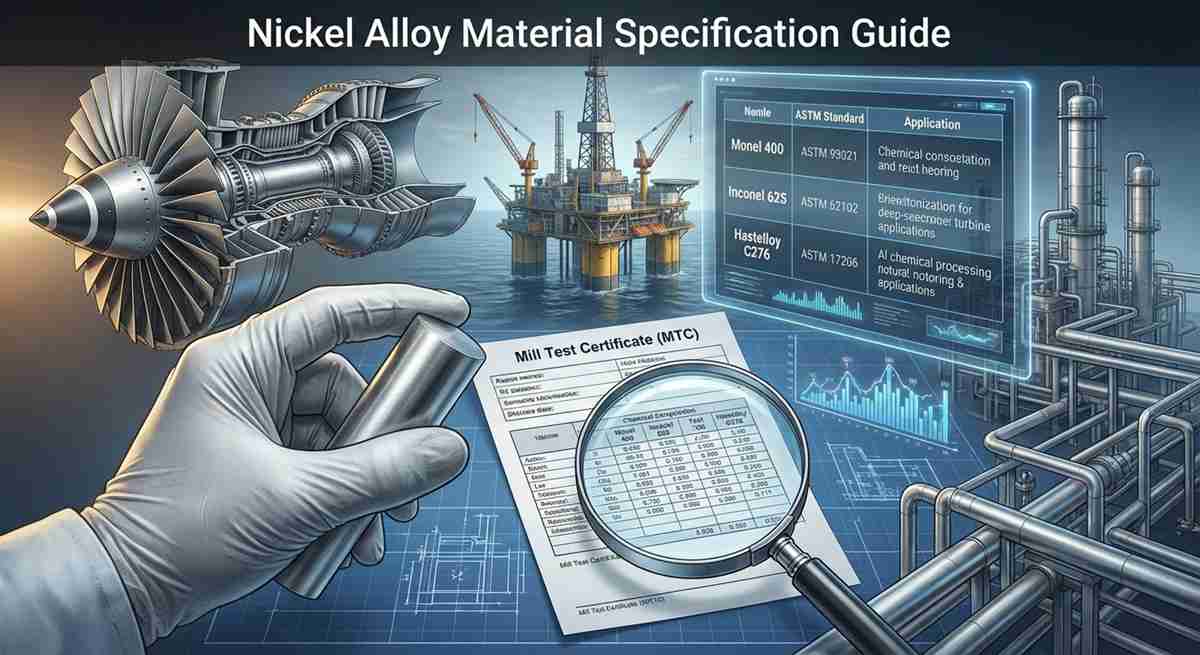
To help you navigate the complexities of material selection, the table below highlights some of the most common grades handled by 28Nickel and their corresponding international standards.
| Alloy Grade | Common UNS | Key Standard (ASTM) | Primary Application |
| Monel 400 | N04400 | ASTM B127 / B164 | Marine engineering and chemical processing |
| Inconel 625 | N06625 | ASTM B443 / B444 | Aerospace, marine, and nuclear reactors |
| Incoloy 825 | N08825 | ASTM B423 / B424 | Oil and gas acid gas piping, heat exchangers |
| Hastelloy C276 | N10276 | ASTM B574 / B575 | Aggressive chemical environments (acidic) |
| Nickel 200/201 | N02200 | ASTM B160 / B162 | Food processing and caustic soda handling |
Critical Factors in Evaluating a Nickel Alloy Material Specification
When reviewing a nickel alloy material specification, it is vital to look beyond just the grade name. The “Condition” or “Temper” of the material (e.g., Annealed, Solution Treated, or Aged) significantly alters its performance. For example, an Inconel 718 nickel alloy material specification in a precipitation-hardened state will offer vastly different tensile properties than one in a solution-annealed state.
Furthermore, environmental compatibility is a core pillar of any nickel alloy material specification. In sour gas environments (H2S), the NACE MR0175/ISO 15156 standard often overlays the basic ASTM spec to prevent Sulfide Stress Cracking (SSC). At 28Nickel, we ensure that every nickel alloy material specification provided matches the specific environmental challenges our clients face.
Conclusion
Mastering the nickel alloy material specification is the first step in successful material procurement. By adhering to global standards and understanding the nuances of chemical and mechanical requirements, 28Nickel provides high-performance solutions that stand the test of time and pressure.
Related Q&A
Q1: Why is the ASTM B-series important for nickel alloys?
The ASTM B-series specifically targets non-ferrous metals. A nickel alloy material specification under this series ensures the material has been manufactured and tested to survive corrosive or high-heat environments common in heavy industry.
Q2: Can a nickel alloy material specification be customized?
Yes. While standard ASTM or ASME specs cover most needs, “Proprietary Specifications” can be created for unique projects requiring tighter tolerances on trace elements or specific mechanical performance levels.
Q3: How does 28Nickel verify the material specification?
We provide a Mill Test Certificate (MTC) with every order. This document serves as proof that the nickel alloy material specification has been met through rigorous laboratory testing.