











In the demanding world of chemical processing and industrial engineering, material failure is not an option. When standard stainless steels succumb to aggressive pitting or stress corrosion cracking, engineers turn to superalloys. Among the most reliable solutions available today are the various hastelloy alloy grades. These nickel-molybdenum chemistries are specifically engineered to survive in environments that would destroy lesser metals within hours. At 28Nickel, we understand that selecting the correct alloy is critical for the longevity and safety of your operations.
Defining High-Performance Hastelloy Alloy Grades
What makes these materials unique? Unlike standard austenitic steels, hastelloy alloy grades are based on the transition metal nickel. Nickel acts as a stabilizer, allowing the alloy to accept significant amounts of other alloying elements like molybdenum and chromium without altering its crystal structure. This results in a material that is not only ductile and formable but also possesses exceptional resistance to both oxidizing and reducing environments.
When browsing the catalog at 28Nickel, you will notice that different hastelloy alloy grades are designated by letters (like B, C, G, or X) followed by numbers. These designations hint at their specific chemical balances and intended applications.
Deep Dive: The Most Popular Hastelloy Alloy Grades
While there are many variations, a few specific grades dominate the market due to their versatility and performance history.
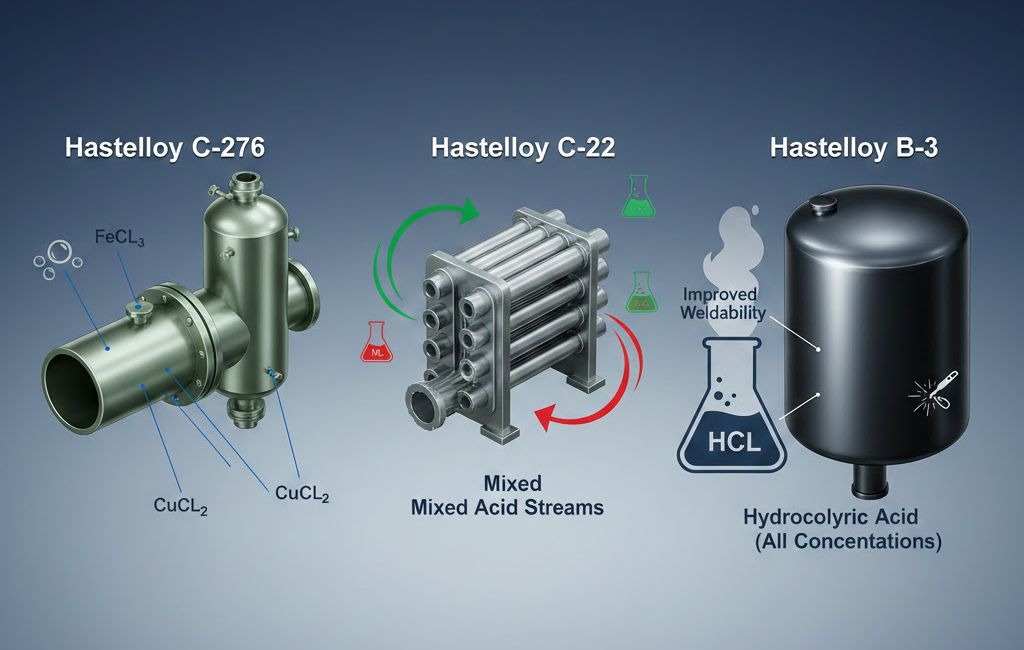
1. Hastelloy C-276 Often considered the workhorse of the industry, C-276 is perhaps the most universally used of all hastelloy alloy grades. It is a nickel-molybdenum-chromium superalloy with an addition of tungsten. Its primary claim to fame is its resistance to localized corrosion, such as pitting. It performs exceptionally well in harsh environments containing ferric and cupric chlorides, hot contaminated mineral acids, and wet chlorine gas. For many of our clients at 28Nickel, C-276 is the default choice for heat exchangers and reaction vessels.
2. Hastelloy C-22 If C-276 is the workhorse, C-22 is the specialist. It contains higher chromium levels than C-276. This adjustment provides better resistance to oxidizing media (like nitric acid) while retaining resistance to reducing media. In mixed acid streams where the environment might fluctuate between oxidizing and reducing, C-22 is often superior to other hastelloy alloy grades.
3. Hastelloy B-3 The B-series alloys are unique. Hastelloy B-3 is known for its outstanding resistance to hydrochloric acid at all concentrations and temperatures. Unlike the older B-2 grade, B-3 has a special chemistry designed to achieve a level of thermal stability that prevents the formation of intermediate phases during welding. This makes it easier to fabricate without losing corrosion resistance.
Comparative Composition of Hastelloy Alloy Grades
To truly understand the performance differences, one must look at the chemistry. Below is a simplified table showing the nominal composition (by weight %) of the grades available through 28Nickel.
| Grade | Nickel (Ni) | Molybdenum (Mo) | Chromium (Cr) | Iron (Fe) | Tungsten (W) | Cobalt (Co) |
| C-276 | Balance | 15.0 – 17.0 | 14.5 – 16.5 | 4.0 – 7.0 | 3.0 – 4.5 | 2.5 Max |
| C-22 | Balance | 12.5 – 14.5 | 20.0 – 22.5 | 2.0 – 6.0 | 2.5 – 3.5 | 2.5 Max |
| B-3 | 65 Min | 27.0 – 30.0 | 1.0 – 3.0 | 1.0 – 3.0 | 3.0 Max | 3.0 Max |
| X | Balance | 8.0 – 10.0 | 20.5 – 23.0 | 17.0 – 20.0 | 0.2 – 1.0 | 0.5 – 2.5 |
Selection Criteria for Hastelloy Alloy Grades
Choosing between these grades requires a detailed analysis of your process media.
-
For Reducing Acids: If you are dealing with pure hydrochloric or sulfuric acid, the high molybdenum content in B-series hastelloy alloy grades is required.
-
For Mixed Environments: If the stream contains oxidizing agents (like ferric ions) alongside chlorides, the C-series (specifically C-22 or C-2000) provides the necessary protection layer.
-
For High Temperature: If the primary stressor is heat rather than wet corrosion, Hastelloy X is often preferred due to its oxidation resistance and high-temperature strength.
At 28Nickel, we supply these materials in various forms, including plate, sheet, bar, and pipe, ensuring that no matter which of the hastelloy alloy grades you require, we can meet your project specifications.
Conclusion
Navigating the specifications of nickel superalloys can be complex. However, understanding the distinctions between hastelloy alloy grades helps in predicting service life and avoiding catastrophic equipment failure. Whether you need the versatility of C-276 or the specific acid resistance of B-3, these alloys represent the pinnacle of materials engineering.
Related Q&A
Q1: What is the main difference between Hastelloy C-276 and C-22?
A1: While both are excellent, C-22 has higher chromium content, giving it superior resistance to oxidizing environments compared to C-276, which is better known for general resistance in severe industrial settings.
Q2: Are hastelloy alloy grades difficult to weld?
A2: Generally, they have good weldability compared to other superalloys. However, specific grades like B-3 are chemically adjusted to provide better thermal stability during welding to prevent cracking.
Q3: Can 28Nickel provide custom cuts for these alloys?
A3: Yes, we supply various hastelloy alloy grades in custom dimensions, including sheets, bars, and tubes, tailored to your specific manufacturing or maintenance requirements.