








When engineering systems for extreme environments, selecting the right materials is not just a preference; it is a critical structural necessity. High-temperature and corrosive applications require metals that will not degrade under stress. This is where partnering with a specialized incoloy alloy supplier becomes vital. As a technical leader in the field, 28Nickel understands the intricate metallurgical demands of these superalloys. Unlike standard stainless steels, Incoloy materials offer exceptional resistance to oxidation, carburization, and high-temperature corrosion, making them indispensable for modern industrial infrastructure.
The Metallurgical Advantage of a True Incoloy Alloy Supplier
Understanding the core chemistry of nickel-iron-chromium alloys is what separates a mere distributor from a technical incoloy alloy supplier. These alloys rely on high nickel content to prevent chloride ion stress-corrosion cracking, while the chromium provides resistance to oxidizing environments. The iron content ensures the material remains cost-effective without sacrificing its structural integrity at elevated temperatures. For engineers designing chemical processing plants or power generation facilities, consulting with a knowledgeable incoloy alloy supplier ensures that the exact chemical balance matches the specific operational environment. 28Nickel specializes in analyzing your project’s environmental stressors to recommend the precise metallurgical profile required.
Key Grades Handled by an Expert Incoloy Alloy Supplier
The Incoloy family contains several distinct grades, each engineered for specific thermal and chemical exposures. An experienced incoloy alloy supplier must offer a comprehensive range to meet diverse engineering specifications. Below is a technical breakdown of the most commonly utilized grades at 28Nickel.
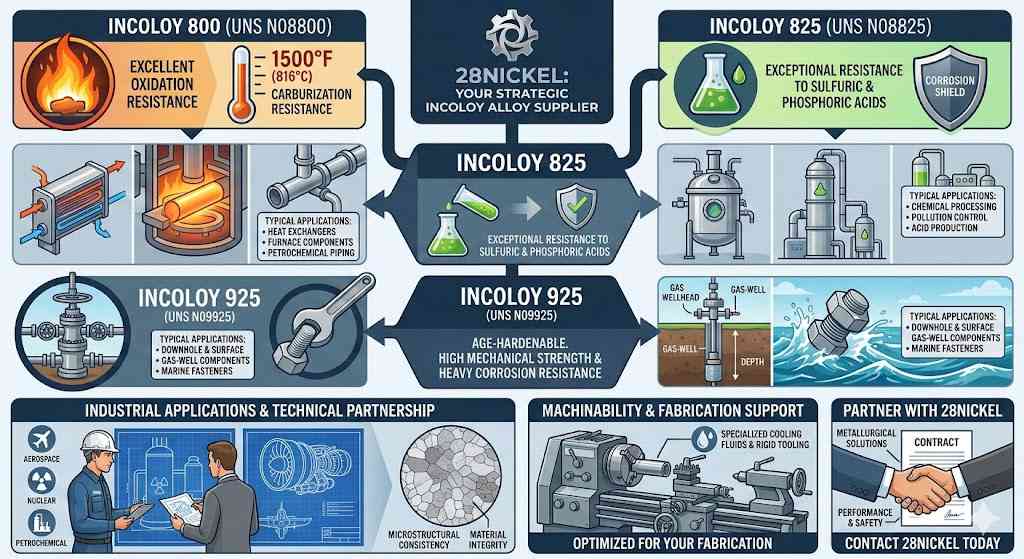
| Grade | Primary Chemistry | Key Characteristics | Typical Industrial Applications |
| Incoloy 800 (UNS N08800) | 30-35% Ni, 19-23% Cr | Excellent oxidation and carburization resistance up to 1500°F (816°C). | Heat exchangers, furnace components, petrochemical piping. |
| Incoloy 825 (UNS N08825) | 38-46% Ni, 19-23.5% Cr | Addition of Mo and Cu. Exceptional resistance to sulfuric and phosphoric acids. | Chemical processing, pollution control systems, acid production. |
| Incoloy 925 (UNS N09925) | 42-46% Ni, 19-22.5% Cr | Age-hardenable. High mechanical strength combined with heavy corrosion resistance. | Downhole and surface gas-well components, marine fasteners. |
Industrial Applications Requiring an Incoloy Alloy Supplier
The performance demands of modern industry leave no room for material failure. Aerospace, nuclear, and petrochemical sectors frequently require the expertise of an incoloy alloy supplier to source metals that withstand harsh operational realities. In chemical processing, the presence of localized corrosion mechanisms, such as pitting and crevice corrosion, can rapidly compromise standard metals. By working with an incoloy alloy supplier, engineers can secure materials like Incoloy 825, which utilizes molybdenum to specifically combat these localized attacks. Furthermore, in heat-treating environments where continuous exposure to extreme heat cycles is the norm, the phase stability of Incoloy prevents embrittlement, ensuring a longer operational lifespan for critical components.
Material Integrity and Microstructural Consistency
When evaluating an incoloy alloy supplier, the discussion must heavily involve material integrity. The severe environments these alloys operate in demand strict adherence to international metallurgical standards. An industry-leading incoloy alloy supplier understands the importance of precise heat treatment processes, such as solution annealing, which optimizes the grain structure of the metal for maximum creep and rupture strength. This microstructural optimization is particularly vital for applications in the power generation sector. Failing to account for grain boundary precipitation can lead to catastrophic failures. Engaging with an incoloy alloy supplier like 28Nickel ensures that the structural integrity of your large-scale projects is never compromised.
Machinability and Fabrication: Consult Your Incoloy Alloy Supplier
Beyond pure chemical resistance, the physical fabrication of these superalloys presents unique engineering challenges. High nickel alloys tend to work-harden rapidly during machining, which generates immense heat and causes rapid tool wear. A technically proficient incoloy alloy supplier does more than provide raw material; they offer insight into the material’s behavior during cutting, welding, and forming. Utilizing heavy-duty equipment, rigid tooling, and specialized cooling fluids is necessary to maintain dimensional accuracy. At 28Nickel, our engineering team works closely with your design units to ensure that the material you receive is optimized for your specific fabrication capabilities.
Partner with 28Nickel: Your Dedicated Incoloy Alloy Supplier
Selecting the correct metallurgical solution requires deep technical insight and a partner who understands the nuances of high-performance superalloys. 28Nickel is committed to functioning as more than just an incoloy alloy supplier; we aim to be an extension of your engineering team. If your upcoming projects require specialized metallurgical solutions that guarantee performance and safety, our technical engineering team is ready to assist. We invite you to share your project specifications, blueprints, or operational challenges with us. Contact 28Nickel today to discuss your technical requirements and discover how our expertise can optimize your material selection process.
Related Q&A
Q1: What makes an incoloy alloy supplier different from a standard steel vendor?
A: A specialized incoloy alloy supplier focuses on high-nickel superalloys that require deep metallurgical knowledge regarding high-temperature phase stability and severe corrosion resistance, whereas standard vendors typically deal with lower-tier alloys suitable only for general, non-critical applications.
Q2: How does an incoloy alloy supplier help mitigate chloride stress corrosion cracking?
A: By analyzing your operational environment, a knowledgeable incoloy alloy supplier will recommend specific grades with elevated nickel content, which naturally resists the cracking mechanisms triggered by chloride ions in aggressive industrial fluids.
Q3: Can a qualified incoloy alloy supplier assist with material substitution for project optimization?
A: Yes. An expert incoloy alloy supplier like 28Nickel can evaluate your current engineering specs and suggest alternative Incoloy grades that provide equivalent or superior physical performance at a highly efficient point for your specific application.