










When operating in severe corrosive environments, material selection is the most critical decision an engineer can make. Industrial processing plants constantly seek advanced alloys that can withstand extreme chemical exposure without degrading prematurely. Understanding the specific incoloy 825 properties is absolutely essential for designing durable, safe, and efficient industrial equipment. Developed with a high nickel-iron-chromium base and strategic additions of molybdenum, copper, and titanium, this superalloy delivers exceptional metallurgical performance. At 28Nickel, we frequently analyze these unique traits to help project managers match the right material to their specific environmental demands. Let us dive deep into the technical aspects that make this alloy so highly regarded.
Chemical Composition Driving Incoloy 825 Properties
The foundation of all incoloy 825 properties lies in its precise and balanced chemical chemistry. The high nickel content ensures excellent resistance to chloride-ion stress-corrosion cracking, while the combination of molybdenum and copper provides resistance to reducing environments.
Below is the standard chemical composition breakdown that forms the basis of its performance:
| Element | Minimum (%) | Maximum (%) |
| Nickel (Ni) | 38.0 | 46.0 |
| Chromium (Cr) | 19.5 | 23.5 |
| Iron (Fe) | 22.0 | Balance |
| Molybdenum (Mo) | 2.5 | 3.5 |
| Copper (Cu) | 1.5 | 3.0 |
| Titanium (Ti) | 0.6 | 1.2 |
The addition of titanium is particularly noteworthy. It serves to stabilize the alloy against sensitization in the as-welded condition, preventing intergranular corrosion that often plagues lesser alloys after exposure to high temperatures.
Evaluating Mechanical Incoloy 825 Properties
Assessing the mechanical incoloy 825 properties reveals its structural viability for heavy-duty applications. This alloy exhibits good mechanical strength from cryogenic temperatures up to moderately high temperatures (around 1000°F or 540°C). Exposure to temperatures above this limit can result in microstructural changes that significantly lower ductility and impact strength.
In its annealed condition, the material demonstrates a typical tensile strength of around 85,000 psi (586 MPa) and a yield strength of 35,000 psi (241 MPa). These robust mechanical incoloy 825 properties mean that equipment fabricated from this material can handle significant internal pressures and external structural stresses, making it ideal for thin-walled vessels and complex piping systems where weight and strength must be optimized.
Corrosion Resistance: The Standout Incoloy 825 Properties
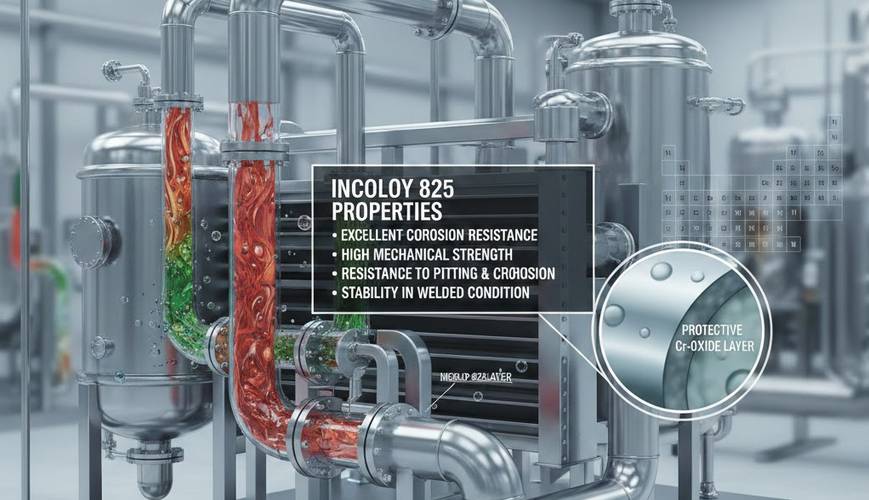
The most celebrated and scrutinized incoloy 825 properties undoubtedly revolve around its unparalleled corrosion resistance. The alloy performs exceptionally well in both reducing and oxidizing environments. The copper addition gives it a distinct advantage in handling sulfuric acid at various concentrations and temperatures.
Furthermore, the molybdenum content heavily bolsters its resistance to pitting and crevice corrosion in aqueous chloride solutions. Whether exposed to phosphoric acid, nitric acid, or organic acids, the passive oxide layer formed by the chromium content remains stable. By leveraging these superior incoloy 825 properties, facilities can drastically reduce equipment downtime, minimize maintenance intervals, and prevent catastrophic failures caused by localized corrosion mechanisms.
Industrial Applications Maximizing Incoloy 825 Properties
Because of its versatility, many diverse industries rely on this superalloy. In chemical processing, it is widely used for heat exchangers, evaporators, and reaction vessels. The oil and gas sector utilizes it for downhole tubing and surface gas well components, especially in sour gas environments containing hydrogen sulfide.
Understanding how to maximize incoloy 825 properties in your specific system requires careful analysis of your operating temperatures, chemical concentrations, and mechanical stress loads. Choosing the optimal material configuration is complex, but it is a critical step in ensuring long-term operational success.
If you are evaluating materials for your next high-stress project and want to explore how this alloy fits your technical requirements, leave your contact details and project specifications with our engineering team at 28Nickel. We provide in-depth technical consultations to ensure your material choices align perfectly with your engineering goals.
Related Q&A
Q1: What is the maximum operating temperature for this alloy?
A: While it maintains good mechanical strength at various temperatures, it is generally recommended for use up to 1000°F (540°C). Prolonged exposure above this temperature can lead to phase precipitation, which reduces its ductility and impact toughness.
Q2: How does welding affect incoloy 825 properties?
A: Thanks to the addition of titanium, the alloy is stabilized against sensitization. This means its excellent incoloy 825 properties, particularly its resistance to intergranular corrosion, are generally preserved even in the as-welded condition without the need for post-weld heat treatment.
Q3: Is it suitable for marine environments?
A: Yes. The combination of nickel, chromium, and molybdenum provides outstanding resistance to chloride-ion stress-corrosion cracking and pitting, making it highly effective for seawater cooling systems and offshore marine exhaust applications.