









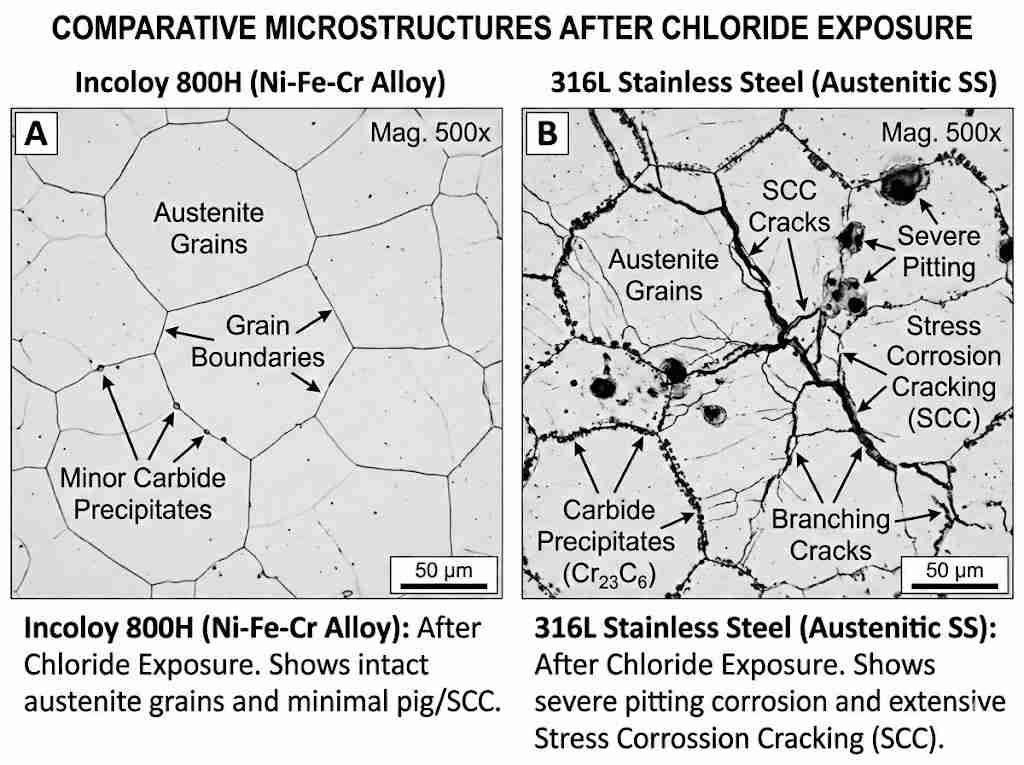
Selecting the optimal Incoloy alloy for heat exchanger units requires a nuanced understanding of the intersection between mechanical stress and chemical aggression. In high-temperature environments or systems exposed to localized pitting, standard stainless steels often fail due to chloride-induced stress corrosion cracking (SCC). As engineers, we look toward the Incoloy series—specifically the 800 and 825 families—to provide the necessary oxidation resistance and metallurgical stability that 300-series steels lack. The secret lies in the controlled balance of nickel, chromium, and iron, often augmented with titanium for stabilization.
The Metallurgical Edge: 800H vs. 825 in Thermal Media
When we evaluate an Incoloy alloy for heat exchanger applications, we are essentially choosing between high-temperature creep resistance and aqueous corrosion protection.
Incoloy 800H (UNS N08811) is the “workhorse” for high-temperature exchangers. Its carbon content is restricted to –, and it undergoes a high-temperature solution anneal to ensure a coarse grain size (ASTM 5 or coarser). This microstructure is critical for maximizing creep-rupture strength above .
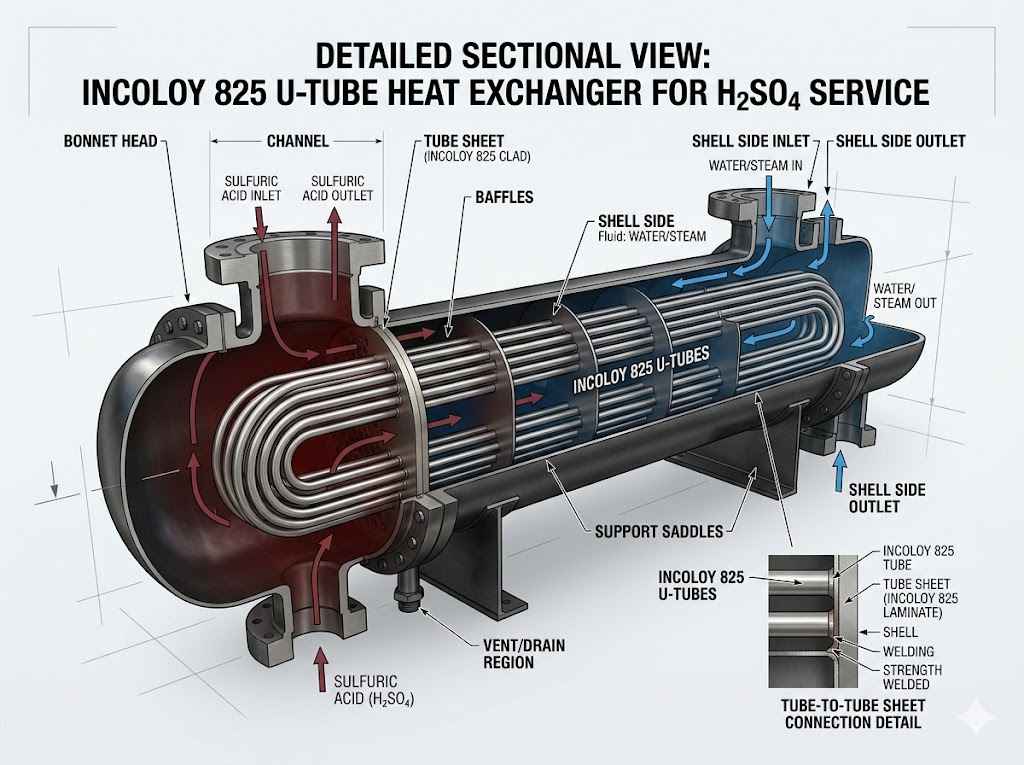
Conversely, Incoloy 825 (UNS N08825) is more of a “specialist” for aggressive chemical media. By increasing the nickel content to – and adding molybdenum (–) and copper (–), the alloy gains exceptional resistance to reducing acids, such as sulfuric and phosphoric acids. In shell-and-tube heat exchangers handling sour gas or polluted cooling water, 825 is often the safer metallurgical bet.
Comparative Material Properties
The following table outlines the chemical benchmarks and mechanical limits that define the performance of these alloys in heat transfer equipment.
| Element / Property | Incoloy 800H (UNS N08811) | Incoloy 825 (UNS N08825) |
| Nickel (Ni) % | 30.0 – 35.0 | 38.0 – 46.0 |
| Chromium (Cr) % | 19.0 – 23.0 | 19.5 – 23.5 |
| Iron (Fe) % | 39.5 min | 22.0 min |
| Molybdenum (Mo) % | – | 2.5 – 3.5 |
| Copper (Cu) % | – | 1.5 – 3.0 |
| Tensile Strength (MPa) | $\ge 450$ | $\ge 585$ |
| Yield Strength (MPa) | $\ge 170$ | $\ge 240$ |
Managing Thermal Expansion and Sulfidation
One common oversight in heat exchanger design is the coefficient of thermal expansion (CTE). Because Incoloy alloys have a high iron content compared to Hastelloy, their CTE is more compatible with carbon steel shells, reducing the risk of tube-sheet joint failure during thermal cycling.
Furthermore, in environments containing sulfur (common in refinery “bottom-of-the-barrel” processing), the chromium content in these alloys facilitates the formation of a protective Cr-oxide scale. However, if the atmosphere shifts from oxidizing to reducing, the stability of this scale is compromised. In such cases, 800H remains superior for gas-to-gas exchangers, while 825 excels in liquid-to-liquid exchangers where acid dew point corrosion is a concern.
Engineering Verdict
The decision to specify an Incoloy alloy for heat exchanger fabrication should never be based on cost alone. It is a decision based on the and the specific creep-rupture curves of the media. For high-pressure steam generators, the 800H/HT variants are non-negotiable. For seawater-cooled systems or phosphoric acid heaters, the Mo-stabilized 825 variant provides the necessary insurance against catastrophic SCC.
Related Q&A:
1. Why is Incoloy 800H preferred over Incoloy 800 for high-temp exchangers?
The “H” designation signifies a controlled carbon range () and a specific solution annealing process. This results in a larger grain size, which significantly improves creep-rupture strength at temperatures exceeding (), whereas standard alloy 800 may suffer from grain growth instability.
2. Can Incoloy 825 resist pitting in stagnant seawater applications?
While Incoloy 825 has excellent resistance to SCC due to its high nickel content, its Mo content () might be insufficient for stagnant seawater where crevice corrosion can occur. In such specific heat exchanger scenarios, an alloy with a higher , like Inconel 625, might be suggested depending on the flow velocity.
3. What are the welding considerations for Incoloy alloy for heat exchanger tubes?
Matching composition filler metals, such as ERNiCrMo-3 (for 825) or ERNiCr-3 (for 800H), are typically used. It is vital to maintain low heat input to prevent solidification cracking and to ensure the heat-affected zone (HAZ) retains its corrosion resistance properties.