










Engineers specifying materials for subsea tiebacks, sour gas wells, or aerospace turbine exhausts face a strict tolerance for failure. When pitting, crevice corrosion, or hydrogen embrittlement threaten system integrity, conducting a rigorous nickel alloy performance comparison is not just a preference; it is a structural necessity. The right material dictates the lifespan of multimillion-dollar infrastructure. Today, we will look closely at the metallurgical distinctions between two of the most heavily specified superalloys in the industry: Alloy 625 (UNS N06625) and Alloy 718 (UNS N07718). Both offer exceptional baseline characteristics, but their strengthening mechanisms, chemical matrices, and thermal limits dictate entirely different end-use profiles. Understanding these microscopic differences is essential for mitigating catastrophic failures in severe service environments.
The Baseline for Nickel Alloy Performance Comparison: Chemistry
The chemical composition baseline dictates the environmental survivability of the metallic matrix. When running a nickel alloy performance comparison for highly corrosive environments, the Pitting Resistance Equivalent Number (PREN) provides a fast, quantifiable metric. Alloy 625 contains significantly higher Molybdenum (8.0-10.0%) compared to Alloy 718 (2.8-3.3%). This elevated Mo content in 625 drastically enhances its resistance to localized attack, particularly chloride-induced pitting and crevice corrosion in seawater applications.
Furthermore, Alloy 625 exhibits near-total immunity to chloride stress corrosion cracking (CSCC). Consequently, in a direct nickel alloy performance comparison focusing on aggressive wet-gas, NACE MR0175 compliance, or marine immersion, Alloy 625 exhibits a distinct and measurable advantage. However, metallurgy is inherently a game of tradeoffs, and exceptional corrosion resistance often requires compromises in raw mechanical strength at lower temperatures.
| Property / Element | Alloy 625 (UNS N06625) | Alloy 718 (UNS N07718) |
| Nickel (Ni) % | 58.0 min | 50.0 – 55.0 |
| Chromium (Cr) % | 20.0 – 23.0 | 17.0 – 21.0 |
| Molybdenum (Mo) % | 8.0 – 10.0 | 2.8 – 3.3 |
| Niobium (Nb) % | 3.15 – 4.15 | 4.75 – 5.50 |
| Iron (Fe) % | 5.0 max | Balance |
| Strengthening | Solid Solution Stiffening | Precipitation Hardening |
| 0.2% Yield Strength | ~60 ksi / 414 MPa (Annealed) | >120 ksi / 827 MPa (Aged) |
| Max Service Temp | 815°C (1500°F) | 650°C (1200°F) |
Mechanical Nickel Alloy Performance Comparison
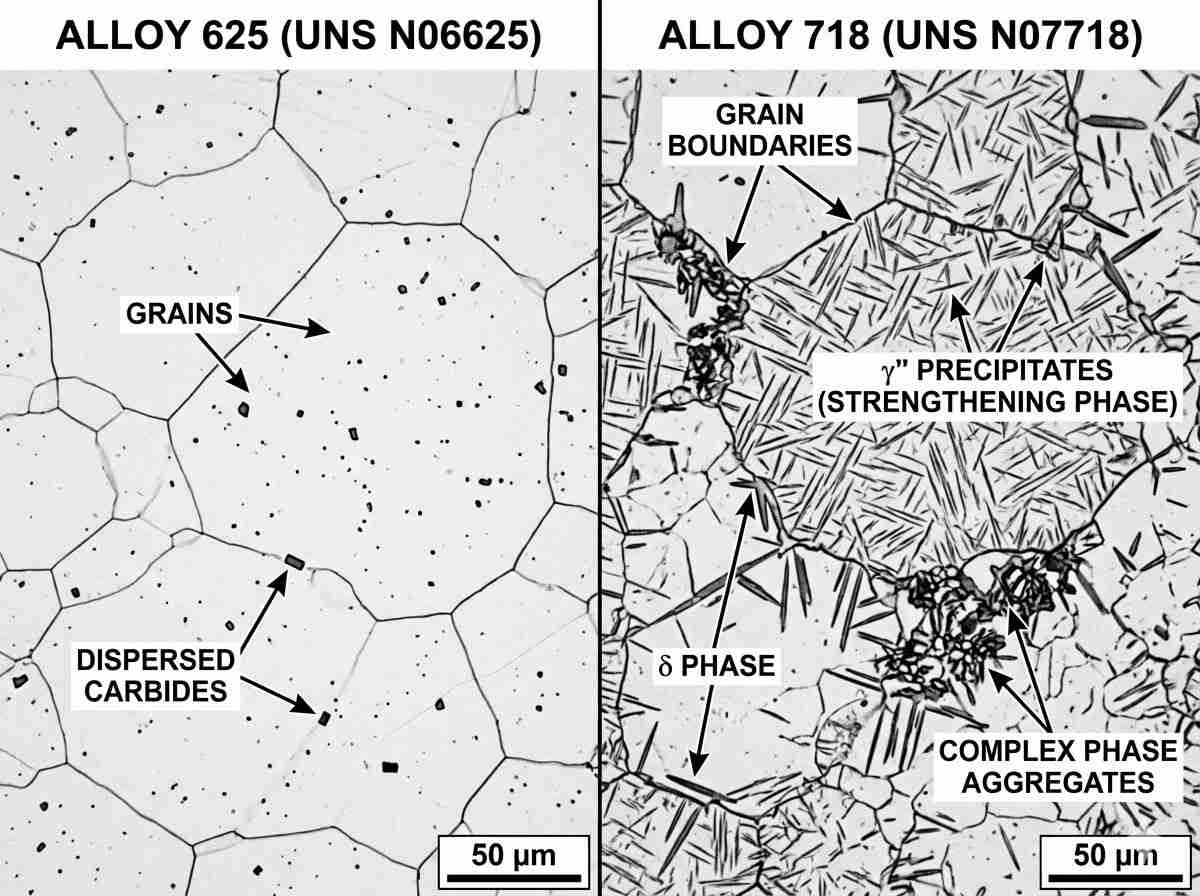
Alloy 718 compensates for its lower Molybdenum with higher concentrations of Niobium + Tantalum coupled with Titanium and Aluminum. This specific alloy design allows for the precipitation of the gamma double prime () phase, , during age hardening. The body-centered tetragonal lattice of the phase induces severe strain in the surrounding nickel matrix, which blocks dislocation movement. Therefore, a mechanical nickel alloy performance comparison at room to moderate temperatures heavily favors Alloy 718. It easily achieves yield strengths exceeding 120 ksi (827 MPa) in the precipitation-hardened condition, providing massive load-bearing capabilities for downhole tooling and high-pressure valve stems.
However, phase stability is heavily temperature-dependent. Evaluating high-temperature tensile data and phase transformation kinetics is a critical aspect of any nickel alloy performance comparison. The phase in Alloy 718 is metastable. When exposed to temperatures above 650°C (1200°F) for prolonged periods, it begins to over-age and transform into the stable, orthorhombic delta () phase. This transformation causes a rapid drop in yield strength and notch ductility. Conversely, Alloy 625 derives its strength from solid solution stiffening provided by Molybdenum and Niobium. Because it does not rely on precipitation hardening for its baseline properties, it maintains stable creep and rupture strength up to 815°C (1500°F) without experiencing abrupt phase embrittlement.
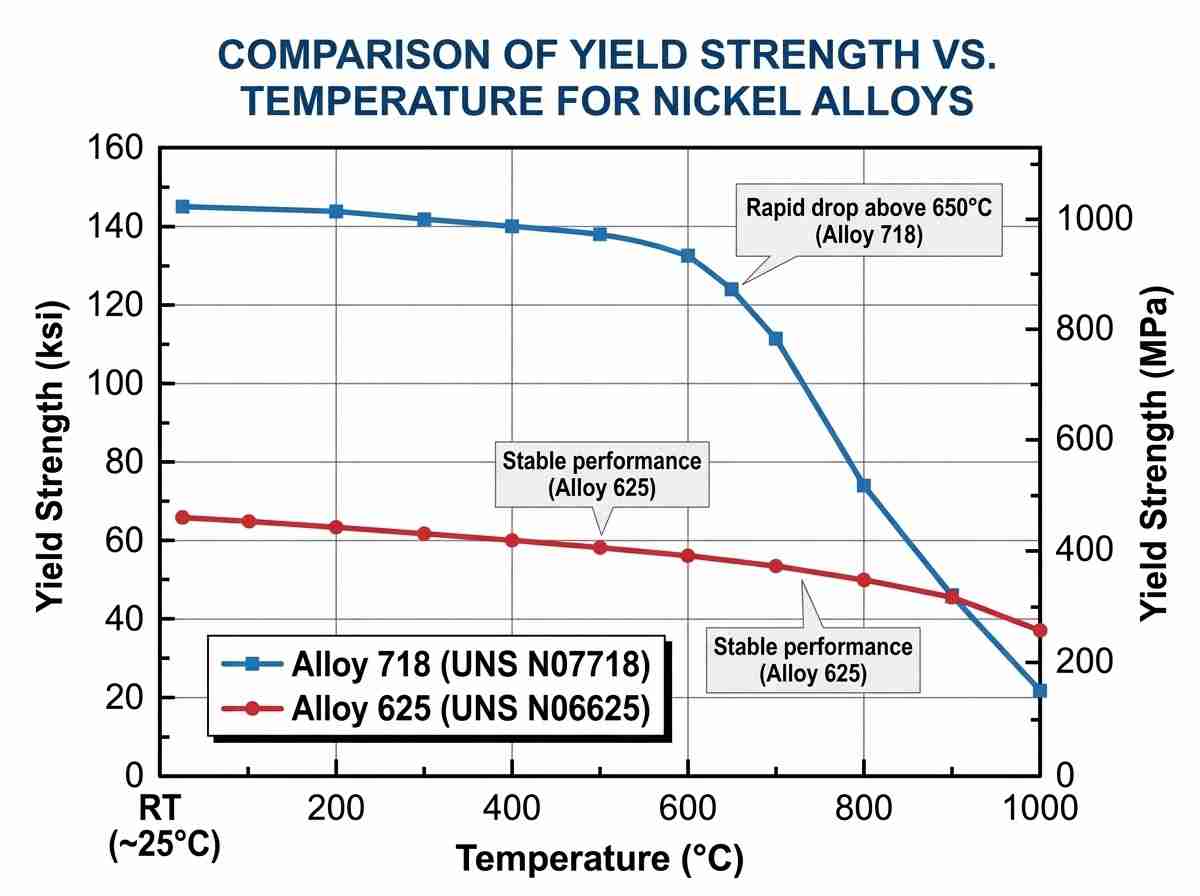
To conclude this nickel alloy performance comparison, your selection hinges entirely on the primary failure mechanism of your application. If extreme chloride stress corrosion cracking, localized pitting, and high-temperature creep are your main concerns, Alloy 625 is the superior metallurgical choice. If maximizing yield strength and fatigue resistance in environments below 650°C is paramount, Alloy 718 provides unmatched structural integrity. Making the right metallurgical choice requires looking far beyond basic datasheets and analyzing precise environmental variables. If you need assistance evaluating fatigue life, specific NACE environmental testing data, or complex metallurgical selections for your next project, reach out to the engineering team at 28Nickel for specialized technical support.
Related Q&A
Q: Why is PREN vital in a nickel alloy performance comparison? A: PREN (Pitting Resistance Equivalent Number) mathematically estimates an alloy’s resistance to localized pitting based on its Chromium, Molybdenum, and Nitrogen content. It is an essential metric when comparing performance in chloride-rich environments like subsea infrastructure or sour gas wells, where localized pitting often initiates catastrophic fatigue failure.
Q: How do strengthening mechanisms affect a nickel alloy performance comparison? A: Solid solution strengthened alloys (like Alloy 625) rely on large atoms distorting the crystal lattice, offering highly stable high-temperature performance and excellent ductility. Precipitation-hardened alloys (like Alloy 718) use microscopic intermetallic precipitates ( and ) to block dislocation movement, providing massively higher yield strengths but imposing strict maximum operating temperature limits.
Q: When conducting a nickel alloy performance comparison for continuous environments above 700°C, which grade is preferred? A: Alloy 625 is generally preferred above 700°C. Alloy 718 experiences a metallurgical phase transformation above 650°C (1200°F), where its strengthening precipitates convert to brittle delta phases, severely degrading mechanical properties. Alloy 625 maintains stable creep-rupture properties at much higher temperatures.