









A nickel alloy weld neck flange supplier is judged less by warehouse tonnage and more by whether the flange package can pass engineering review without friction. In corrosive and high-temperature piping, the flange is not a commodity ring. It carries pressure, gasket load, weld transition geometry, material traceability, and installation tolerance in one relatively small component.
The difficulty is that many flange problems appear late. A nickel alloy weld neck flange supplier may quote the correct alloy and pressure class, yet still create trouble if the bore is wrong for the pipe schedule, if the raised face finish is undocumented, if the heat number is not transferred after machining, or if the certificate does not match the shipment marks. Those details decide whether the spool shop welds smoothly or starts sending nonconformance reports.
How a Nickel Alloy Weld Neck Flange Supplier Controls Risk
Material selection comes first. Alloy 625, 825, C276, C22, 600, 601, and Monel grades are all used in flange form, but their corrosion behavior is not interchangeable. Chloride stress corrosion cracking, reducing acid attack, oxidizing contamination, caustic exposure, seawater erosion, and thermal cycling can all push the engineer toward a different alloy family. A responsible nickel alloy weld neck flange supplier should ask about service media, design temperature, pressure class, gasket type, and the matching pipe or fitting grade before confirming stock.
Standard control comes next. ASME B16.5, ASME B16.47, EN 1092, MSS, project specifications, and customer drawings can define dimensions differently. Even within one nominal size and class, the bore, hub profile, facing, drilling, and allowable tolerances may need project confirmation. A nickel alloy weld neck flange supplier should not treat forged flange procurement as a pure catalogue exercise when the flange will be welded into a pressure boundary.
Heat treatment and machining history also matter. Nickel alloy flanges are usually supplied from forgings or forged bars, then solution annealed or heat treated according to grade requirements. Excessive machining heat, poor surface protection, or mixed handling with carbon steel can compromise the final package. The flange may look correct from a distance, but engineers care about the path from raw forging to marked, inspected, protected component.
| Review item | Why engineers care | Supplier evidence to request |
| Grade and heat traceability | Confirms the flange is the intended alloy and can be matched to the MTC | Heat number transfer, marking photo, chemical analysis, and certificate copy |
| Bore and pipe schedule | Avoids weld mismatch, ID step issues, and field fit-up delay | Bore dimension report and confirmation against matching pipe schedule |
| Facing and finish | Controls gasket sealing performance and bolting reliability | Raised face, RTJ, or flat face condition plus surface finish record |
| Forging and heat treatment | Supports mechanical strength and corrosion behavior for the selected alloy | Forging route, heat treatment condition, mechanical test data, and hardness if required |
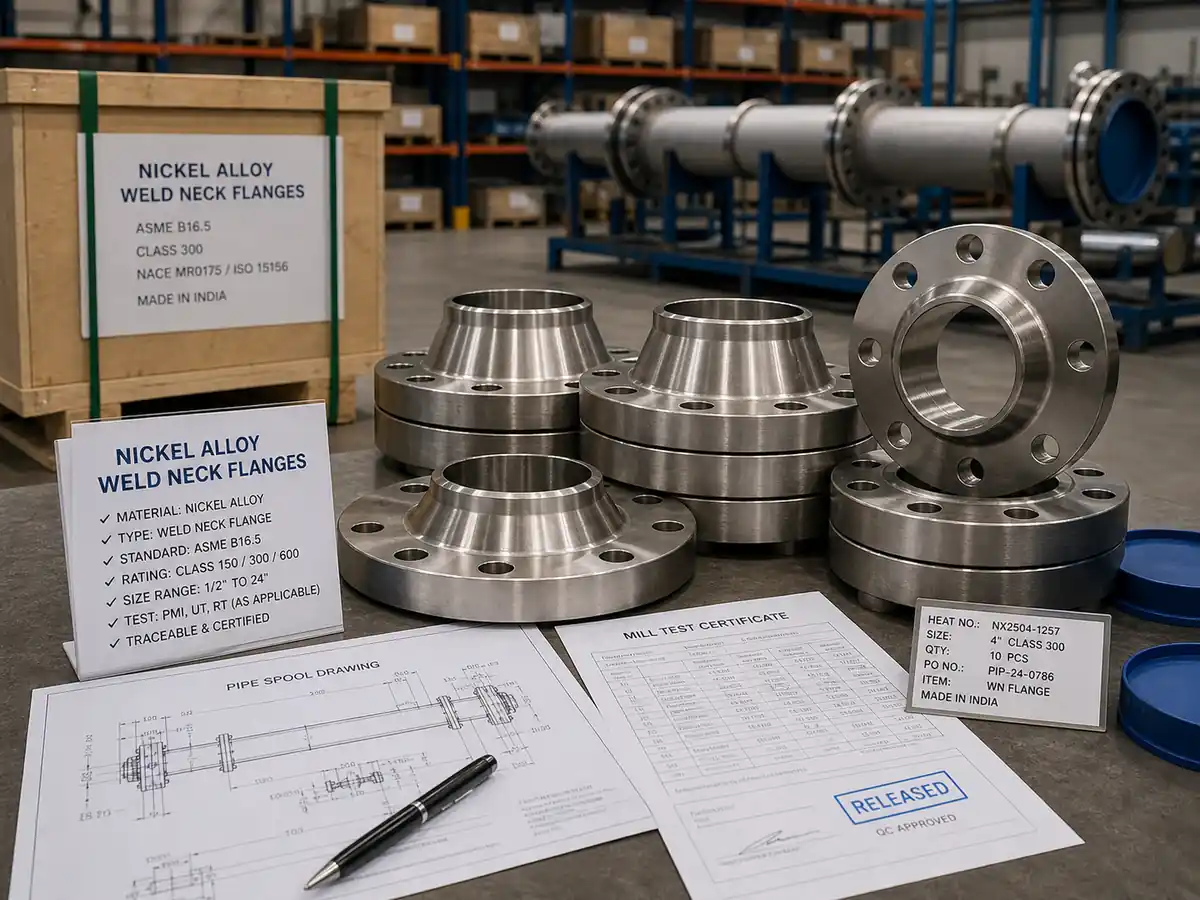
| Packing and release | Prevents damage, mix-up, and inspection dispute after delivery | Separated packing, flange protectors, labels, photo records, and final inspection checklist |
Inspection Package for Nickel Alloy Weld Neck Flanges
Inspection should begin with identity. The inspector needs to compare purchase order, drawing, standard, heat number, and MTC before dimensional checks begin. For a nickel alloy weld neck flange supplier, this early review prevents one common mistake: delivering a technically good flange that belongs to the wrong heat, wrong schedule, or wrong facing requirement.
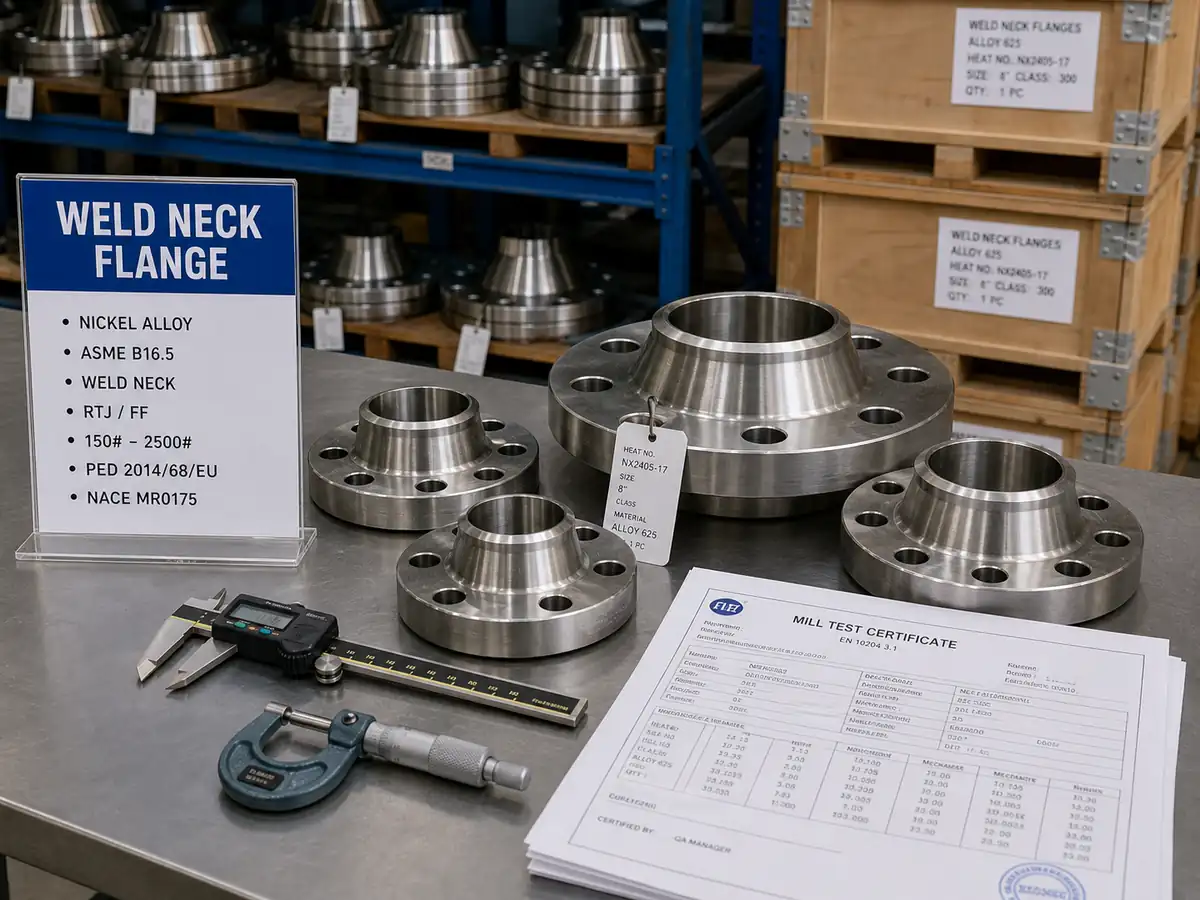
Dimensional inspection should cover OD, thickness, hub diameter, neck length, bore, bolt circle, number and diameter of bolt holes, facing height, serration or finish, and gasket contact surface. On high-value nickel alloy packages, I prefer inspection photos with a ruler or gauge in the frame. They are not a substitute for a formal report, but they reduce ambiguity when the buyer is reviewing material remotely.
PMI is often worth adding when several nickel alloys are shipped together. A nickel alloy weld neck flange supplier may handle Alloy 625, 825, C276, 400, and 600 in the same production chain. Visual similarity is not a control method. Positive material identification gives the buyer another layer of assurance before flanges are welded into spools or bolted into an acid service line.
Documentation is the final pressure test for the supplier. The release pack should include EN 10204 3.1 or project-specified certification, chemical and mechanical data, dimensional report, PMI or third-party inspection record if required, and packing photos. If the end user requires NACE, sour service review, or owner witness inspection, those requirements need to be visible in the purchase order and confirmed by the supplier before machining starts.
Conclusion
The best nickel alloy weld neck flange supplier helps the buyer reduce risk before the flange reaches the spool shop. That means verifying alloy suitability, standard compliance, bore compatibility, facing quality, traceability, inspection evidence, and packing protection as one controlled package. 28Nickel supports engineers and purchasers who need flange materials that can survive both corrosive service and document review.
Related Q&A
Q1: Why is bore confirmation so important for weld neck flanges?
The bore affects weld fit-up, internal step, flow path, and inspection acceptance. A nickel alloy weld neck flange supplier should confirm the bore against the matching pipe schedule, not only against nominal size.
Q2: Should every nickel alloy flange have heat number marking?
Yes. Heat identity is the foundation of traceability. The mark should match the certificate and remain visible after machining, inspection, and packing.
Q3: Is PMI necessary for nickel alloy weld neck flanges?
PMI is highly recommended for mixed alloy shipments, critical service, or third-party inspection projects. It helps confirm the nickel alloy weld neck flange supplier has not mixed visually similar grades.