










Best nickel alloy for seawater valves and pumps is not a question that should be answered by alloy name alone. In real projects, the same nickel alloy can perform well in one plant and disappoint in another because velocity, contamination, temperature, stress, fabrication route, and inspection discipline are different. That is why 28Nickel treats alloy selection as an engineering review, not a quick product match.
The commercial risk is simple: if best nickel alloy for seawater valves and pumps is selected from a simplified table, the buyer may receive material that looks correct on the certificate but is weak against the actual failure mode. Engineers and purchasers need a package that links service chemistry, component geometry, manufacturing route, testing, and documentation before the order reaches production.
How to Choose best nickel alloy for seawater valves and pumps
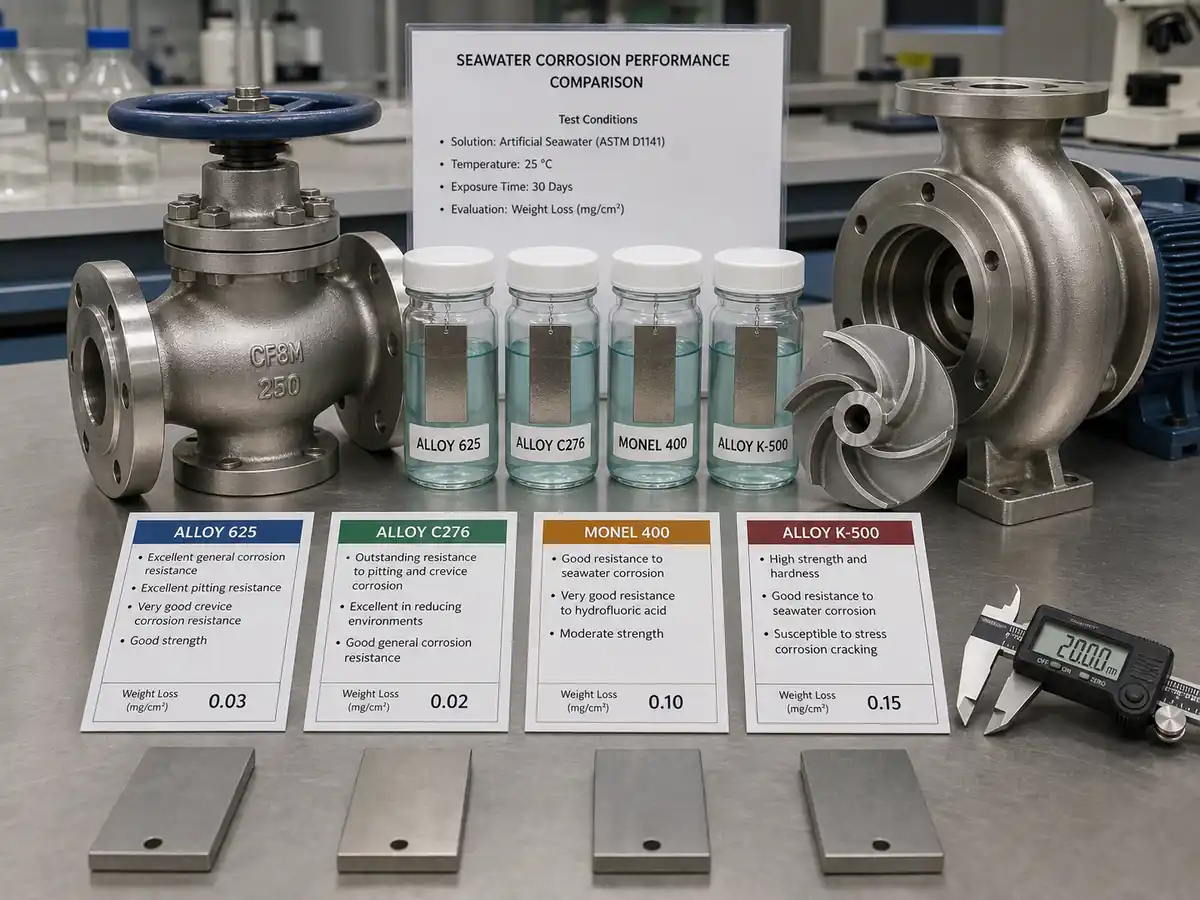
There is no single answer that fits every seawater duty. The best nickel alloy for seawater valves and pumps depends on velocity, biofouling, crevice geometry, stagnant zones, chlorination, sand loading, and galvanic contact with other alloys. Monel 400 and K500 are common in marine shafts and fasteners, Alloy 625 is often chosen for aggressive seawater piping and overlays, and C276 or C22 may be considered when seawater is mixed with acid chlorides or contaminated process streams. The valve or pump designer should start from the failure mode, not from a catalog grade.
Seawater valves and pumps create severe local conditions. A pump impeller sees high velocity, turbulence, and possible erosion-corrosion, while a valve seat or gasket area may see stagnant chloride concentration. The best nickel alloy for seawater valves and pumps must therefore be reviewed by component location. The same alloy that works well as a shaft may not be the correct choice for a crevice-prone trim part or a cast pump casing with complex geometry.
Product form also matters. Forgings, castings, bars, plates, weld overlays, and pipe spools have different defect risks and inspection routes. Heavy pump components may need ultrasonic testing or radiographic inspection, while valve trim may need hardness control, close dimensional tolerances, and galling review. If the purchase order only says ‘seawater service,’ the supplier has too much room to guess. A better inquiry names the component, seawater chemistry, flow regime, joining method, and inspection class.
| Selection factor | Engineering reason | What 28Nickel should verify |
| Monel 400/K500 | Useful marine resistance and good history in shafts, fasteners, and some trim | Strength level, galvanic contact, and crevice details |
| Alloy 625 | Strong chloride and seawater resistance with weld-overlay use | Heat condition, NDE, PMI, and overlay dilution when welded |
| C276/C22 | Considered for seawater mixed with aggressive chemical contaminants | Acid chloride chemistry, oxidizing species, and cost justification |
| Component geometry | Crevices and stagnant zones often control failure | Seat pockets, gasket faces, threaded areas, and pump casing details |
| Inspection package | Prevents late rejection of high-value pump and valve parts | MTC, PMI, dimensions, NDE, marking photos, and packing records |
Inspection Evidence for seawater pump and valve alloy
For best nickel alloy for seawater valves and pumps, inspection should start before the material is cut or packed. The reviewer needs to connect alloy grade, heat number, delivery condition, product form, and service note to the purchase order. A certificate alone is useful, but it does not prove that the chosen material fits the local corrosion mechanism.
The release package should include chemical analysis, mechanical properties, heat treatment condition, PMI when mixed alloys are shipped, dimensional reports for machined items, and NDE records for castings or forgings. For duplex or stainless components connected to nickel alloys, galvanic compatibility should be reviewed. The best nickel alloy for seawater valves and pumps is not just a resistant grade; it is a controlled material package that avoids crevice mistakes, mix-ups, and late owner comments.
A capable supplier will ask whether the valve or pump sees continuous flow, intermittent operation, seawater chlorination, shutdown stagnation, or abrasive solids. The best nickel alloy for seawater valves and pumps should be selected with those details visible before quotation. 28Nickel can support this review by comparing available alloys, forms, inspection options, and certificate requirements so the buyer receives material that matches both service and fabrication route.

Conclusion
The right answer to best nickel alloy for seawater valves and pumps is a controlled decision, not a slogan. Buyers should confirm chemistry, temperature, impurities, stress state, product form, welding or machining route, inspection scope, and certificate requirements together. When those details are clear, 28Nickel can help supply nickel alloy materials that are easier to approve, easier to inspect, and safer to install in demanding service.
Related Q&A
Q1: Is Monel always the best marine alloy?
No. Monel grades have strong marine history, but the best nickel alloy for seawater valves and pumps depends on crevice severity, velocity, galvanic contact, and component function.
Q2: When should Alloy 625 be considered?
Alloy 625 is often considered for aggressive chloride exposure, weld overlays, and seawater piping where higher resistance and strength are needed.
Q3: What information should be sent with an inquiry?
Send component type, seawater temperature, flow velocity, chlorination practice, stagnant periods, solids content, drawing, required standard, and inspection scope.