




Lorsque les ingénieurs ou les équipes de recherche de fournisseurs demandent pourquoi avoir besoin d'un fournisseur d'alliages de nickel certifié ISO, En général, ils réagissent à un véritable problème : chimie incohérente, traçabilité incomplète, documents tardifs ou matériaux qui semblent acceptables sur le papier mais qui ne fonctionnent pas lors de la fabrication ou de l'utilisation. En matière d'approvisionnement en alliages de nickel, le risque est rarement un simple “retard de livraison”. Il peut s'agir d'une reprise dans l'atelier de soudure, d'un échec de PMI sur le site, d'une escalade de NCR ou d'une corrosion prématurée en présence de chlorure, d'acide ou de haute température. Un fournisseur certifié ISO ne transforme pas par magie une mauvaise métallurgie en une bonne métallurgie, mais il crée un système de qualité discipliné qui contrôle la manière dont les matériaux sont achetés, inspectés, identifiés, documentés et libérés. Dans les services critiques, cette distinction est importante.
Pourquoi avoir besoin d'un fournisseur d'alliages de nickel certifié ISO pour les services critiques ?
Les alliages de nickel ne sont pas de l’acier au carbone ordinaire. Que vous achetiez de l’alliage 625, 718, C-276, 400 ou 800H/HT, les conditions d’utilisation sont souvent extrêmes : températures élevées, acides réducteurs, chlorures présents dans l’eau de mer, gaz acide ou contraintes mécaniques cycliques. Dans ces applications, un seul maillon faible de la chaîne d'approvisionnement peut réduire à néant les avantages d'un alliage haut de gamme.
Ainsi, pourquoi avoir besoin d'un fournisseur d'alliages de nickel certifié ISO au lieu de se contenter de comparer les prix et les délais ? Parce que le risque technique réside dans les détails :
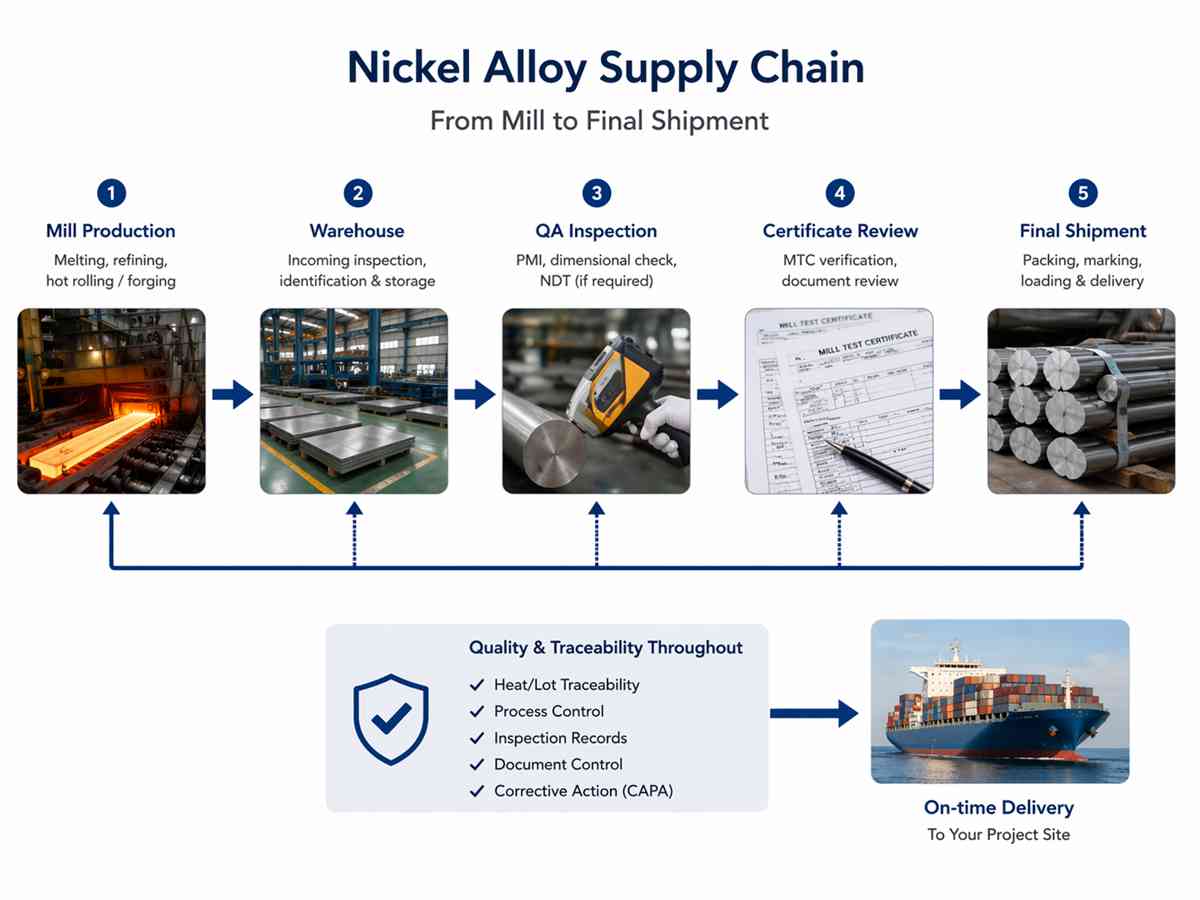
- Traçabilité de la chaleur et du lot, de l'usine à l'expédition finale
- Vérification de la nuance UNS, de la norme ASTM/ASME et de la forme du produit
- Contrôle de l'exactitude des MTC/MTR et de l'historique des révisions
- Inspection à l'arrivée, PMI, vérification dimensionnelle et contrôles de surface
- Séparation des stocks conformes et non conformes
- Traitement correct des exigences particulières du client telles que la documentation NACE, PED ou EN 10204 3.1/3.2
Sans système formel de gestion de la qualité, ces contrôles dépendent souvent de l'expérience individuelle. Cette méthode n'est pas assez robuste pour les équipements sous pression, le matériel aérospatial, les systèmes de traitement chimique ou les composants offshore.
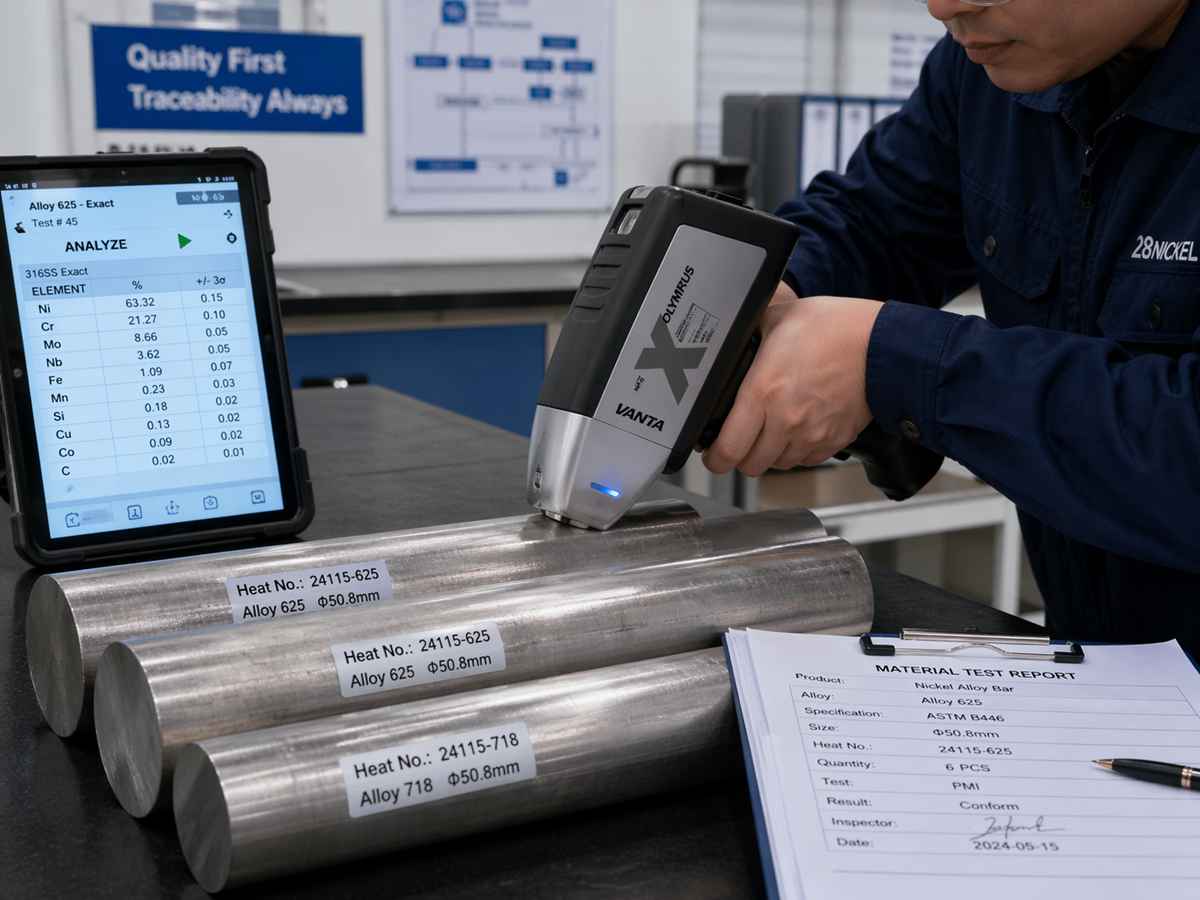
La certification ISO n'est pas un slogan. C'est une discipline de processus.
Lorsque les acheteurs demandent pourquoi avoir besoin d'un fournisseur d'alliages de nickel certifié ISO, La meilleure réponse est que la certification ISO, généralement ISO 9001, impose un contrôle reproductible du flux de travail. Elle exige des procédures documentées, la conservation des enregistrements, des audits internes, des actions correctives, un contrôle de la formation, une évaluation des fournisseurs et une réflexion basée sur le risque. Pour les alliages de nickel, cette structure réduit plusieurs modes de défaillance courants.
Tout d'abord, il réduit le risque de confusion. Les alliages des séries 600, 601, 625 et 800 peuvent se ressembler lors du stockage, mais ils se comportent très différemment en service et pendant le soudage. Un fournisseur certifié doit disposer de règles d'identification et de ségrégation qui réduisent considérablement les risques de substitution accidentelle.
Deuxièmement, il améliore l'intégrité des documents. Dans de nombreux litiges, le métal lui-même n'est pas le premier problème, c'est la paperasserie qui l'est. Un fournisseur certifié ISO sérieux contrôle l'état des révisions, l'émission des documents, l'examen des certificats d'usine et le lien entre le marquage des produits et les certificats.
Troisièmement, il améliore la réaction en cas de problème. Même les chaînes d'approvisionnement les plus solides connaissent des écarts occasionnels : dérive de la dureté, non-conformité dimensionnelle, rapports manquants ou indication de surface douteuse. Les systèmes ISO exigent le traitement des RNC, l'analyse des causes profondes et les CAPA plutôt qu'un patchwork informel.
Où la certification ISO apporte une réelle valeur ajoutée aux acheteurs d'alliages de nickel
Ci-dessous se trouve l'endroit où pourquoi avoir besoin d'un fournisseur d'alliages de nickel certifié ISO devient pratique plutôt que théorique.
| Domaine de risque des marchés publics | Ce qui ne va généralement pas | Comment un fournisseur certifié ISO réduit les risques | Pourquoi c'est important dans les alliages de nickel |
|---|---|---|---|
| Identification de l'année d'études | Mélange de chaleur ou mauvaise libération de l'alliage | Étiquetage contrôlé, PMI, ségrégation des stocks | De petites erreurs de nuance peuvent entraîner une corrosion importante ou des défaillances de soudage. |
| Documentation | MTC/MTR incomplets ou mal appariés | Examen des documents, contrôle des révisions, conservation des documents | Les utilisateurs finaux exigent souvent une traçabilité complète pour les audits et la clôture des projets. |
| Qualité entrante | Matériel d'origine non vérifiée | Gestion des fournisseurs agréés et contrôle à l'entrée | Le coût de l'alliage de nickel est élevé ; la non-conformité cachée est coûteuse. |
| Produit non conforme | Le stock suspect reste disponible pour l'expédition | Processus NCR et procédure de quarantaine | Empêche le déversement accidentel dans la fabrication |
| Spécifications clients | Clauses spéciales manquantes telles que les certifications NACE ou 3.1 | Révision du contrat avant l'acceptation de la commande | Évite le rejet tardif par l'EPC ou l'utilisateur final |
| Action corrective | Le même problème se répète d'une commande à l'autre | Analyse des causes profondes et CAPA | La fiabilité à long terme est plus importante que la récupération ponctuelle |
Pourquoi avoir besoin d'un fournisseur d'alliages de nickel certifié ISO au-delà de la conformité ?
Il existe une autre couche de pourquoi avoir besoin d'un fournisseur d'alliages de nickel certifié ISOl'efficacité de l'ingénierie. Un bon approvisionnement ne consiste pas seulement à éviter les mauvais matériaux. Il s'agit également de réduire les frictions entre les équipes chargées de l'approvisionnement, de l'assurance qualité, de la fabrication et du travail sur le terrain.
Un fournisseur discipliné peut généralement répondre sans délai aux questions importantes :
- Ce matériel a-t-il été fourni par une ou plusieurs chaufferies ?
- Des tests supplémentaires sont-ils disponibles ?
- Le fournisseur peut-il fournir des enregistrements d'essais PMI, UT, de dureté, de granulométrie ou de corrosion si nécessaire ?
- Les considérations relatives à la soudabilité ou les conditions de traitement thermique sont-elles clairement énoncées ?
- La traçabilité peut-elle être maintenue après le découpage, l'usinage ou les expéditions fractionnées ?
Ces points deviennent importants lorsque les fabricants préparent des dossiers WPS/PQR, lorsque les équipes d'assurance qualité compilent les dossiers de renouvellement et lorsque les inspecteurs sur le terrain contestent le marquage ou le lien avec le certificat. Si le fournisseur n'est pas en mesure de soutenir la chaîne de documentation, le projet perd du temps, même si le métal est chimiquement correct.
Ce que la certification ISO ne garantit pas
Un ingénieur chevronné doit également être réaliste. Pourquoi un fournisseur d'alliages de nickel certifié ISO ? ne signifie pas que la norme ISO suffise à elle seule. La certification ISO confirme que le fournisseur opère dans le cadre d'un système de gestion audité. Elle ne prouve pas automatiquement que chaque article en stock provient d'une usine de premier ordre, que chaque opérateur comprend les risques liés à la fabrication d'alliages spécifiques ou que chaque exigence du projet a été correctement saisie.
C'est pourquoi les acheteurs compétents continuent de vérifier :
- La source du moulin et la pratique de la fonte, le cas échéant
- Normes des produits et conditions de livraison
- Besoins supplémentaires en matière de CND ou d'essais
- Exigences en matière de documentation pour l'utilisateur final
- Discipline en matière d'emballage, de marquage et de traitement des exportations
En d'autres termes, la certification ISO est un plancher et non un plafond. Mais dans le secteur des alliages de nickel, un plancher bas est dangereux.
Conclusion
Si vous vous posez encore la question pourquoi avoir besoin d'un fournisseur d'alliages de nickel certifié ISO, La réponse courte est la suivante : parce que les alliages de nickel sont achetés pour leurs performances dans des conditions où la substitution, une traçabilité insuffisante ou une documentation non contrôlée peuvent se traduire par un échec technique et commercial. Un fournisseur qualifié et certifié ISO contribue à protéger le contrôle de la chimie, la traçabilité de la chaleur, la discipline d'inspection et l'action corrective. Cela ne remplace pas l'examen technique, mais donne à votre projet un point de départ plus fiable.
Pour les acheteurs de tôles, barres, tuyaux, raccords, consommables de soudage ou pièces forgées en alliage de nickel, la question la plus judicieuse n'est pas “Qui est le moins cher aujourd'hui ?”. C'est “Qui peut encore prendre en charge ce matériau lorsque l'assurance qualité, le soudage et l'utilisateur final commenceront à poser des questions difficiles ?” C'est généralement à ce moment-là que le bon fournisseur prouve sa valeur.
Questions et réponses connexes
Q1. La norme ISO 9001 est-elle suffisante pour l'achat d'alliages de nickel destinés aux équipements sous pression ?
Pas toujours. La norme ISO 9001 constitue une base solide pour la gestion de la qualité, mais les projets d'équipements sous pression peuvent également nécessiter la conformité à la directive PED, la certification EN 10204 3.1/3.2, des contrôles liés à la NACE ou des plans d'inspection spécifiques au client.
Q2. Pourquoi la traçabilité est-elle plus importante pour les alliages de nickel que pour l'acier inoxydable standard ?
Parce que les alliages de nickel sont généralement choisis pour des fenêtres de service étroites impliquant la résistance à la corrosion, la résistance au fluage ou la stabilité à haute température. Une erreur de nuance peut entraîner une perte rapide de performance et une enquête coûteuse sur la défaillance.
Q3. Les distributeurs et les actionnaires doivent-ils également être certifiés ISO, ou seulement les usines ?
Oui. Même lorsque l'usine est entièrement qualifiée, le distributeur ou l'actionnaire contrôle le stockage, le réétiquetage, la découpe, le transfert de documents et la libération de l'expédition. Ces étapes peuvent rompre la traçabilité si elles ne sont pas gérées dans le cadre d'un système discipliné.