When designing equipment for severe, elevated-temperature environments, metallurgical engineers must carefully analyze specific Incoloy 800 properties to ensure long-term structural integrity. Operating in the demanding space between standard stainless steels and high-nickel superalloys, this specific nickel-iron-chromium alloy offers a unique balance of strength and resistance to surface degradation. By understanding the core metallurgical characteristics of this material, engineers can prevent catastrophic equipment failures in petrochemical pipelines, heat exchangers, and power generation components.
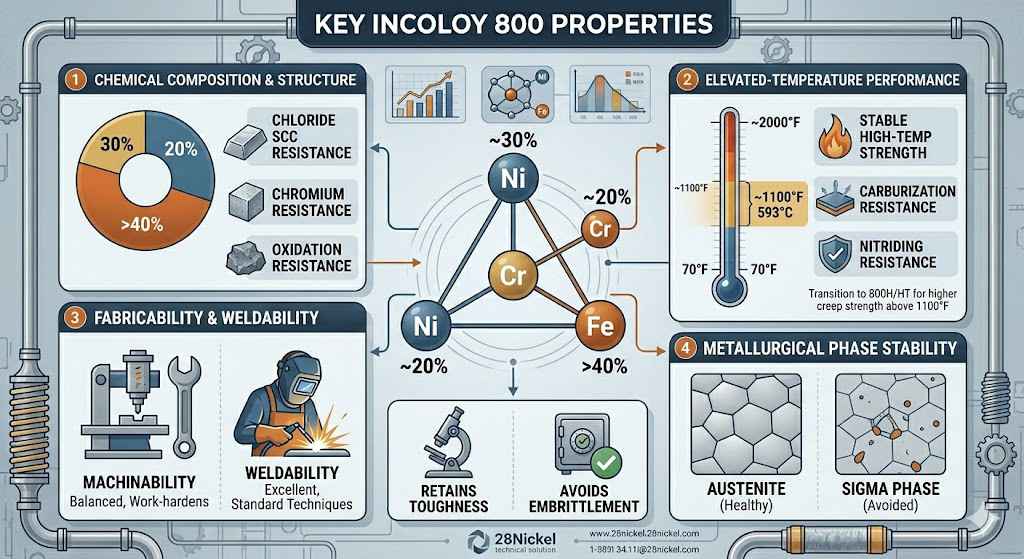
The Chemistry Driving Incoloy 800 Properties The foundation of all Incoloy 800 properties lies in its tightly controlled chemical composition. The alloy primarily consists of 30% to 35% nickel, 19% to 23% chromium, and a minimum of 39.5% iron. This specific elemental ratio creates a stable, fully austenitic, face-centered cubic crystalline structure. The substantial nickel content provides exceptional resistance to chloride stress-corrosion cracking—a common failure mode in lower-grade austenitic stainless steels. Concurrently, the chromium addition imparts critical resistance to oxidation and localized corrosion in aggressive aqueous environments.
Mechanical Incoloy 800 Properties Structural applications demand materials that do not simply resist corrosion but can also bear significant mechanical loads over time. The mechanical Incoloy 800 properties remain highly stable from room temperature up to approximately 1100°F (593°C). Beyond this threshold, engineers typically transition to the 800H or 800HT variants for higher creep and rupture strength, but standard Alloy 800 remains formidable for mid-range elevated temperatures. It maintains excellent ductility, impact strength, and toughness without suffering from sudden embrittlement after prolonged heating.
Table: Typical Room Temperature Mechanical Incoloy 800 Properties
| Mechanical Property | Metric Value | Imperial Value |
| Tensile Strength (Ultimate) | 520 – 600 MPa | 75,000 – 87,000 psi |
| Yield Strength (0.2% Offset) | 205 – 240 MPa | 30,000 – 35,000 psi |
| Elongation in 2 inches | 30% – 45% | 30% – 45% |
| Hardness (Brinell) | 135 – 150 HB | 135 – 150 HB |
High-Temperature Incoloy 800 Properties One of the most heavily scrutinized Incoloy 800 properties is its behavior under sustained thermal exposure. Industrial processes often subject metals to aggressive carburizing and nitriding atmospheres. When carbon or nitrogen infiltrates a metal matrix at high heat, it causes internal carbide or nitride formation, leading to severe embrittlement. Thanks to its high nickel and chromium matrix, Alloy 800 forms a highly adherent, protective surface oxide layer. This passivation layer prevents the ingress of carbon, making the material indispensable for furnace components, cracking tubes, and heat-treating equipment.
Phase Stability and Longevity A hidden but crucial advantage among Incoloy 800 properties is its metallurgical phase stability. Many complex alloys precipitate deleterious intermetallic phases—such as the brittle sigma phase—when exposed to intermediate temperatures (1000°F to 1400°F) for thousands of hours. Because of its optimized iron-nickel ratio, Alloy 800 largely avoids sigma phase precipitation, ensuring that the component retains its structural impact toughness even after years of continuous service in chemical refineries.
Fabrication and Machining Characteristics When reviewing Incoloy 800 properties, engineers must also evaluate manufacturability. High-strength superalloys are notoriously difficult to machine due to rapid work-hardening. However, Alloy 800 strikes a manageable balance. While it does work-harden more rapidly than low-carbon steel, it can be formed, machined, and welded using standard heavy industrial equipment. Utilizing rigid tooling, positive feeds, and adequate lubrication mitigates work-hardening effects, allowing for the precise fabrication of complex geometries.
Partner with 28Nickel for Technical Solutions Selecting the precise alloy for aggressive industrial conditions requires more than just reading a standard datasheet; it demands deep metallurgical expertise. The engineers at 28Nickel understand how different operational variables—such as pressure fluctuations, acidic concentrations, and thermal cycling—interact with specific Incoloy 800 properties. If you are designing a new high-temperature system or looking to upgrade your current infrastructure to prevent premature material failure, our technical team is ready to assist. Contact 28Nickel today to discuss your project parameters, and let our experts help you engineer a more reliable, durable solution.
Related Q&A
Q: How do Incoloy 800 properties differ from standard 304 or 316 stainless steel?
A: Alloy 800 contains significantly more nickel (up to 35%) compared to standard 304/316 stainless steels (which contain 8-14%). This massive increase in nickel drastically improves its resistance to high-temperature oxidation, carburization, and chloride stress-corrosion cracking, making it vastly superior for extreme thermal environments.
Q: Can welding procedures alter Incoloy 800 properties?
A: Yes, thermal input during welding can affect the local microstructural heat-affected zone. However, Alloy 800 is readily weldable using standard techniques (GTAW, GMAW, SMAW). Using matching or over-alloyed filler metals (such as Inconel 82 or 182) ensures the weld seam matches the base metal’s corrosion and heat resistance.
Q: Are Incoloy 800 properties suitable for cryogenic applications?
A: While primarily specified for high-temperature service, its fully austenitic face-centered cubic structure prevents ductile-to-brittle transition at low temperatures. This means it retains excellent toughness even in cryogenic environments, though other specific alloys are usually more cost-effective for pure cryogenic use.