When engineering projects demand materials that can survive the most hostile environments on Earth (and beyond), nickel-chromium superalloys are usually the first choice. Among these, the inconel material properties represent the pinnacle of metallurgical performance. Developed to withstand extreme heat, high pressure, and severe corrosion, Inconel alloys have become indispensable in aerospace, chemical processing, and marine engineering. At 28Nickel, we understand that selecting the right grade requires a deep dive into how these alloys behave under stress.
The Metallurgy Behind Inconel Material Properties
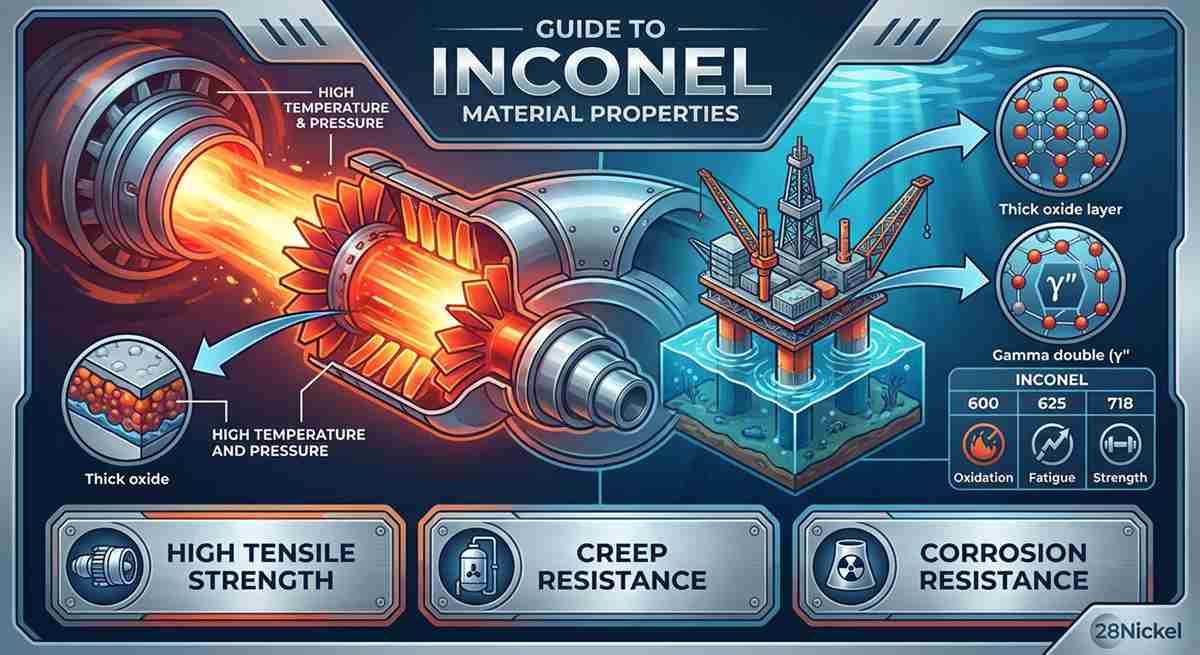
Inconel is a family of austenitic nickel-chromium-based superalloys. The primary reason for the superior inconel material properties lies in their unique microstructure. Unlike standard stainless steels, which may lose their structural integrity as they approach their melting points, Inconel forms a thick, stable, passivating oxide layer when heated. This layer protects the surface from further atmospheric attack.
Furthermore, the strength of Inconel is often derived through solid-solution strengthening or precipitation hardening. For instance, in grades like Inconel 718, the “gamma double prime” () phase provides exceptional yield strength even at temperatures reaching ().
Key Mechanical Inconel Material Properties
To appreciate why these alloys are favored, one must look at the specific mechanical inconel material properties across different grades.
-
High Tensile Strength: Most Inconel grades maintain high tensile and yield strength across a wide temperature range, from cryogenic levels to over .
-
Creep Resistance: Creep is the tendency of a solid material to move slowly or deform permanently under the influence of persistent mechanical stresses. A core feature of inconel material properties is their ability to resist this deformation at high temperatures.
-
Thermal Fatigue Resistance: Because of their stable microstructure, these alloys can handle repeated cycles of heating and cooling without cracking.
Comparison of Popular Inconel Grades
The following table outlines the physical and mechanical inconel material properties for the three most common grades used in industrial applications:
| Property | Inconel 600 | Inconel 625 | Inconel 718 |
| Density (g/cm³) | 8.47 | 8.44 | 8.19 |
| Melting Point (°C) | 1354–1413 | 1290–1350 | 1260–1336 |
| Tensile Strength (MPa) | 550 | 830 | 1240 (Aged) |
| Yield Strength (MPa) | 240 | 415 | 1035 (Aged) |
| Primary Advantage | Oxidation resistance | Fatigue/Corrosion | High Strength/Welding |
Corrosion Resistance and Chemical Stability
A significant portion of the global demand for Inconel stems from its chemical inconel material properties. These alloys are virtually immune to chloride-ion stress-corrosion cracking. This makes them the primary choice for deep-sea oil and gas extraction where high-pressure brine is a constant threat.
Moreover, the high chromium content allows the material to resist oxidizing chemicals, while the high nickel content provides resistance to reducing environments. Whether it is sulfuric acid, hydrochloric acid, or alkaline solutions, the inconel material properties ensure a long service life with minimal degradation.
Applications Driven by Material Performance
The versatility of inconel material properties allows for wide-ranging applications:
-
Aerospace: Used in turbine blades, seals, and combustors where heat is intense.
-
Automotive: Found in high-performance exhaust systems and turbocharger rotors.
-
Nuclear Power: Used for steam generator tubing and core components due to its resistance to high-purity water corrosion.
Conclusion: Why Choose Inconel?
In summary, the inconel material properties provide a unique combination of heat resistance, mechanical strength, and corrosion-fighting capabilities. While the initial cost of nickel alloys may be higher than steel, the longevity and reliability they offer in extreme conditions result in lower lifecycle costs. As a specialized supplier, 28Nickel provides high-quality Inconel solutions tailored to your specific technical requirements.
Related Q&A
1. Is Inconel difficult to machine?
Yes, due to its rapid work-hardening and high strength, Inconel can be challenging to machine. It requires heavy-duty equipment, sharp carbide tools, and slower speeds to prevent tool wear.
2. What is the main difference between Inconel 625 and 718?
The primary difference lies in the strengthening mechanism. Inconel 625 is primarily solid-solution strengthened (using Molybdenum and Niobium), making it excellent for corrosion resistance and welding. Inconel 718 is precipitation-hardened, offering much higher strength at high temperatures.
3. Can Inconel withstand cryogenic temperatures?
Absolutely. Many inconel material properties remain stable even in sub-zero environments, maintaining ductility and toughness where other metals would become brittle and fail.