When selecting high-performance materials for extreme environments, the debate of Inconel vs Hastelloy often takes center stage. Both are nickel-based superalloys designed to withstand conditions that would cause standard stainless steel to fail. However, choosing the right one requires a deep understanding of their metallurgical differences. At 28Nickel, we recognize that the distinction between these two alloys isn’t just about price; it’s about the specific chemical challenges and thermal stresses your project will face.
The Metallurgical Foundation: Inconel vs Hastelloy
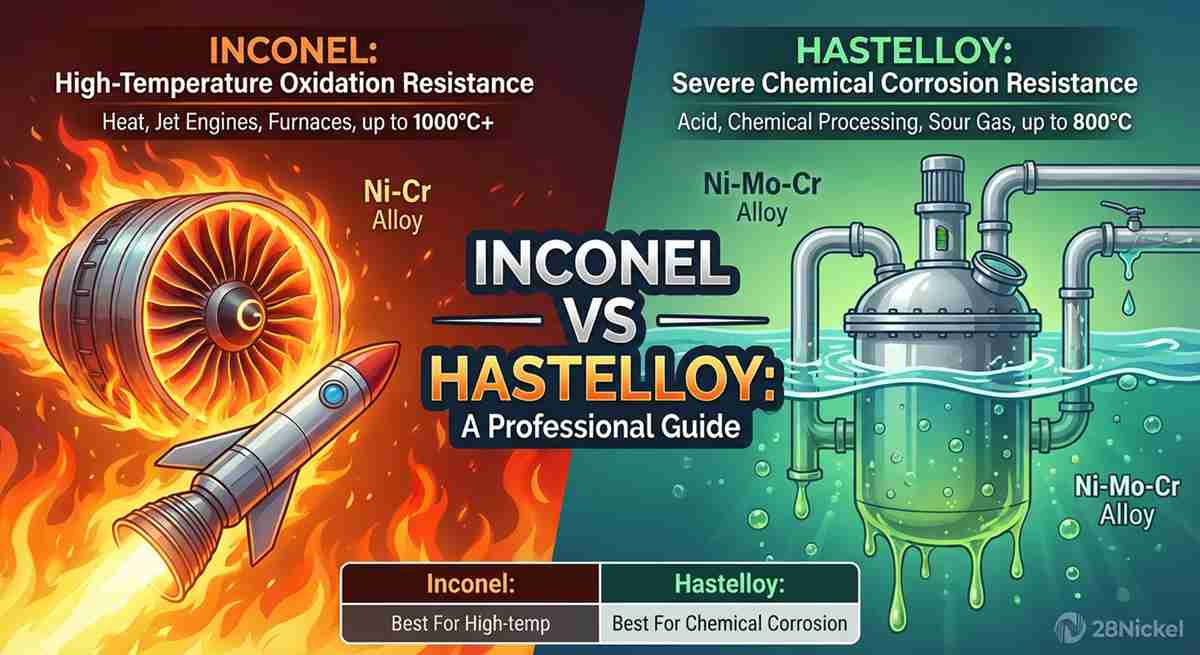
To understand the Inconel vs Hastelloy comparison, we must look at their elemental “DNA.” Inconel is primarily a nickel-chromium alloy. Its high chromium content creates a thick, stable, passivating oxide layer when exposed to heat, making it the industry standard for high-temperature oxidation resistance.
Hastelloy, on the other hand, is a nickel-molybdenum-chromium alloy. The addition of significant amounts of molybdenum (and sometimes tungsten) is what sets it apart. While Inconel fights the fire of high temperatures, Hastelloy is engineered to fight the “acid” of corrosive chemical processing. This fundamental difference dictates where and how these materials are deployed in global industries.
High-Temperature Performance: Where Inconel Leads
In any Inconel vs Hastelloy discussion regarding heat, Inconel (specifically grades like 625 and 718) usually wins. When materials are subjected to extreme thermal cycling, they tend to lose their structural integrity. Inconel alloys utilize “solid solution strengthening” or “precipitation hardening” to maintain high tensile strength and creep-rupture strength at temperatures reaching .
Common applications for Inconel include:
-
Jet engine components and turbine blades.
-
Nuclear reactor core components.
-
Exhaust systems in high-performance automotive engineering.
Corrosion Resistance: The Hastelloy Advantage
While Inconel excels in oxidation, the Inconel vs Hastelloy battle shifts toward Hastelloy when dealing with reducing acids. Hastelloy (particularly the C-276 and C-22 grades) is arguably the most versatile corrosion-resistant alloy available. It resists pitting, stress-corrosion cracking, and specialized chemical attacks from sulfuric, hydrochloric, and phosphoric acids.
If your application involves chemical reactors, sour gas environments, or waste treatment plants, Hastelloy’s unique chemistry provides a level of longevity that Inconel cannot match in those specific acidic mediums.
Comparison Table: Inconel vs Hastelloy at a Glance
| Feature | Inconel (e.g., 625 / 718) | Hastelloy (e.g., C-276 / C-22) |
| Primary Alloying Elements | Nickel, Chromium, Iron | Nickel, Molybdenum, Chromium |
| Best For | High-temperature oxidation | Severe chemical corrosion |
| Max Service Temp | Very High (up to $1000°C+$) | Moderate to High (up to $800°C$) |
| Acid Resistance | Good (Oxidizing acids) | Excellent (Reducing & Oxidizing) |
| Common Grades | Inconel 600, 625, 718 | Hastelloy C-276, B-3, X |
Fabrication and Cost Considerations
From a trade perspective, the Inconel vs Hastelloy choice also impacts your fabrication timeline and budget. Both materials are notoriously difficult to machine due to their “work-hardening” nature. However, Inconel 718 is specifically designed for better weldability compared to many other superalloys.
Cost-wise, both are premium materials. Hastelloy often carries a higher price tag due to the high molybdenum content, which is a more volatile and expensive alloying element than chromium. For a supplier like 28Nickel, we often advise clients to look at the “Life Cycle Cost” rather than just the initial purchase price. Spending more on the correct alloy now prevents catastrophic failure later.
Final Thoughts on Choosing Inconel vs Hastelloy
Choosing between Inconel vs Hastelloy comes down to one question: Is your primary threat Heat or Acid? If you are building a furnace or a rocket engine, Inconel is your best bet. If you are building a chemical processing tank or dealing with seawater at high pressure, Hastelloy is the superior choice.
Related Q&A
Q1: Can Hastelloy be used in high-temperature applications?
Yes, certain grades like Hastelloy X are specifically designed for high-temperature strength and are often used in gas turbine parts, though Inconel remains more common for pure oxidation resistance.
Q2: Is Inconel more difficult to weld than Hastelloy?
Inconel 718 was actually engineered for excellent weldability, resisting “post-weld cracking.” While both require expert techniques (like TIG welding), Inconel is often considered slightly more forgiving in complex fabrications.
Q3: Why is Hastelloy C-276 so popular in the Oil & Gas industry?
Hastelloy C-276 is favored because it survives “sour gas” (hydrogen sulfide) environments, where most other metals suffer from rapid stress-corrosion cracking.