When engineers compare Inconel X-750 vs Hastelloy C-276 for heat exchanger tubing, the wrong decision usually does not fail on paper first. It fails in service. A tube that looks adequate in a datasheet may suffer chloride-induced attack, stress relaxation at temperature, or a fatigue issue around vibration and thermal cycling. That is why the comparison should never stop at “nickel alloy versus nickel alloy.” For heat exchanger tubing, the real question is simpler and more practical: which alloy matches the actual damage mechanism in your unit?
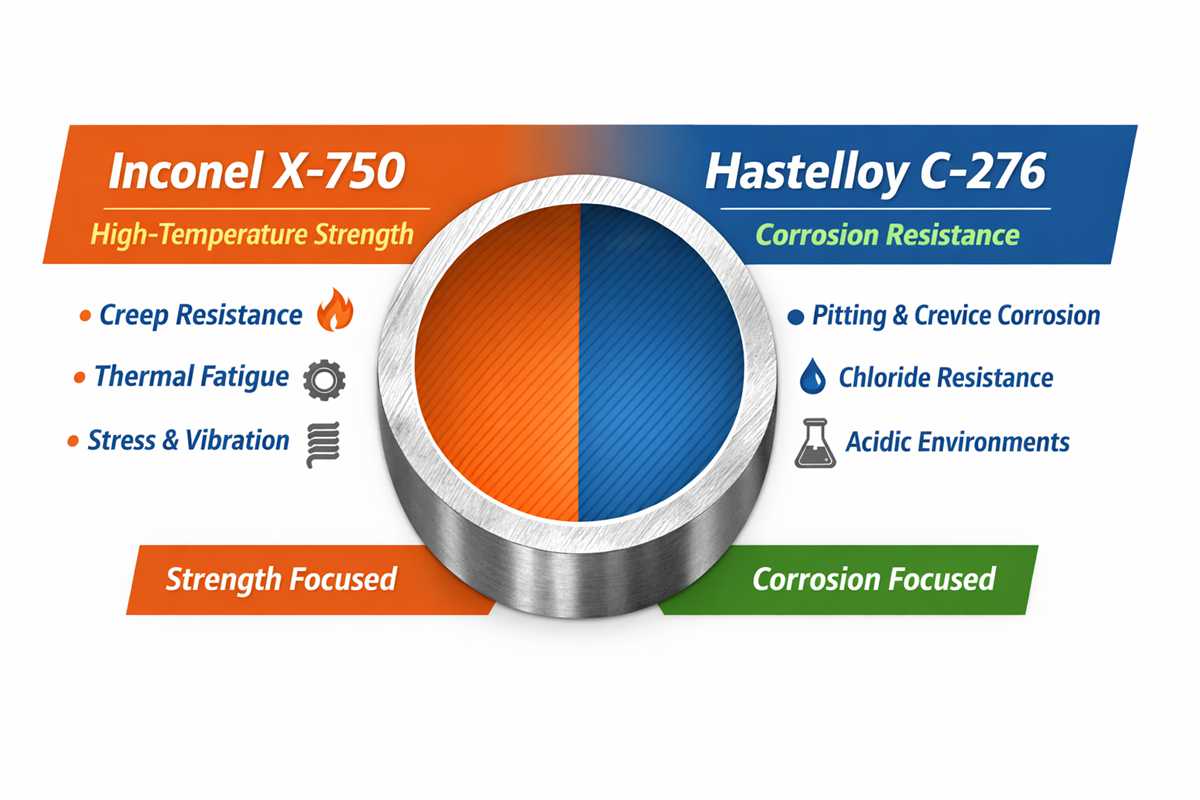
In my experience, Inconel X-750 and Hastelloy C-276 sit in very different engineering positions. X-750 is fundamentally a precipitation-hardenable nickel-chromium alloy developed for strength, spring properties, and oxidation resistance at elevated temperature. C-276, by contrast, is the classic nickel-molybdenum-chromium corrosion-resistant workhorse used where reducing media, chlorides, and mixed aggressive chemistries dominate. If you are selecting tubing for a heat exchanger, that distinction matters far more than brand familiarity.
Inconel X-750 vs Hastelloy C-276 for Heat Exchanger Tubing: First Screening Logic
Start with failure mode, not just design temperature.
If the service is dominated by high-temperature mechanical loading, moderate oxidation, and a need for retained strength under thermal cycling, Inconel X-750 deserves serious attention. Its age-hardened microstructure gives it much higher strength than most solution-annealed corrosion alloys. That makes it attractive where tube supports, vibration, pressure fluctuation, or stress-bearing components are part of the problem.
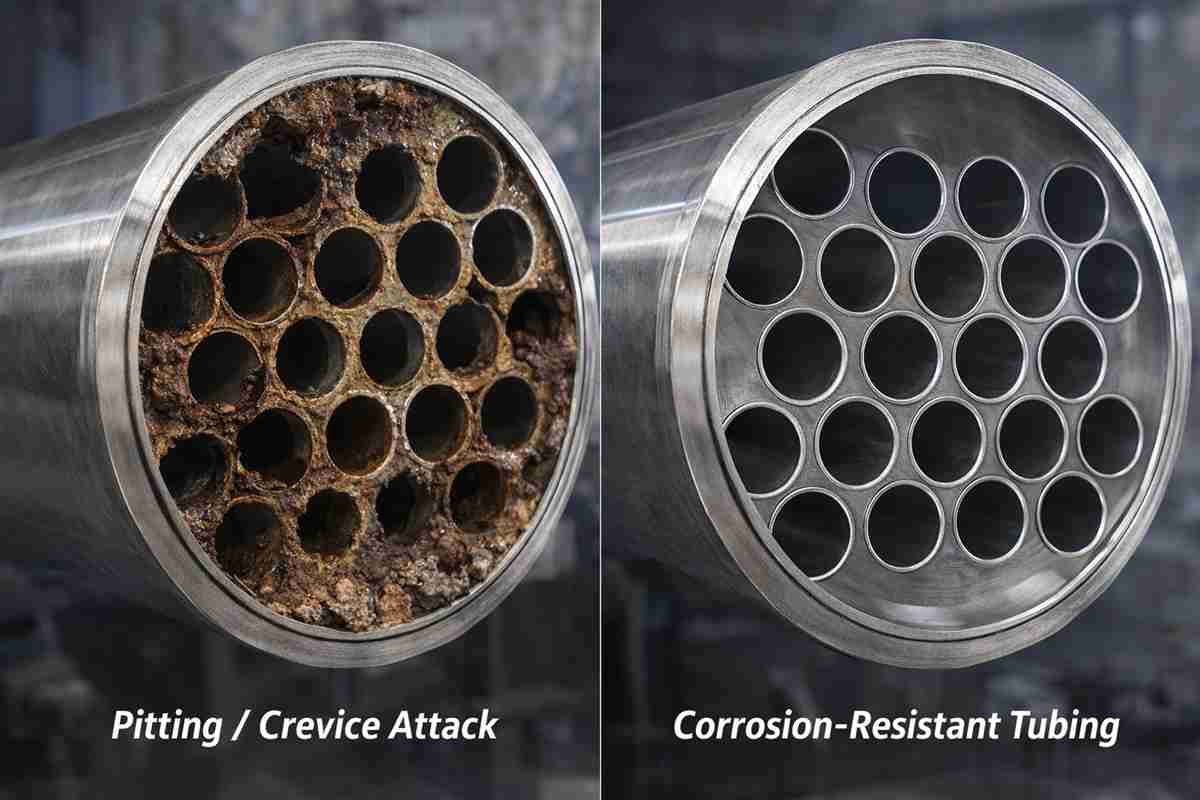
If the service is dominated by corrosion, especially localized corrosion in chlorides, wet process streams, oxidizing-reducing mixed media, or contaminated acids, Hastelloy C-276 is usually the safer candidate. In many exchanger environments, tubing does not fail because ultimate tensile strength was too low. It fails because pitting, crevice corrosion, or process-side chemical attack quietly consumes the wall.
So in the Inconel X-750 vs Hastelloy C-276 for heat exchanger tubing decision, the first filter is this:
- Choose X-750 when strength retention at temperature is the controlling requirement.
- Choose C-276 when corrosion resistance is the controlling requirement.
That sounds straightforward, but real plants are never that tidy.
Metallurgical Difference Behind the Performance Gap
This is where many purchasing decisions become oversimplified.
Inconel X-750 derives much of its strength from precipitation hardening, mainly through gamma-prime type strengthening phases after proper heat treatment. That gives the alloy excellent mechanical performance in elevated-temperature service, but it also means the final tubing properties depend heavily on heat treatment route, grain size control, and fabrication history. Weld heat-affected behavior and post-fabrication condition should never be treated casually.
Hastelloy C-276 is not chosen because it is especially strong. It is chosen because its Ni-Mo-Cr chemistry gives broad resistance to pitting, crevice corrosion, and many severe chemical environments. The alloy is particularly valued where process upset conditions occur. That is a major advantage in real-world chemical plants, scrubbers, sour systems, and multi-contaminant streams where media purity is not guaranteed.
For Inconel X-750 vs Hastelloy C-276 for heat exchanger tubing, the metallurgical trade-off is therefore clear:
- X-750 offers a strength-centered solution.
- C-276 offers a corrosion-centered solution.
The phrase sounds simple, but it should guide almost every technical discussion with procurement.
Where Inconel X-750 Is the Better Tubing Choice
There are cases where engineers underestimate X-750 because they view all heat exchanger tubing as mainly a corrosion problem. That is not always true.
X-750 can be the better option when the exchanger sees:
- Elevated temperatures where creep relaxation or loss of mechanical integrity matters
- Significant thermal fatigue or vibration
- Oxidizing atmospheres rather than severe wet chemical corrosion
- Applications where tube assemblies or adjacent components require higher strength margins
For example, in certain gas-side, hot section, or mechanically demanding exchanger designs, the higher strength of X-750 can allow better dimensional stability and improved resistance to deformation. In these cases, switching automatically to C-276 may add corrosion capability you do not really need, while giving away useful mechanical margin.
That said, X-750 is not the alloy I would select casually for chloride-laden, stagnant, or crevice-prone aqueous service unless the environment has been very carefully characterized.
Comparative Table: Inconel X-750 vs Hastelloy C-276 for Heat Exchanger Tubing
| Property / Selection Factor | Inconel X-750 | Hastelloy C-276 | Engineering Comment |
|---|---|---|---|
| Alloy type | Precipitation-hardened Ni-Cr alloy | Ni-Mo-Cr corrosion-resistant alloy | Different design philosophies from the start |
| Primary advantage | High-temperature strength and fatigue resistance | Exceptional resistance to aggressive corrosion | Match to dominant damage mechanism |
| Strength level | Higher, especially after age hardening | Lower than X-750 in typical annealed condition | Important for mechanically loaded tubing |
| Chloride resistance | Limited compared with C-276 | Excellent | Critical in wet chloride service |
| Pitting / crevice corrosion resistance | Moderate to limited, environment dependent | Very strong | Major advantage for C-276 |
| Oxidation resistance | Good at elevated temperature | Good, but usually not the main reason to select it | X-750 often favored in hot oxidizing service |
| Fabrication sensitivity | Heat treatment condition is very important | More straightforward from corrosion-selection perspective | Processing route must be controlled for both |
| Typical best-fit service | High-temp structural or mechanically demanding exchanger duty | Severe chemical process and mixed-corrosion exchanger duty | Best choice depends on actual process conditions |
| Relative cost justification | Justified when strength matters | Justified when corrosion risk is costly | Overengineering either alloy can waste budget |
Why C-276 Often Wins in Chemical Process Exchangers
In many wet-process plants, the answer to Inconel X-750 vs Hastelloy C-276 for heat exchanger tubing is not especially close. C-276 tends to win because corrosion, not strength, is the real life-limiting factor.
Engineers working with chlorides, bleach contamination, flue gas scrubber chemistry, acidic condensates, or mixed oxidizing-reducing streams usually need robustness under upset conditions. C-276 has earned its reputation there for a reason. It tolerates complex service environments better than many alloys that look acceptable in a simplified lab comparison.
Another practical point: heat exchangers rarely operate forever under clean, ideal chemistry. Deposits form. Crevices develop under supports or at tube sheet transitions. Process control drifts. Maintenance intervals stretch. C-276 gives more forgiveness when the plant stops behaving like the original design basis.
Final Engineering Verdict
If you ask me to summarize the Inconel X-750 vs Hastelloy C-276 for heat exchanger tubing decision in one sentence, it would be this: X-750 is selected for strength at temperature; C-276 is selected for survival in harsh chemistry.
Do not choose between them by headline alloy reputation. Choose by service mechanism, upset risk, fabrication route, and lifecycle cost. In exchanger tubing, corrosion allowance is limited, inspection access is often poor, and failure consequences can be expensive. That is why the right alloy is rarely the cheapest alloy per kilogram. It is the alloy that prevents the most probable failure mode.
For engineering teams or buyers evaluating tube material for a new project, a useful next step is to review the actual process media, chloride level, temperature profile, design stress, and expected upset conditions with an alloy specialist before release for procurement. A short technical review at this stage can prevent a very expensive material mismatch later.
Related Q&A
1. Is Inconel X-750 more suitable than Hastelloy C-276 for high-temperature heat exchanger tubing?
Yes, when elevated-temperature strength, stress relaxation resistance, and mechanical stability are more critical than severe aqueous corrosion. But for chemically aggressive wet service, C-276 is often the safer choice.
2. Why is Hastelloy C-276 often preferred in corrosive heat exchanger environments?
Because it offers broader resistance to pitting, crevice corrosion, and mixed chemical attack, especially in chloride-containing or upset-prone process streams where tubing wall loss is the main failure risk.
3. What data should be checked before choosing between Inconel X-750 and Hastelloy C-276 tubing?
At minimum: operating and upset temperature, process composition, chloride content, oxidizing/reducing character, flow regime, fouling tendency, vibration, design stress, and fabrication or welding requirements.