When engineers search Inconel 600 vs Inconel 625 for heat exchanger tubing, they are rarely looking for a generic alloy list. They are usually trying to prevent the expensive kind of failure: tube leakage after a few shutdowns, under-deposit attack near the tubesheet, or an over-specified material package that raises cost without adding real service life. Both are nickel-based alloys. Both outperform common stainless grades in severe duty. But in exchanger service, they are not solving the same problem.
At the metallurgical level, Inconel 600 is a Ni-Cr-Fe alloy built around high nickel content, good oxidation resistance, and strong resistance to chloride-ion stress-corrosion cracking, caustic media, and high-purity water. Inconel 625 shifts the balance by adding substantial molybdenum and niobium, which raises strength dramatically and improves resistance to pitting, crevice corrosion, and mixed oxidizing/reducing acidic environments. For heat exchanger tubing, that difference is not academic; it determines whether you are designing against SCC, localized chloride attack, or mechanical loading.
The practical answer is therefore failure-mode driven. If the dominant risk is dry-side oxidation, carburization, nitrogen absorption, or chloride SCC without a strong pitting or crevice mechanism, 600 can still be the smarter engineering choice. If the exchanger sees seawater, brine, acidic chlorides, stagnant crevices, under-deposit chemistry, or a requirement for higher pressure capability, 625 is normally the safer alloy. That is the real logic behind Inconel 600 vs Inconel 625 for heat exchanger tubing.
What Actually Matters in Inconel 600 vs Inconel 625 for Heat Exchanger Tubing
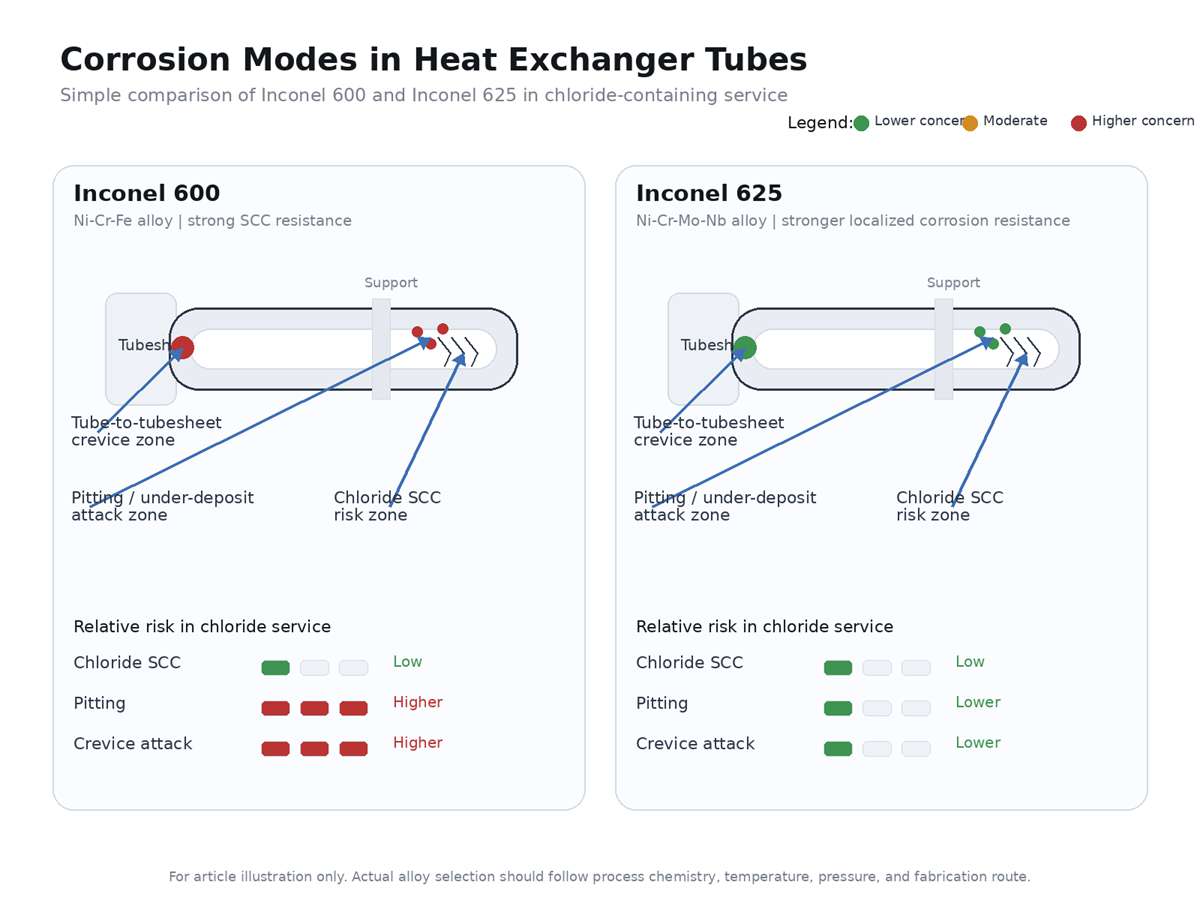
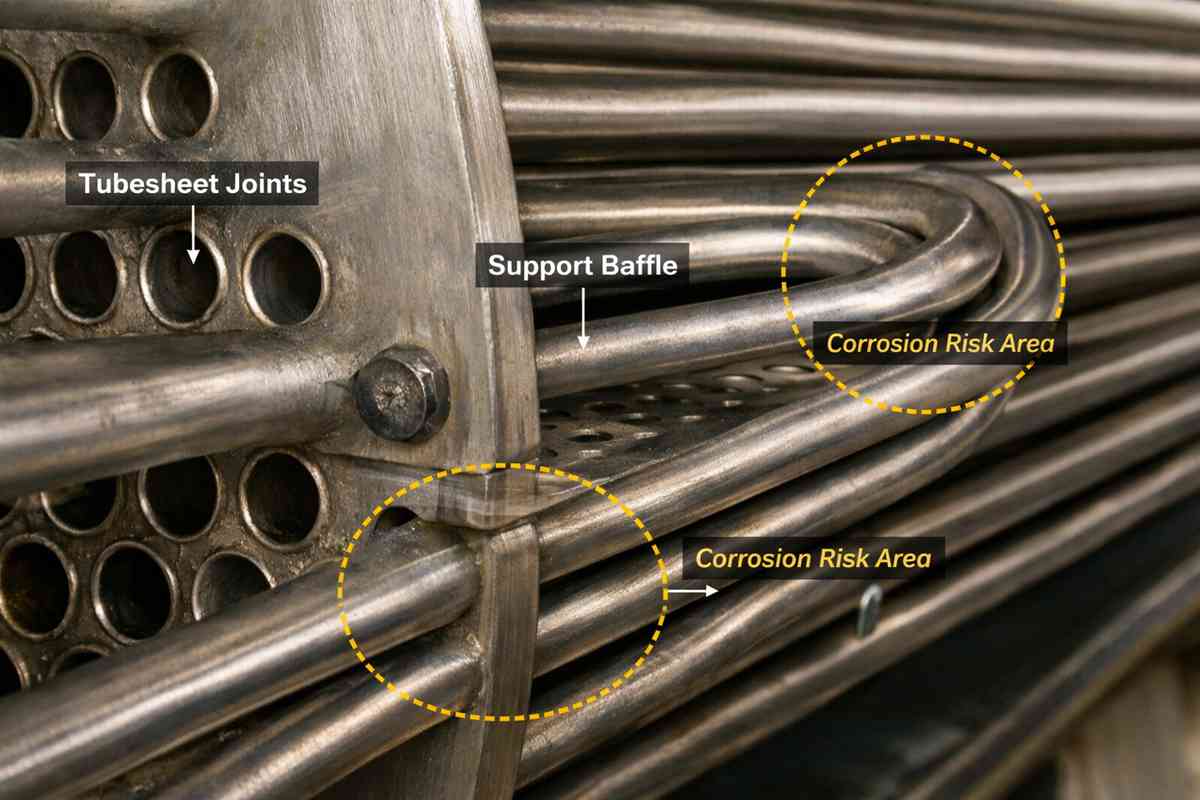
Corrosion mode is the first separator. Tube-grade UNS N06600 data show excellent resistance to chloride SCC, but its pitting resistance is only roughly comparable to AISI 304. UNS N06625, by contrast, is specifically described as very resistant to pitting and crevice corrosion, virtually immune to chloride SCC, and highly resistant in chloride-bearing and acidic environments, with a PRE of at least 48 in seamless tube data. In real exchangers, that difference becomes visible at the places where failures usually start: support plates, deposit shadows, low-flow zones, and the tube-to-tubesheet crevice.
Strength is the second separator, and this is where many RFQs stay too generic. Heat exchanger tube data for UNS N06600 show proof strength around 241–245 MPa and tensile strength in the 552–700 MPa range, with elongation of at least 35% depending on condition. For UNS N06625 tubing, Grade 1 starts at about 415 MPa proof strength and 827 MPa tensile strength, while Grade 2 starts at about 276 MPa and 690 MPa, both with at least 30% elongation. That extra margin can justify thinner-wall designs, better pressure containment, or improved resistance to vibration and corrosion-fatigue. In the fabrication shop, though, it also means higher forming loads, more springback in U-bends, and more force during tube expansion into the tubesheet.
Thermal and fabrication behavior complete the picture. Special Metals lists thermal conductivity for alloy 600 at about 14.9 W/m·K near room temperature, versus about 9.8 W/m·K for alloy 625, so 600 does provide a more favorable conduction path through the wall. But exchanger duty depends on total thermal resistance, not tube-wall conductivity alone; convection, fouling, and wall resistance all contribute to the overall conductance. Welding behavior also differs. Alloy 625 is relatively forgiving because niobium stabilizes the alloy against sensitization during welding, whereas alloy 600 can become susceptible to intergranular attack after exposure in the sensitizing range of roughly 540–760°C.
Inconel 600 vs Inconel 625 for Heat Exchanger Tubing: Property Table
| Selection factor | Inconel 600 (UNS N06600) | Inconel 625 (UNS N06625) | Why it matters in exchanger tubing |
|---|---|---|---|
| Nominal chemistry | Ni ≥72%, Cr 14–17%, Fe 6–10%; no intentional Mo or Nb | Ni ≥58%, Cr 20–23%, Mo 8–10%, Nb+Ta 3.15–4.15%, Fe ≤5% | Mo and Nb are the big reason 625 outperforms 600 in localized chloride attack and strength |
| Tube strength at 20°C | Rp0.2 about 241–245 MPa; Rm 552–700 MPa; A ≥35% | Grade 1: Rp0.2 ≥415 MPa, Rm ≥827 MPa, A ≥30%; Grade 2: Rp0.2 ≥276 MPa, Rm ≥690 MPa, A ≥30% | Higher 625 strength can support thinner walls, more pressure margin, and better vibration tolerance |
| Thermal conductivity near room temperature | ~14.9 W/m·K | ~9.8 W/m·K | 600 conducts heat better through the wall, though wall resistance is only one part of exchanger duty |
| Chloride SCC resistance | Very strong; virtually immune in manufacturer data | Very strong; virtually immune in chloride environments | Both handle SCC well, so the decision often shifts to pitting and crevice risk |
| Pitting / crevice corrosion | About AISI 304 level in tube data | Very good; PRE ≥48 | This is the main reason 625 is preferred for seawater, brines, and stagnant chloride duty |
| Welding / sensitization | Good weldability, but thermal history matters; sensitization can raise intergranular attack risk | Good weldability; Nb helps resist sensitization during welding | Welded areas and HAZ behavior often decide exchanger tube life |
| High-temperature note | Strong oxidation, carburization, nitrogen absorption, and dry chlorine/HCl resistance; air scaling data up to about 1175°C in tube data | Good oxidation/scaling resistance, but prolonged exposure above 600°C may lead to embrittlement in tube data | Hot-side temperature and exposure time can swing the decision |
| Typical tube standards | ASTM B163 / B167 | ASTM B444 Grade 1 / Grade 2 | Buyers should specify standard and condition, not just alloy name |
Source note: chemistry, corrosion, mechanical, thermal, and tube-standard values above are compiled from Special Metals INCONEL technical bulletins and Alleima seamless tube datasheets for UNS N06600 and UNS N06625.
How I Would Choose Between 600 and 625 on a Real RFQ
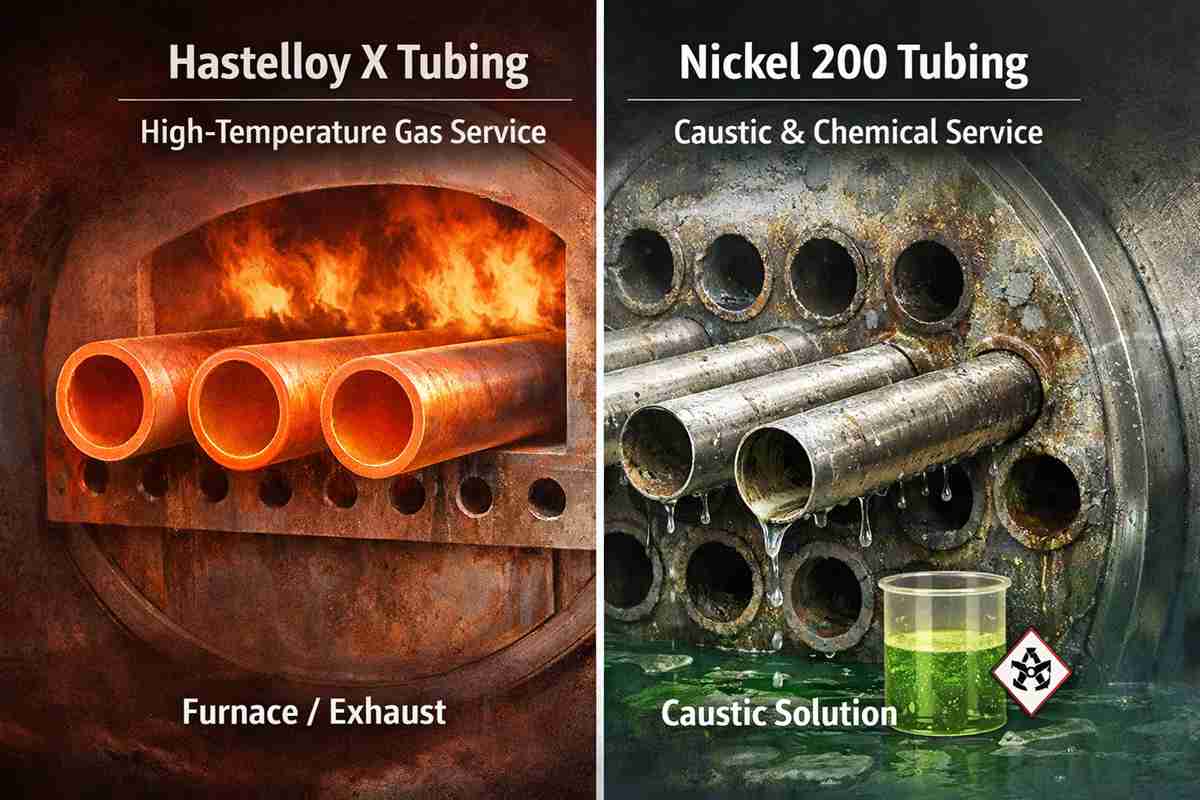
I would start with Inconel 600 when the service is high-purity water, caustic alkali, dry hot gas, furnace-like atmospheres, or chloride SCC concern without a strong pitting or crevice driver. It also remains attractive when better thermal conductivity, easier forming, and more forgiving tube expansion are important. In practice, 600 is often a rational choice when the exchanger lives in a relatively clean system and the design basis does not involve stagnant chlorides, seawater, or aggressive mixed-acid chemistry.
I would move to Inconel 625 when the process includes seawater cooling, brine, acidic chlorides, shutdown deposits, low-flow crevices, or a combination of corrosion and mechanical loading. That is also the better direction when you need higher proof strength, thin-wall capability, stronger corrosion-fatigue resistance, or a welded fabrication route with better protection against sensitization-related problems. One subtle but important point: on a 625 inquiry, the buyer should not stop at the alloy name. Grade 1 and Grade 2 tubing are not the same engineering answer. Grade 1 gives the higher room-temperature strength, while Special Metals notes that solution-treated material is preferred when creep or rupture resistance at higher temperature matters.
Before releasing a purchase order, I would always verify five things: chloride level, deposit or crevice likelihood, actual metal temperature, welding route, and whether the tube needs to be U-bent or heavily expanded. In exchanger troubleshooting, the decisive issue is usually the mismatch between local chemistry, fabrication condition, and the real damage mechanism in service—not just the catalog alloy name.
Conclusione
If you reduce the question to a one-line answer, you will probably overbuy or underprotect. Inconel 600 is still a serious heat exchanger tubing alloy when SCC resistance, dry high-temperature stability, caustic or high-purity water service, formability, and better wall conductivity matter more than localized chloride attack. Inconel 625 earns its place when chloride pitting, crevice corrosion, higher pressure loading, corrosion-fatigue, or aggressive mixed chemistries are the real design limiters. If your team is qualifying a new exchanger bundle or replacing a failed tube set, send 28Nickel the process chemistry, chloride level, design temperature, pressure, and fabrication route. That is enough information to tell whether 600 is sufficient—or whether 625 is the safer lifecycle decision.
Domande e risposte correlate
Q1. Is Inconel 625 always better than Inconel 600 for heat exchanger tubing?
No. Alloy 625 is clearly stronger and much better against pitting and crevice corrosion in chloride-bearing service, but alloy 600 offers higher thermal conductivity and remains highly valuable where chloride SCC, dry hot atmospheres, caustic media, or high-purity water are the main concerns. The “better” alloy depends on the dominant failure mode, not the higher alloy content alone.
Q2. Can Inconel 600 be used in seawater or chloride cooling service?
Only with caution. Manufacturer tube data show excellent SCC resistance for UNS N06600, but its pitting resistance is roughly at the AISI 304 level. Once the exchanger design includes stagnant zones, deposits, supports, or tubesheet crevices, 625 is usually the more defensible choice because it is specifically built for localized chloride attack resistance.
Q3. Should I specify 625 Grade 1 or Grade 2 tubing?
Specify the grade deliberately. Grade 1 gives higher room-temperature strength, while Grade 2 is solution-annealed and is the condition commonly chosen when elevated-temperature creep or rupture performance matters more. If the inquiry only says “625 tube” and does not define the condition, the engineering basis is incomplete.