









サワーガス・サービスのためのヘインズ214の選び方

エンジニアが尋ねるとき how to choose Haynes 214 for sour gas service, the real question is usually not “Is it a nickel alloy?” but “Is the actual corrosion mechanism compatible with what this alloy was designed to do?” That distinction matters. Haynes 214 is a nickel-based alloy with strong high-temperature oxidation resistance, largely because it forms a stable alumina-rich scale. That is a very different design philosophy from alloys selected primarily for wet H2S cracking resistance in conventional upstream or gas-processing sour service.

So the first principle is simple: do not select Haynes 214 for sour gas merely on brand recognition or nickel content. In many wet sour systems, it would not be the first material an experienced corrosion engineer reaches for. In some high-temperature, relatively dry sulfur-bearing gas environments, however, it can become a technically defensible candidate. The key is separating “sour” into the actual variables that drive damage.

サワーガス・サービスのためのヘインズ214の選び方

How to choose Haynes 214 for sour gas service starts with defining the sour environment

The biggest mistake in alloy selection is treating sour gas as one service category. It is not. A wet H2S separator, a hot sulfur-bearing transfer line, and a combustion-side component exposed to sulfur-containing gases do not behave the same way metallurgically.

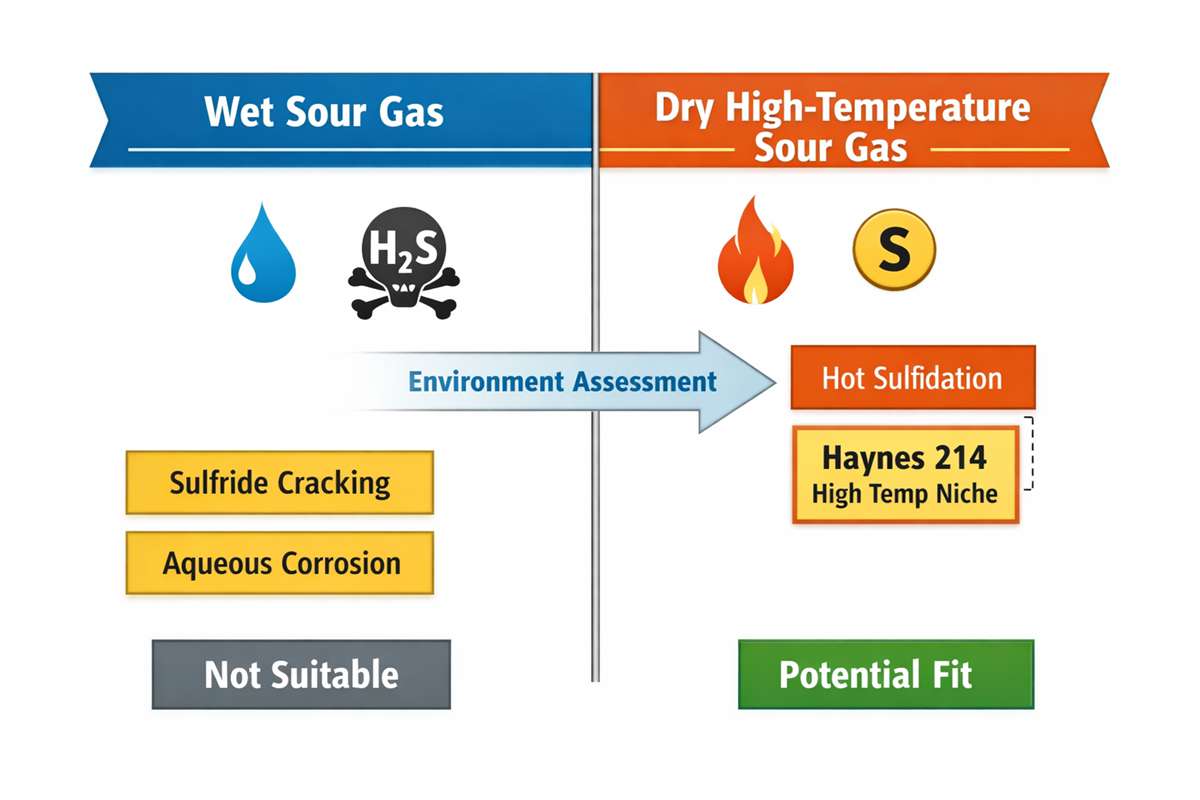
If you are serious about how to choose Haynes 214 for sour gas service, begin with five screening questions. First, is the environment wet or dry at the metal surface? Once liquid water condenses, the selection logic changes dramatically because sulfide stress cracking, hydrogen uptake, and localized corrosion become more important than high-temperature scaling behavior. Second, what is the actual metal temperature, not just the bulk gas temperature? Haynes 214 becomes more relevant when oxidation-scale stability matters. Third, what are the H2S, sulfur vapor, oxygen potential, CO2, and chloride levels? Fourth, is the component pressure-retaining, or is it an internal part where some oxidation allowance is acceptable? Fifth, what code basis governs the job?

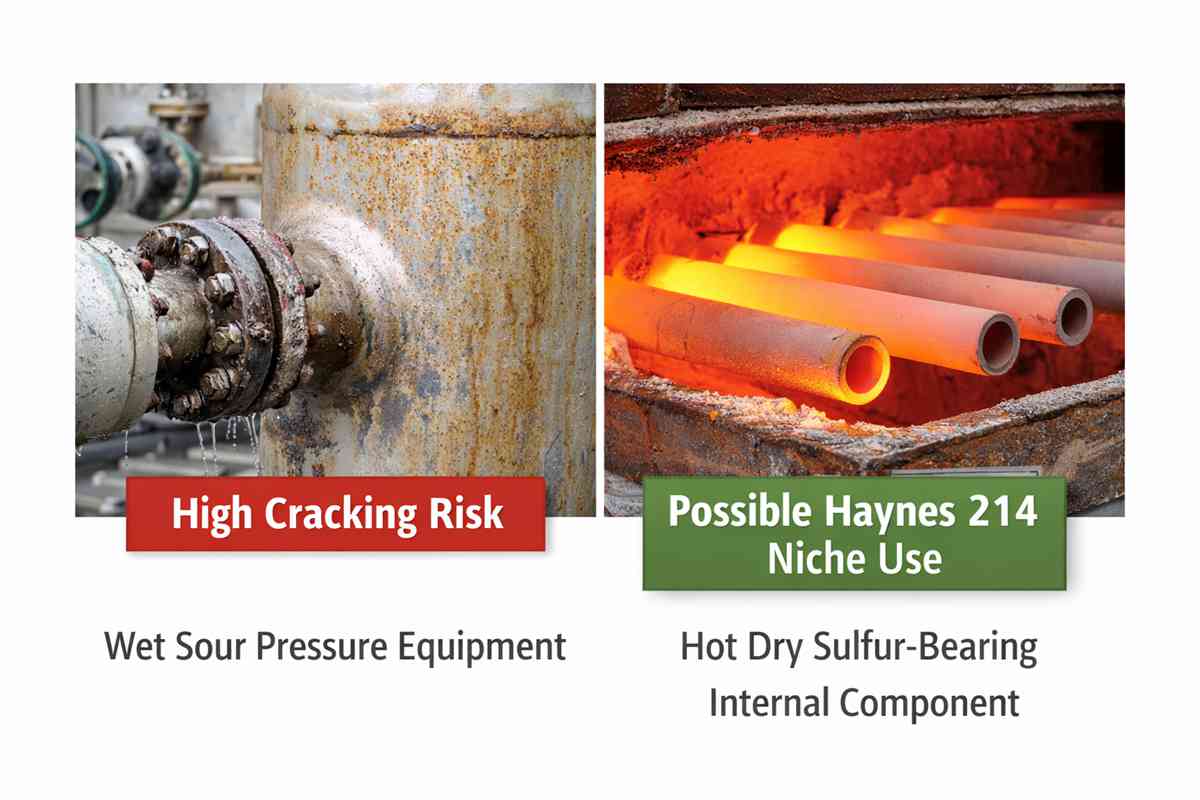
This is where many purchasing decisions go wrong. The word “sour” tends to push teams toward a generic corrosion-resistant alloy discussion, but Haynes 214 is not a generic CRA. It is a specialized alloy whose strength lies in high-temperature oxidation resistance. In practical terms, that means it deserves attention for hot, mostly dry gas streams where scale integrity controls life. It deserves caution, or outright rejection, in wet sour service where cracking compliance and aqueous corrosion behavior dominate.

Metallurgical limits matter when you choose Haynes 214 for sour gas service

に対する健全な回答 how to choose Haynes 214 for sour gas service must come from metallurgy, not marketing. Haynes 214 contains chromium and a relatively high aluminum addition compared with many general-purpose ニッケル合金. That aluminum is important because it helps generate a tenacious alumina layer at elevated temperature. In oxidizing furnace-type conditions, that can be extremely valuable.

But sour gas is often mixed-potential chemistry. Sulfur-bearing environments can become reducing, sulfidizing, or cyclically oxidizing depending on shutdowns, dew point excursions, contaminants, and gas composition. Under those conditions, the protective behavior of the surface film has to be evaluated, not assumed. An alloy that performs beautifully in clean oxidation may not be the best answer in complex wet H2S service or in deposits that disrupt scale formation.

This is why how to choose Haynes 214 for sour gas service should always include a distinction between resistance to high-temperature attack and resistance to environmentally assisted cracking. Those are not interchangeable properties. For piping, vessels, and well-stream equipment under wet sour conditions, engineers typically focus on compliance with project sour-service requirements, hardness control, welding qualification, and cracking risk. Haynes 214 is simply not the default answer in that part of the industry.

Welding also deserves attention. Nickel alloys are often assumed to be forgiving, yet welded areas can alter local corrosion behavior through microsegregation, heat tint, residual stress, and scale damage. If a Haynes 214 component is fabricated, the weld procedure, filler selection, surface finishing, and post-fabrication cleaning all influence field performance. In marginal sour environments, that detail can be the difference between a long campaign and an early failure review.

選択要因 Why it matters in sour gas Haynes 214 implication Engineering judgment
Presence of liquid water Drives hydrogen-related cracking and aqueous corrosion Major caution area Usually not a first-choice alloy for wet sour duty
Metal temperature Controls oxidation/sulfidation mechanism Stronger candidate at elevated temperature More relevant in hot, dry gas service
H2S partial pressure and sulfur activity Affects sulfide scale stability Must be verified by test data or field history Do not assume nickel base alone is enough
Oxygen potential Determines whether alumina scale can remain protective Critical to Haynes 214 performance Better when a stable oxide can form and heal
Chlorides/condensate contamination Increases localized corrosion risk Can undermine otherwise good high-temp performance Requires conservative review
コンポーネント機能 Pressure boundary vs internal hardware Risk tolerance is different Pressure parts demand stricter qualification
Welding/fabrication route Alters surface condition and local metallurgy Weld detail matters significantly Qualify procedures, not just base metal
Code and owner specification Determines what is permitted May limit or exclude its use Always screen against project requirements

A practical framework for how to choose Haynes 214 for sour gas service

In practice, how to choose Haynes 214 for sour gas service should follow a three-step framework.

First, classify the service honestly. If the metal ever operates below the water dew point, or if shutdowns introduce condensation, treat the environment as potentially wet sour unless proven otherwise. That single decision often eliminates unsuitable materials early and saves expensive debate later.

Second, map the dominant damage mode. Are you trying to resist high-temperature oxidation, mixed oxidation-sulfidation, metal dusting tendencies, carburization, or wet sour cracking? Haynes 214 becomes interesting only when high-temperature surface stability is the central problem. If the main risk is sulfide stress cracking or hydrogen damage, you are solving a different materials problem.

Third, demand evidence. For critical service, the right approach is not a brochure comparison. It is a package of owner specification review, corrosion test data, weld qualification records, and, where possible, comparable field exposure history. When customers ask us at 28Nickel to review a sour gas application, the fastest route to a useful answer is a process data sheet with temperature range, pressure, gas composition, water content, contaminants, flow regime, design life, and fabrication route. Without that, any alloy recommendation is guesswork dressed as confidence.

Where Haynes 214 makes sense—and where it usually does not

A balanced discussion of how to choose Haynes 214 for sour gas service leads to a narrow but important conclusion. Haynes 214 can make sense in hot, mostly dry sulfur-bearing gas environments where oxidation-scale durability at elevated temperature is the governing life-limiting factor. Think less about generic upstream sour service and more about specialized thermal equipment, hot gas handling internals, or components exposed to oxidizing/sulfur-bearing atmospheres at temperatures where conventional CRA logic is incomplete.

It usually does ない make sense as a casual upgrade for wet sour piping, pressure vessels, or general gas-production hardware simply because it is a nickel alloy. That is not conservative engineering; it is category confusion. In those applications, the selection basis normally shifts toward cracking resistance, code acceptance, fabrication control, and total lifecycle cost rather than maximum oxidation resistance.

サワーガス・サービスのためのヘインズ214の選び方

In other words, how to choose Haynes 214 for sour gas service is really about knowing when ない to choose it. That is often the mark of a mature materials decision. If your service window truly sits in the high-temperature, dry, sulfur-bearing niche, Haynes 214 deserves serious review. If it does not, another alloy system may be technically safer and commercially smarter.

結論

The correct answer to how to choose Haynes 214 for sour gas service is conditional, not universal. Haynes 214 is a specialized high-temperature alloy, not a blanket solution for all sour gas environments. Select it only after you confirm that the service is predominantly hot and dry, that alumina-scale protection is relevant, that wet sour cracking is not the governing failure mode, and that fabrication plus project code requirements are fully addressed.

If you are evaluating a real project, send the operating window and process chemistry to 28Nickel. A serious alloy review starts with service definition, not with alloy names.

関連Q&A

Q1: Is Haynes 214 suitable for wet H2S sour service?
Usually not as a default choice. Wet sour service is typically governed by cracking risk, code compliance, and aqueous corrosion behavior rather than the high-temperature oxidation strength that makes Haynes 214 attractive.

Q2: What is the key criterion in how to choose Haynes 214 for sour gas service?
The key criterion is whether the environment is truly hot and predominantly dry at the metal surface. If the damage mechanism is high-temperature oxidation or mixed oxidation-sulfidation, Haynes 214 may be worth evaluating. If condensation or wet sour cracking dominates, it is usually the wrong starting point.

Q3: Should Haynes 214 be approved based on datasheet properties alone?
No. For sour applications, especially critical equipment, the decision should include process chemistry, temperature profile, weld procedure qualification, owner specification review, and preferably test data or field history from comparable service.

この記事を共有する

関連記事

この見出しは訪問者の注意を引く

あなたのビジネスとサービスを訪問者に紹介する短い説明文。.
スオルエットゥ
上部へスクロール