









NACE Compliant Nickel Alloy for Sour Gas Service?

NACE compliant nickel alloy for sour gas service is not a decorative phrase for sales literature. In H2S-containing environments, material failure can develop through sulfide stress cracking, stress corrosion mechanisms, hardness-related vulnerability, or corrosive attack accelerated by the actual fluid chemistry. Engineers therefore search for NACE compliant nickel alloy for sour gas service when the process risk is too high to rely on generic corrosion-resistant claims. The requirement is as much about disciplined material selection and condition control as it is about alloy family. Two materials may share a similar commercial name and still behave very differently if hardness, heat treatment, cold work, or weld condition are not properly managed.

This is why sour gas qualification must begin with service definition, not just catalogue preference. Partial pressure of H2S, chlorides, elemental sulfur, pH, temperature, and the presence of wet service all affect material choice. In some cases, a standard corrosion-resistant alloy is sufficient. In others, only a carefully controlled NACE compliant nickel alloy for sour gas service will satisfy the cracking and corrosion exposure simultaneously. Buyers who treat NACE as a simple checkbox often discover too late that documentation, hardness control, and processing route matter just as much as the alloy label itself.

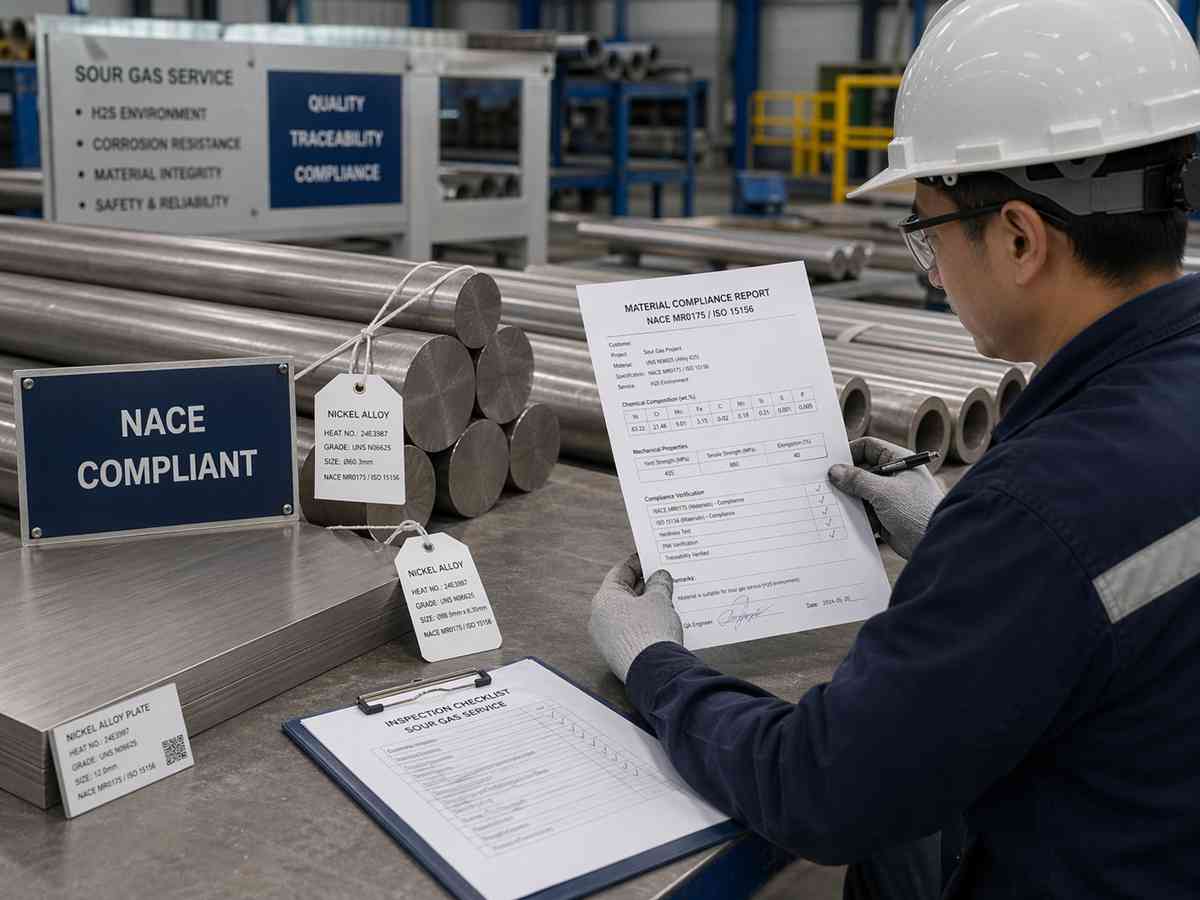
Suggested image: a compliance review scene for 니켈 합금 소재 intended for sour gas projects.

NACE compliant nickel alloy for sour gas service

What NACE Compliant Nickel Alloy for Sour Gas Service Really Means

For procurement teams, the first point to remember is that NACE compliance is condition-specific. A NACE compliant nickel alloy for sour gas service is not defined only by chemistry. It also depends on how the material was produced, heat treated, cold worked, welded, and inspected against the relevant standard and service envelope. Depending on project rules, buyers may be working to MR0175 / ISO 15156 concepts, internal owner standards, hardness limits, or additional documentation requirements. If the supplier cannot explain those relationships, it becomes difficult to trust the compliance claim.

That is especially important for bars, 단조품, and fabricated components that may see additional machining or welding after supply. A mill-certified alloy may still become unsuitable if later processing changes the hardness or local metallurgical condition beyond acceptable limits. Therefore, when specifying NACE compliant nickel alloy for sour gas service, the buyer should request the full compliance basis: applicable standard, product form, heat-treatment condition, hardness evidence where relevant, and any restrictions on subsequent fabrication. This shifts the discussion from marketing language to engineering control, which is where sour service procurement needs to live.

Control item Why it matters in sour gas What buyers should verify
Applicable NACE basis Defines acceptance criteria for the service envelope Project standard, MR0175 / ISO 15156 reference, or owner requirement
Heat-treatment condition Influences cracking resistance and hardness response Certificate and route details tied to the delivered heat
Hardness control Excess hardness can raise sour-service cracking risk Measured hardness records where required
Post-supply processing limits Machining or welding can alter condition Supplier guidance on fabrication restrictions or requalification needs

When to Specify NACE Compliant Nickel Alloy for Sour Gas Service

The best time to specify NACE compliant nickel alloy for sour gas service is at inquiry stage, before the supplier selects stock route and before any substitute is considered. That early definition matters because some materials can meet corrosion expectations but still fall short on sour-service acceptance once hardness or processing history is reviewed. It also matters because upstream and gas-processing projects often combine sour exposure with pressure, temperature variation, and demanding release documentation. By the time fabrication begins, changing the material strategy is rarely cheap.

Buyers should therefore send the actual service description whenever possible: H2S level, chloride content, water presence, design temperature, pressure class, and any owner standard. At 28Nickel, we usually find that the most productive technical discussions begin when the project team explains the environment first and the alloy second. That approach makes it easier to determine whether a NACE compliant nickel alloy for sour gas service is necessary, which 제품 양식 are realistic, and which inspections or hardness checks should be built into the supply route. In sour gas work, clarity early is almost always cheaper than correction late.

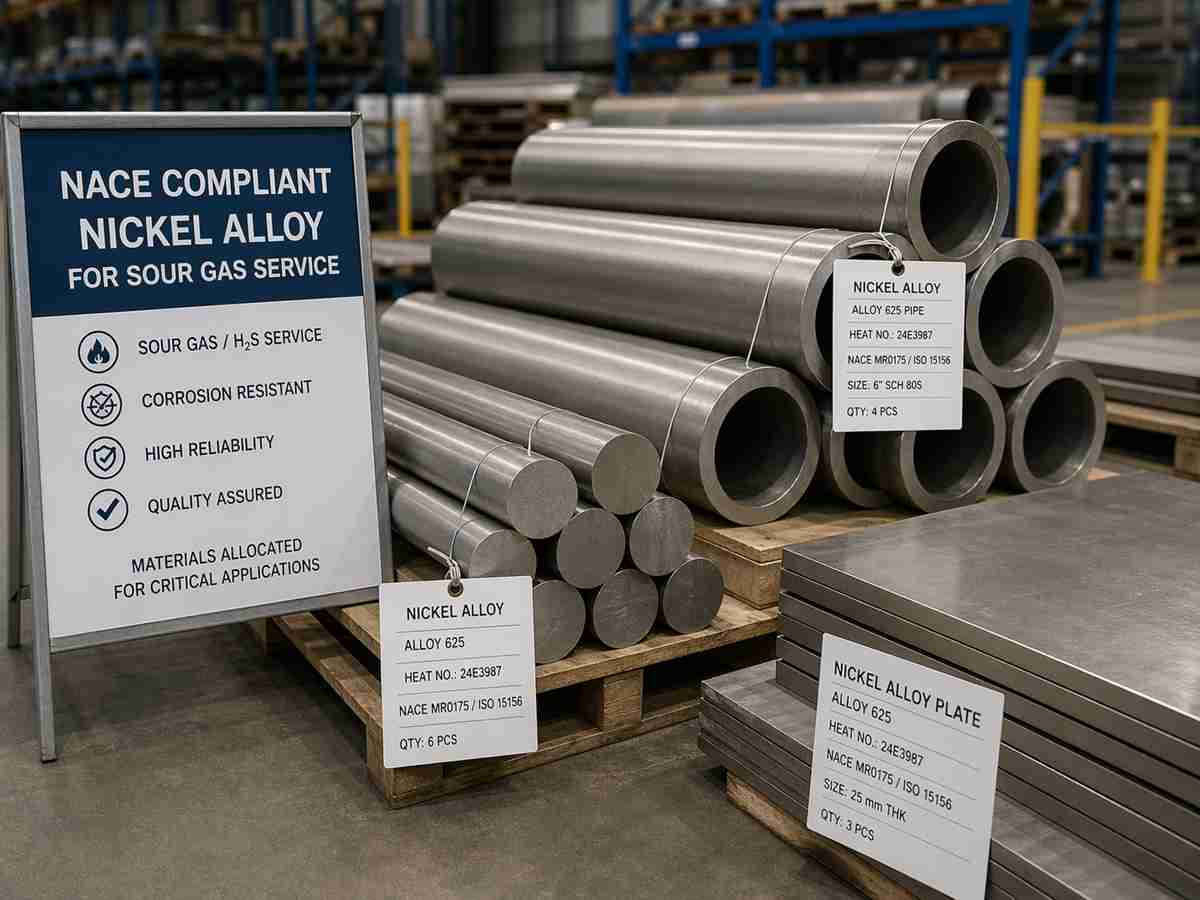
Suggested image: a simple warehouse application scene showing nickel alloy materials allocated for sour gas service.

NACE compliant nickel alloy for sour gas service

결론

Sour gas service punishes vague material thinking. The right alloy family matters, but the compliance basis and condition control matter just as much. If you need help reviewing sour-service requirements or checking whether a supplier’s NACE claim is technically sound, 28Nickel can help align the material route with the real operating environment before release.

관련 Q&A

Q: Does a corrosion-resistant alloy automatically qualify for sour gas service?

No. Corrosion resistance alone does not prove sour-service suitability. Condition, hardness, fabrication route, and the specific NACE basis still matter.

Q: Why do buyers need to share H2S and chloride information?

Because material selection for sour service depends heavily on the real environment, not only on the alloy name. Those details affect both cracking risk and corrosion behavior.

Q: Can welding change NACE compliance?

Yes. Welding and post-weld handling can alter local hardness and metallurgical condition, so fabricated components may require additional control or requalification.

게시물을 공유하세요:

관련 게시물

방문자의 시선을 사로잡는 헤드 라인

방문자에게 비즈니스와 서비스를 소개하는 간단한 설명입니다.
suoluetu
위로 스크롤