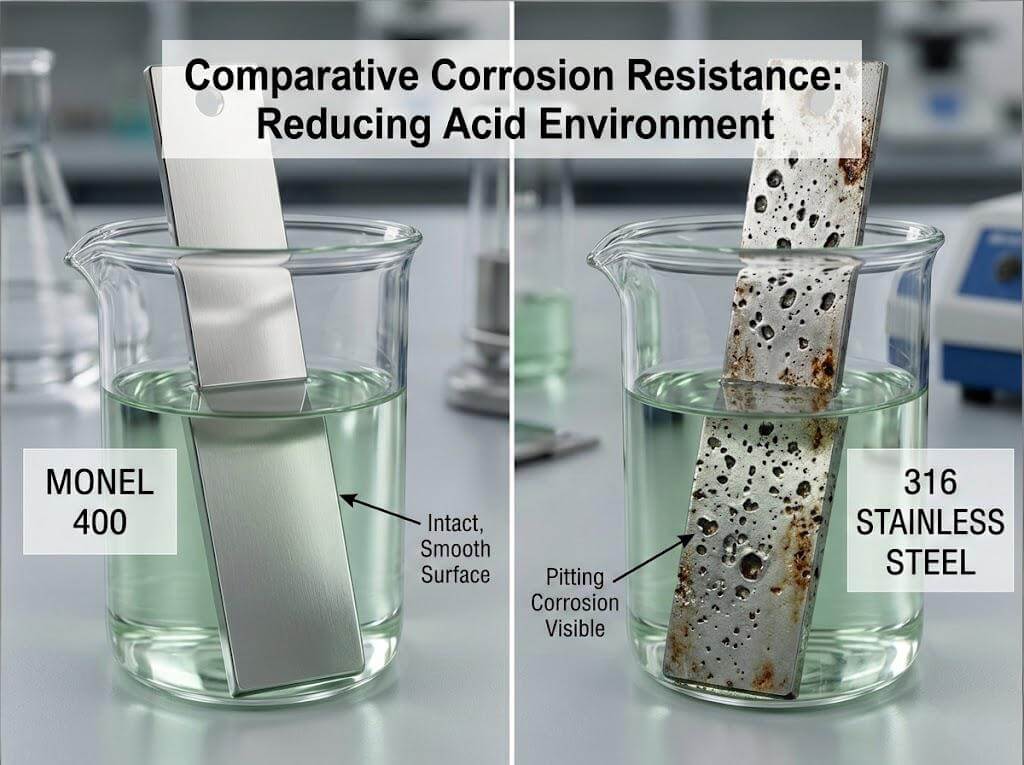
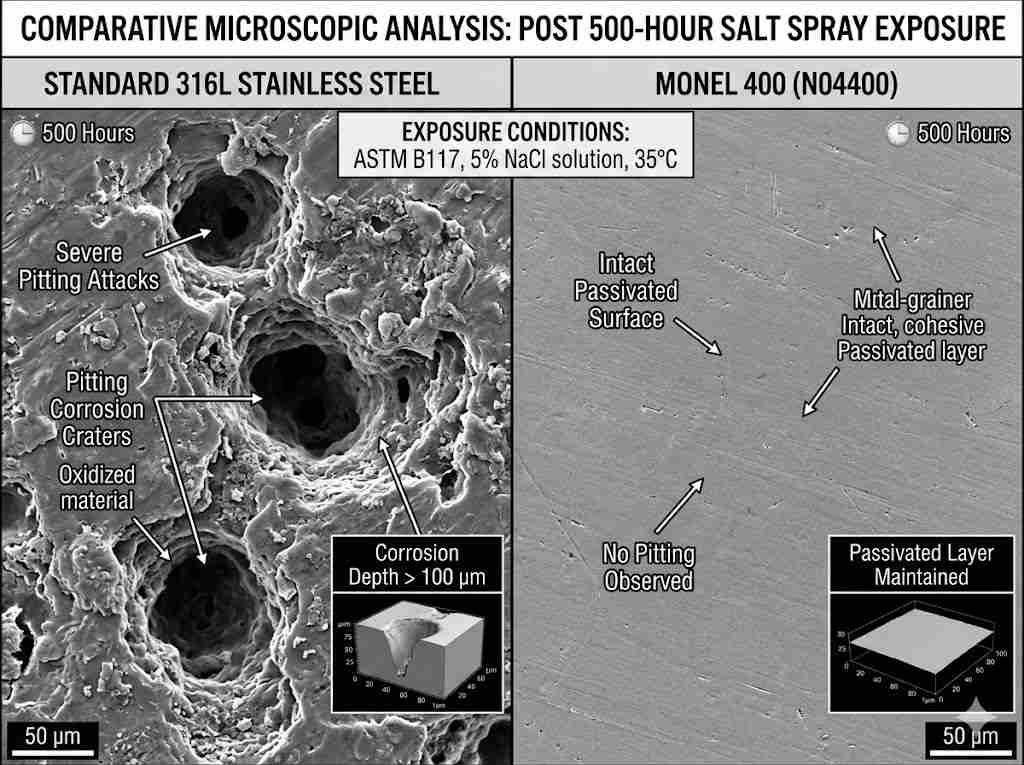
Material failure in aggressive environments is not just a maintenance headache; it is a catastrophic safety risk. When austenitic stainless steels are exposed to high-velocity seawater or hydrofluoric acid (HF), chloride-induced stress corrosion cracking (SCC) accelerates rapidly. This is exactly where specific monel alloy applications become critical. Composed primarily of nickel (up to 67%) and copper, this solid-solution binary alloy exhibits thermodynamic stability that standard alloys simply cannot match. For engineers dealing with offshore splash zones or sour gas environments, understanding the precise limits of these materials is non-negotiable.
Metallurgical Mechanics Behind Monel Alloy Applications
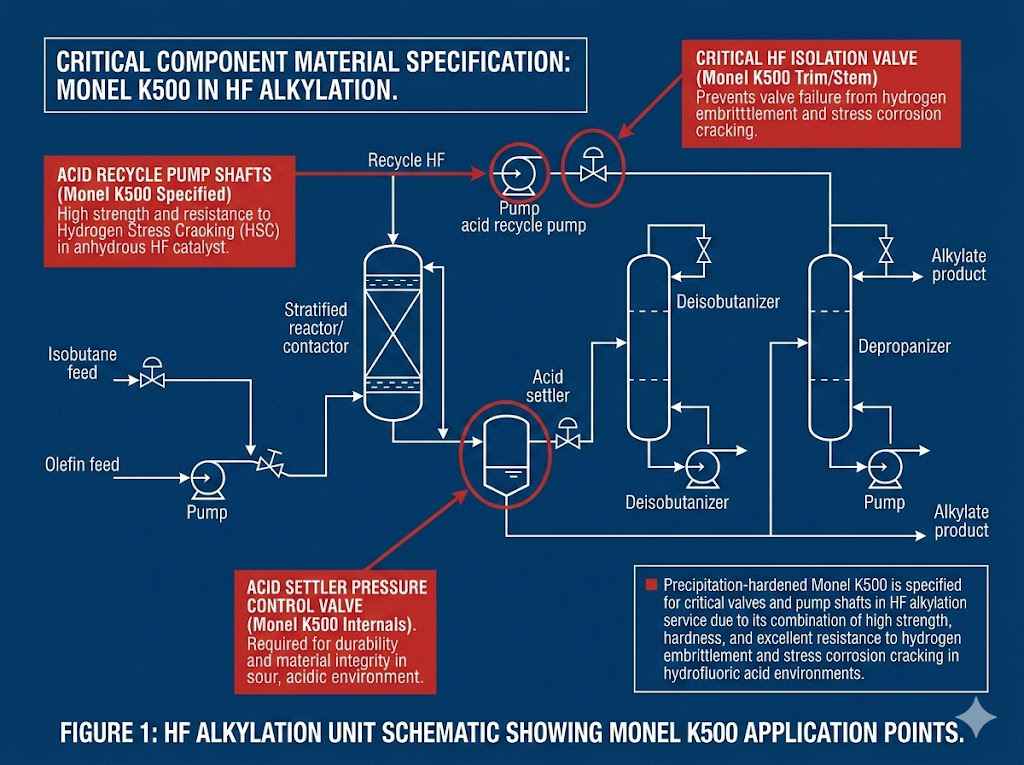
The defining characteristic of these alloys is their single-phase face-centered cubic (FCC) structure. This metallurgical configuration ensures high ductility and toughness, even at cryogenic temperatures without ductile-to-brittle transition. In industrial contexts, monel alloy applications frequently involve environments containing reducing acids. For example, Monel 400 (UNS N04400) demonstrates near-zero corrosion rates in deaerated hydrofluoric acid across all concentrations up to the boiling point. The copper addition provides noble characteristics in reducing conditions, while the high nickel content heavily suppresses anodic dissolution.
| Alloy Grade | Ni (%) | Cu (%) | Yield Strength (MPa) | Tensile Strength (MPa) | Hardness | Primary Engineering Use Case |
| Monel 400 | 63.0 min | 28.0 – 34.0 | 170 – 345 | 480 – 585 | 60 – 80 HRB | HF acid alkylation piping, marine fixtures |
| Monel K500 | 63.0 min | 27.0 – 33.0 | 690 – 790 | 965 – 1100 | 24 – 35 HRC | Centrifugal pump shafts, drill collars |
When operational stresses demand higher mechanical performance without sacrificing corrosion resistance, engineers pivot to age-hardenable variants like Monel K500 (UNS N05500). By adding aluminum and titanium to the Ni-Cu base, microscopic precipitates ($\gamma’$ phase, $Ni_3(Ti,Al)$) form within the matrix during thermal processing. This thermal treatment triples the yield strength compared to alloy 400. High-stress monel alloy applications include centrifugal pump shafts in marine desalination plants and non-magnetic drill collars in directional drilling. In these scenarios, the material must withstand intense torsional fatigue while continuously submerged in highly corrosive brines containing trace hydrogen sulfide ($H_2S$).
Evaluating the exact corrosion allowance, galvanic coupling effects, and fluid dynamics is highly complex. Miscalculating the aeration levels in a process stream can drastically shift the electrochemical dynamics, turning a highly resistant material into a reactive anode. Expanding your knowledge on monel alloy applications requires meticulously analyzing your specific operational parameters—from impingement velocity to trace chemical contaminants. If your current systems are exhibiting premature fatigue, localized pitting, or unexpected stress cracking, a rigorous metallurgical review is necessary. Our technical team at 28Nickel specializes in these precise failure analyses and structural evaluations.
Would you like me to connect you with one of our materials engineers to review your specific fluid velocities, chemical concentrations, and operating temperatures?
Related Q&A
1. Q: At what temperature does Monel 400 begin to lose its resistance in hydrofluoric acid?
A: Monel 400 remains exceptionally resistant to HF acid in completely deaerated conditions up to its boiling point. However, if the acid is highly aerated or contains oxidizing salts, the corrosion rate increases exponentially even at ambient room temperature.
2. Q: Why is Monel K-500 preferred over Monel 400 for marine pump shafts?
A: While both alloys offer nearly identical marine corrosion resistance, K-500 undergoes precipitation hardening. This microstructural alteration gives it two to three times the yield strength of 400, which is absolutely critical for resisting torsional sheer forces and mechanical fatigue in high-RPM pump shafts.
3. Q: Can galvanic corrosion occur if Monel alloys are coupled with carbon steel in seawater?
A: Yes. Monel alloys are highly noble (cathodic) in an electrolytic environment like seawater. If coupled directly with carbon steel without proper dielectric insulation, the carbon steel (anodic) will experience accelerated and severe galvanic corrosion.