










When engineers evaluate Monel K-500 corrosion resistance in sulfuric acid, the right answer is rarely a simple yes or no. Monel K-500 is a precipitation-hardened nickel-copper alloy, essentially a higher-strength evolution of Monel 400, with aluminum and titanium added for age hardening. That gives it a very attractive combination of corrosion resistance, strength, and galling resistance. However, sulfuric acid service is unforgiving. In this environment, alloy selection is controlled less by tensile strength and more by electrochemical behavior, surface film stability, oxidizing contamination, and the actual process envelope.
This is why Monel K-500 corrosion resistance in sulfuric acid must be judged case by case. A buyer looking only at the alloy family name can easily make the wrong call. K-500 may perform acceptably in certain low-temperature, low-oxidizing, carefully controlled sulfuric acid streams. But once temperature rises, acid concentration shifts, or dissolved oxygen and ferric ions enter the system, the corrosion mechanism can change quickly. What looks acceptable in a static lab note may become a maintenance problem in a real pickling line, acid transfer skid, or pump assembly.
From an engineering standpoint, the first thing to remember is that Monel K-500 does not rely on a chromium-rich passive film the way many stainless steels or high-chromium nickel alloys do. In reducing media, nickel-copper alloys can be useful. In hotter or more oxidizing sulfuric acid, that advantage narrows or disappears. This distinction matters more than many procurement sheets admit.
Why Monel K-500 Corrosion Resistance in Sulfuric Acid Is Conditional
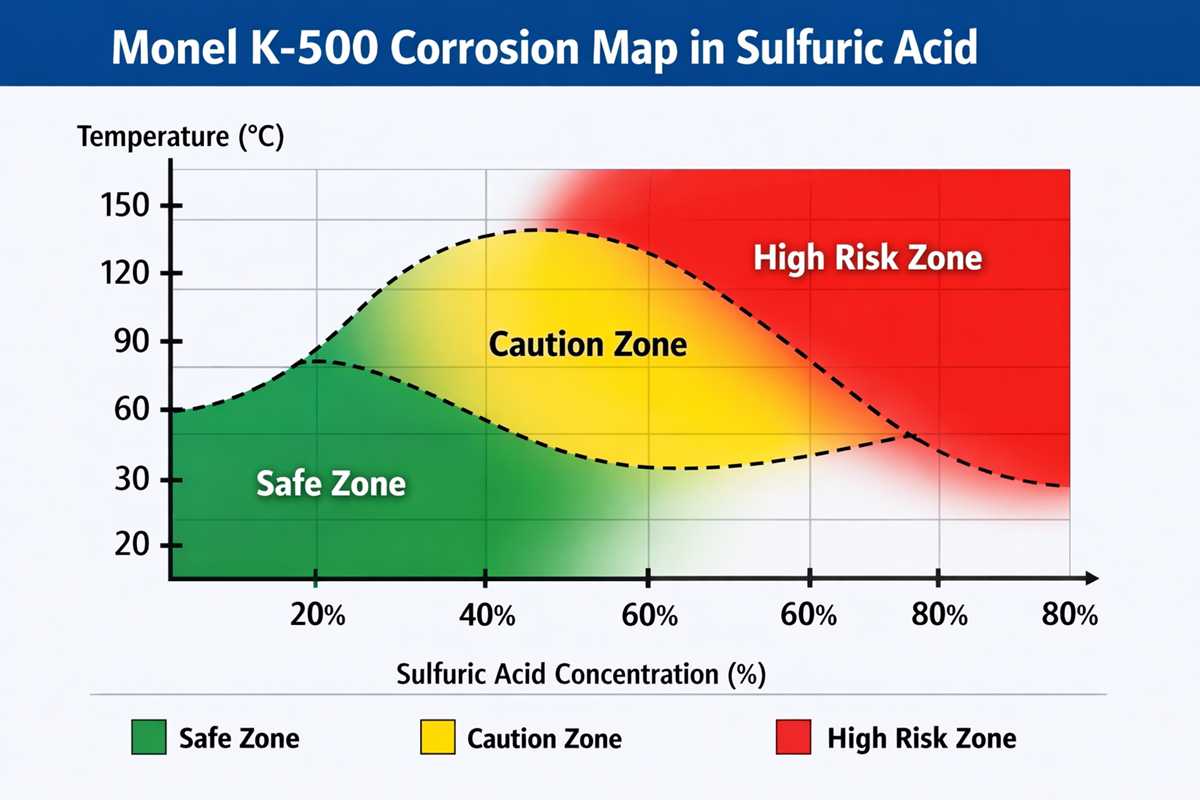
The technical challenge with Monel K-500 corrosion resistance in sulfuric acid is that sulfuric acid is not one environment. A 5% acid stream at ambient temperature behaves very differently from 50% acid at elevated temperature. Add aeration, ferric sulfate, copper salts, chlorides, or intermittent evaporation, and the severity can increase further. In practical service, five variables usually decide whether K-500 survives:
First, acid concentration. Dilute sulfuric acid may be manageable under controlled conditions, but intermediate and concentrated ranges often become much more aggressive, especially once film stability is lost.
Second, temperature. Corrosion rates that appear moderate at room temperature can accelerate sharply above roughly process-warm conditions. This is often where field failures begin, not because the alloy “suddenly became bad,” but because the original selection window was too optimistic.
Third, oxidizing contamination. Pure sulfuric acid is one thing; sulfuric acid contaminated with ferric ions, cupric ions, nitric species, or entrained air is another. These oxidizers can shift the corrosion potential and promote faster attack.
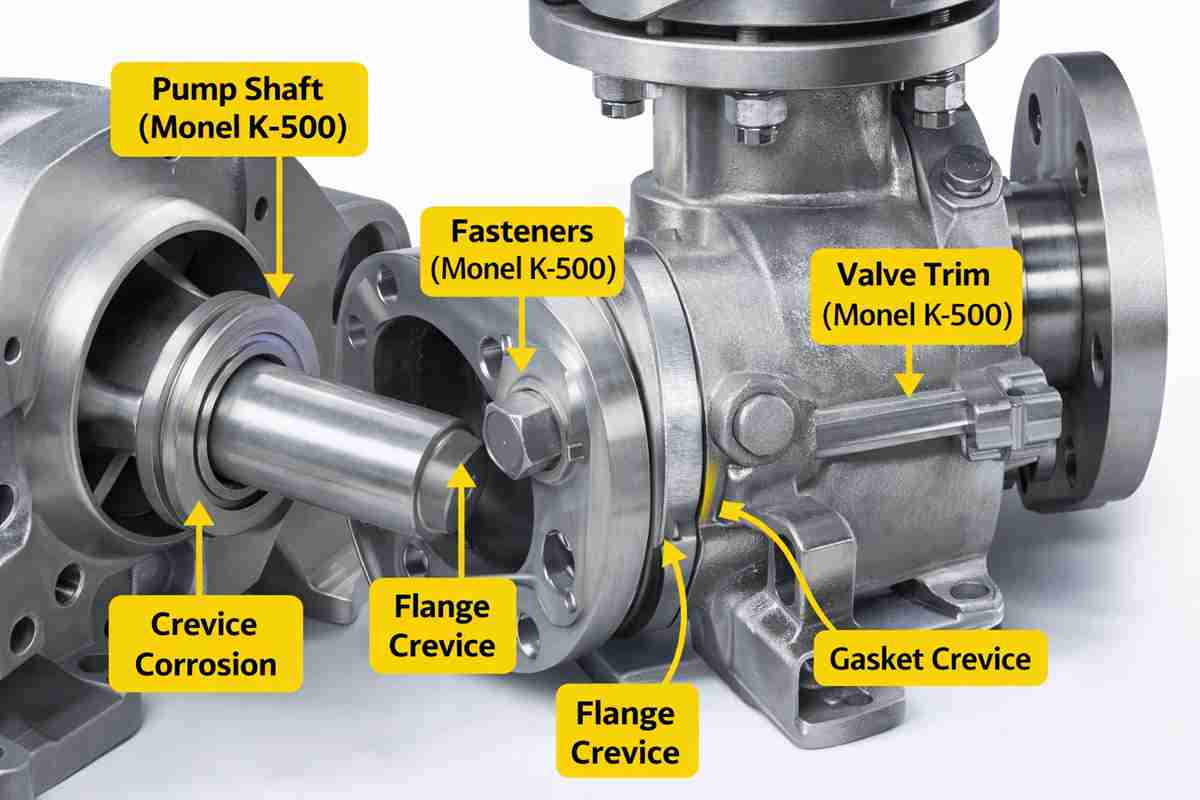
Fourth, flow and deposits. Clean, controlled flow is easier on the alloy than under-deposit zones, stagnant pockets, gasket crevices, and pump dead legs. Localized chemistry matters.
Fifth, metallurgical condition. The precipitation-hardening treatment that gives K-500 its mechanical strength does not automatically improve acid resistance. In fact, for sulfuric acid duty, the added strength should never be treated as proof of broader chemical suitability.
Practical Guide to Monel K-500 Corrosion Resistance in Sulfuric Acid
The table below is not a substitute for coupon testing, but it reflects how experienced materials engineers usually screen Monel K-500 corrosion resistance in sulfuric acid before they recommend a trial.
| Sulfuric acid condition | General assessment for Monel K-500 | Engineering comment |
|---|---|---|
| Dilute acid, ambient temperature, low aeration | Conditionally usable | Possible for limited service if the stream is clean and reducing; verify with lab or field coupons. |
| Dilute to moderate acid, ambient to mildly elevated temperature | Borderline | Small increases in temperature or oxidizing contamination can move the alloy out of a safe window. |
| Moderate acid with dissolved oxygen or ferric contamination | High risk | General corrosion can rise quickly; localized attack in crevices or stagnant zones becomes more likely. |
| Hot sulfuric acid, especially above moderate concentration | Generally not preferred | K-500 is rarely the first-choice alloy here; higher-alloy Ni-Cr-Mo systems are usually screened instead. |
| Cyclic wet-dry or evaporative acid service | Poor candidate | Local concentration spikes and deposit formation can make apparent “mild” acid far more severe. |
| High-strength fasteners or shafts with combined stress and acid exposure | Needs extra caution | Mechanical strength helps load capacity, not necessarily corrosion margin; test the exact heat-treated condition. |
One of the most common specification mistakes is to assume that because Monel K-500 is stronger than Monel 400, it must also be better in sulfuric acid. That is not a safe assumption. Strength is valuable for shafts, springs, pump sleeves, and marine hardware. But in sulfuric acid, the controlling question is whether the alloy remains electrochemically stable under the real chemistry of the system.
Monel K-500 Corrosion Resistance in Sulfuric Acid vs. Monel 400
A more useful comparison is Monel K-500 corrosion resistance in sulfuric acid versus Monel 400 in the same stream. In many general environments, K-500 is often described as having corrosion resistance broadly similar to Monel 400, while adding higher strength. Yet “broadly similar” does not mean “interchangeable without review.” The age-hardening additions and heat treatment introduce microstructural complexity that a corrosion engineer cannot ignore, especially when sulfuric acid is involved.
For equipment designers, the selection logic should be straightforward:
- If the job is primarily mechanical, and the acid exposure is secondary, intermittent, cool, and well characterized, K-500 may remain on the shortlist.
- If the job is primarily chemical, and the sulfuric acid is hot, contaminated, oxidizing, or concentration-variable, K-500 usually moves down the ranking.
- If failure consequences are high, the correct path is not “choose the strongest Monel grade.” The correct path is coupon testing, impurity review, and a temperature-concentration map built around the actual process fluid.
This is where experienced suppliers can add real value. A serious engineering conversation should cover acid concentration swings, startup and shutdown conditions, idle periods, metal ion contamination, weld details, crevice geometry, and whether the part is in a solution-treated or age-hardened condition. Those are the details that decide whether Monel K-500 corrosion resistance in sulfuric acid is acceptable on paper only, or reliable in service.
Final Engineering Judgment
So, is Monel K-500 corrosion resistance in sulfuric acid good? The disciplined answer is: good only in a narrow and controlled envelope. It is not a universal sulfuric acid alloy, and it should not be marketed that way to engineers or buyers. Where the acid is dilute, cool, relatively clean, and non-oxidizing, K-500 may be a workable option when high strength is also needed. Where the acid is hot, concentrated, aerated, contaminated, or variable, the risk increases fast and alternative alloys usually deserve first review.
For buyers, this is the key takeaway: do not purchase K-500 for sulfuric acid service from a generic alloy table alone. Ask for condition-specific guidance, expected corrosion mode, and whether the recommendation is backed by coupon logic. At 28Nickel, that is exactly the level of discussion worth having before a PO is issued.
Related Q&A
1) Is Monel K-500 better than 316L stainless steel in sulfuric acid?
Often yes in some reducing, low-oxidizing sulfuric acid situations, because 316L can lose corrosion margin quickly. But for hotter or more oxidizing sulfuric acid, neither 316L nor K-500 may be the best answer. Alloy selection should be based on the actual chemistry, not a simple grade hierarchy.
2) Does the higher strength of Monel K-500 mean better sulfuric acid resistance?
No. Higher strength improves load-bearing capability, wear resistance, and hardware performance. It does not automatically improve sulfuric acid corrosion behavior. Mechanical advantage and chemical compatibility are separate design questions.
3) What should a buyer confirm before ordering K-500 for sulfuric acid service?
Confirm acid concentration range, operating and upset temperature, oxidizing contaminants, flow pattern, crevice exposure, required product form, and heat-treated condition. For critical service, request coupon testing or prior service evidence that matches your process closely.