Quando os engenheiros perguntam como escolher Hastelloy X for sour gas service, the real issue is usually not whether the alloy is “good” or “bad.” The real issue is whether the service is truly compatible with what Hastelloy X was designed to do. That distinction matters. Hastelloy X is a nickel-chromium-iron-molybdenum alloy with very good oxidation resistance, useful high-temperature strength, and reliable fabricability. In furnace hardware, combustion equipment, and hot gas components, it is a familiar material. In sour gas systems, however, selection must be more disciplined. H2S severity, water phase, chlorides, temperature, weld condition, and compliance with project sour-service rules can completely change the answer.
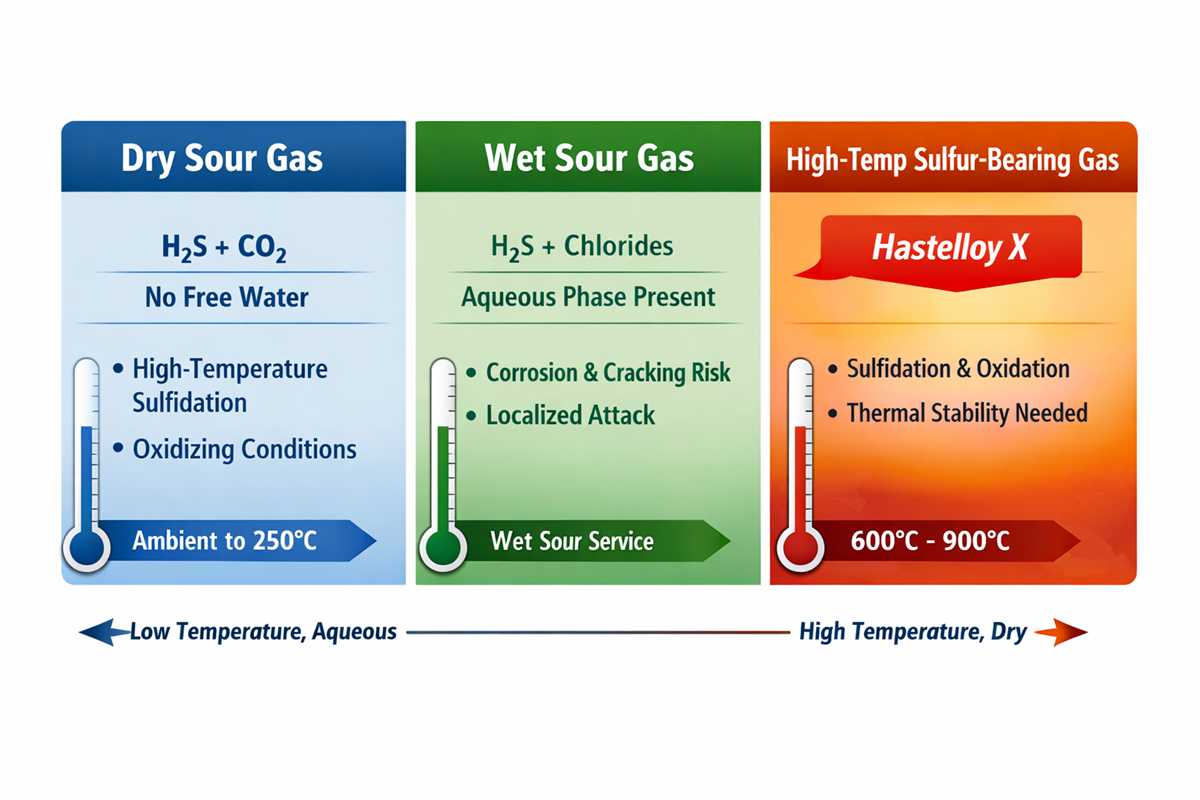
A senior materials engineer will usually start with one blunt question: is this dry sour gas, hot sulfur-bearing gas, or wet aqueous sour service? Those are not interchangeable environments. If free water is present, the material selection logic becomes much more conservative. If the stream is predominantly dry and the main concern is elevated-temperature sulfidation with some oxidation exposure, Hastelloy X may enter the conversation for its thermal stability and fabrication advantages. But if the service is wet, chloride-bearing, and governed by strict upstream oil and gas qualification requirements, Hastelloy X should not be selected casually from a brochure.
How to Choose Hastelloy X for Sour Gas Service in Real Projects
O primeiro passo para how to choose Hastelloy X for sour gas service is to define the damage mechanism, not just the fluid name. “Sour gas” is an umbrella term, but the alloy does not see an umbrella term; it sees H2S partial pressure, condensate chemistry, chloride activity, sulfur deposition, and metal temperature. If your dominant risk is high-temperature oxidation or mixed oxidizing/sulfidizing attack above the range where common stainless grades lose margin, Hastelloy X can be technically attractive. Its chromium helps with oxidation resistance, and its solid-solution-strengthened matrix gives it good stability at elevated temperature.
That said, one of the biggest mistakes in how to choose Hastelloy X for sour gas service is to ignore the difference between high-temperature process corrosion and ambient-to-moderate-temperature wet sour corrosion. In wet H2S service, especially where chlorides and CO2 coexist, the governing question is often not only general corrosion rate. Localized corrosion, crevice attack, sulfide-related cracking concerns, and weld-zone behavior become far more important. In many owner specifications, alloys such as 625, C-276, or C-22 are screened earlier because they are more commonly discussed in sour-service qualification workflows. Hastelloy X may still be considered, but it usually requires more deliberate technical justification.
Another practical point: do not confuse “nickel alloy” with “automatic approval.” Nickel-based alloys behave very differently from one grade to another. Hastelloy X was optimized primarily for heat- and oxidation-resistant service, not as a universal answer for aggressive wet sour environments. So if you are evaluating how to choose Hastelloy X for sour gas service, the right mindset is to ask where its strengths align with the actual corrosion and mechanical risks of the component.
A Screening Table for Choosing Hastelloy X
| Selection Variable | Porque é que é importante | Signal Favoring Hastelloy X | Signal Requiring Extra Caution |
|---|---|---|---|
| Fluid state | Dry and wet sour environments behave very differently | Predominantly dry gas, minimal condensed water | Free water, intermittent condensation, aqueous phase present |
| Operating temperature | Hastelloy X is strongest where heat resistance matters | Elevated metal temperature with oxidation/sulfidation concerns | Moderate temperature wet sour service where corrosion qualification dominates |
| H2S severity | Influences sour-service restrictions and testing needs | Controlled H2S with no aggressive aqueous phase | High H2S partial pressure combined with water and chlorides |
| Chloride content | Drives pitting/crevice risk in wet service | Low chloride, dry operation | Brine, seawater carryover, stagnant crevices |
| Sulfur deposition | Can intensify high-temperature attack | Hot gas hardware with predictable sulfur chemistry | Deposits plus thermal cycling plus condensate formation |
| Percurso de fabrico | Weld metallurgy and repair history affect performance | Solution-annealed base metal with qualified weld procedure | Heavy cold work, unverified repair welds, mixed filler strategy |
| Codes and end-user rules | Material may need formal sour-service acceptance | Project allows engineering assessment and testing route | End user requires only pre-qualified listed alloys |
| Component function | Failure consequence changes risk tolerance | Non-pressure hot gas internals with inspection access | Critical pressure boundary in remote or shutdown-sensitive equipment |
Once this screening is done, how to choose Hastelloy X for sour gas service becomes a narrower engineering decision. If the component is a hot gas duct, burner part, retort support, or thermal processing hardware exposed to sulfur-bearing gas at elevated temperature, Hastelloy X may be justified because oxidation resistance, creep strength, and fabrication reliability are doing real work for you. If the component is a valve trim, downhole part, separator internals in wet sour brine, or a pressure boundary with stagnant crevices, the burden of proof becomes much higher.
What Experienced Engineers Check Before Final Approval
A sound route for how to choose Hastelloy X for sour gas service usually includes five checks.
First, verify whether the service is dry in practice, not only on the PFD. Many failures occur in systems labeled “gas service” that actually condense during startup, shutdown, dead-leg cooling, or winter operation.
Second, review the weld condition. Hastelloy X is weldable, but sour environments are never kind to undocumented welding variables. Filler metal choice, heat input, repair count, and post-fabrication heat treatment history should be clear.
Third, separate corrosion resistance from standards compliance. An alloy may look acceptable in a corrosion table and still fail the project approval route if the operator requires formal sour-service qualification or internal approved material lists.
Fourth, evaluate whether another nickel alloy is simply a better fit. This is an important part of how to choose Hastelloy X for sour gas service because sometimes the best engineering answer is not Hastelloy X at all. A good material engineer protects plant reliability, not alloy preference.
Fifth, consider inspection and replacement strategy. Hastelloy X can be a rational choice in maintainable hot-zone equipment where its thermal advantages outweigh a more expensive corrosion-resistant alternative. The same decision may be hard to defend in inaccessible equipment with severe wet sour uncertainty.
Final Engineering View
Então, how to choose Hastelloy X for sour gas service? Choose it when the service is dominated by elevated-temperature oxidation or sulfidation resistance, when the environment is confirmed to be dry or tightly controlled, when the weld procedure is qualified, and when project sour-service rules permit its use. Do not choose it merely because it is a nickel alloy. In wet sour systems with chlorides, stagnant zones, or strict qualification demands, a different alloy may offer a safer and more defensible solution.
For buyers and design engineers, the best commercial decision is usually the one backed by service chemistry, fabrication details, and component function—not by nominal alloy family. If your team is screening materials for a specific sour gas component, a serious technical review of media composition, operating temperature, and weld condition will save far more money than correcting a wrong alloy after fabrication. That is exactly where experienced alloy suppliers and materials engineers can add value.
Perguntas e respostas relacionadas
1. Is Hastelloy X suitable for wet H2S service?
It can be considered only with caution and project-specific validation. Hastelloy X is not usually the first alloy engineers screen for severe wet sour service with chlorides and condensate. In that environment, localized corrosion risk, weld-zone behavior, and sour-service qualification rules become decisive.
2. What is the biggest mistake when selecting Hastelloy X for sour gas service?
The biggest mistake is treating all sour gas as one environment. Dry high-temperature sulfur-bearing gas and wet chloride-containing sour condensate are completely different corrosion problems, and they should not be screened with the same logic.
3. When is Hastelloy X a strong candidate in sulfur-bearing gas systems?
It becomes a stronger candidate when metal temperature is high, oxidation resistance matters, mechanical stability at temperature is required, and the service is dry or very tightly controlled against condensation. In those cases, its heat-resistant alloy design is working in the direction it was intended for.